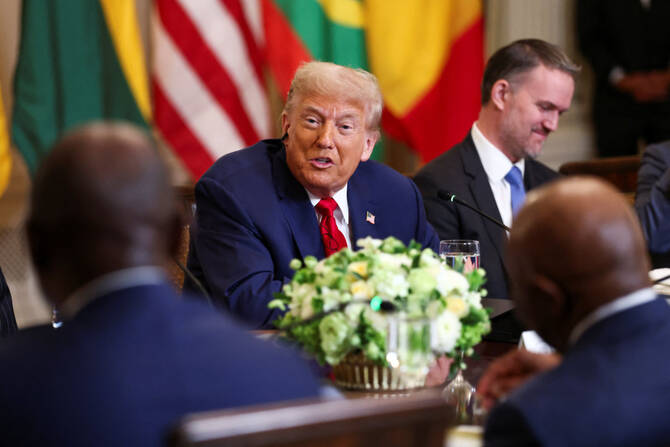

MONROVIA, Liberia: US President Donald Trump’s praise of the “beautiful” English of Liberia’s President Joseph Boakai drew confusion Thursday in the English-speaking African country and umbrage over what many considered condescending remarks.
“Such good English,” Trump said to Boakai during an event at the White House, with visible surprise. “Such beautiful English.”
Although English has been the official language of Liberia since the country’s founding in the 1800s, Trump asked Boakai where he had learned to speak the language “so beautifully,” and continued as Boakai murmured a response. “Where were you educated? Where? In Liberia?”
The exchange took place Wednesday during a meeting in the White House between Trump and five West African leaders, amid a pivot from aid to trade in US foreign policy.
Boakai’s government said it took no offense at Trump’s remarks, but other groups in Liberia described the remarks as an insult.
The White House declined to comment on whether Trump was aware that English was Liberia’s official language. Massad Boulos, the president’s senior adviser for Africa, stressed that Trump “actually complimented the language skills of the Liberian president,” and that everyone at the meeting was ”deeply appreciative” of the president’s time and effort.
Trump’s comments draw mixed reaction
Liberia has had deep ties with the United States for two centuries, stemming from the drive to relocate freed slaves from the United States. It started in the 1820s when the Congress- and slaveholder-funded American Colonization Society began sending freed slaves to its shores. In 1847, the growing Americo-Liberian settlers declared themselves independent, setting up a government to rule over a native African majority.
Liberian Foreign Minister Sara Beysolow Nyanti said on X that “President Trump’s comment on Boakai’s ‘beautiful English’ simply acknowledged Liberia’s familiar American-rooted accent and no offense was taken.”
“Our linguistic heritage is deeply American‑influenced, & this was simply recognized by @realDonaldTrump. We remain committed to strengthening Liberia‑US ties, built on mutual respect, shared values, and meaningful partnership,” the minister said.
Foday Massaquio, chairman of Liberia’s opposition Congress for Democratic Change-Council of Patriots, said the remarks exemplified Trump’s lack of respect for foreign leaders, particularly African ones.
“President Trump was condescending, he was very disrespectful to the African leader,” Massaquio said, adding that it “proves that the West is not taking us seriously as Africans.”
Comments add to alarm over aid cuts
For many observers, Trump’s comments added to the sense of alarm and even betrayal over cuts in US aid to the African country.
The decision by US authorities earlier this month to dissolve the US Agency for International Development sent shockwaves across Liberia. American support previously had made up almost 2.6 percent of the gross national income, the highest percentage anywhere in the world, according to the Center for Global Development.
Liberians thought they would be spared from Trump’s cuts because of the countries’ close relationship. Their political system is modeled on that of the US, along with its flag. Liberians often refer to the US as their “big brother.”

Liberia's flag is patterned after the flag of the United States and is sometimes referred to as the Lone Star.
Liberia was one of the first countries to receive USAID support, starting in 1961. The street signs, taxis and school buses resemble those in New York.
“Liberia is a long standing friend of the USA, therefore Trump should have understood that we speak English as an official language,” said Moses Dennis, 37, a businessman from Monrovia.
Condescension or praise?
Siokin Civicus Barsi-Giah, a close associate of former President George Weah, echoed the notion that Trump should have known that Liberians speak English.
“Liberia is an English speaking country,” he said. “Former slaves and slave owners decided to organize themselves to let go of many people who were in slavery in the United States of America, and they landed on these shores now called the Republic of Liberia.”
For him, the exchange was “condescending and ridiculing,” and he said: “Joseph Boakai was not praised. He was mocked by the greatest president in the world.”
Some observers, however, said that they believed Trump’s remarks genuinely were intended as praise.
“To some, the comment may carry a whiff of condescension, echoing a long-standing Western tendency to express surprise when African leaders display intellectual fluency,” said Abraham Julian Wennah, a researcher at the African Methodist Episcopal University.
But if one looks at “Trump’s rhetorical style,” the remarks were “an acknowledgment of Boakai’s polish, intellect, and readiness for global engagement,” he said.