

Pakistani PM orders urgent overhaul of tariff commission that sets trade duties

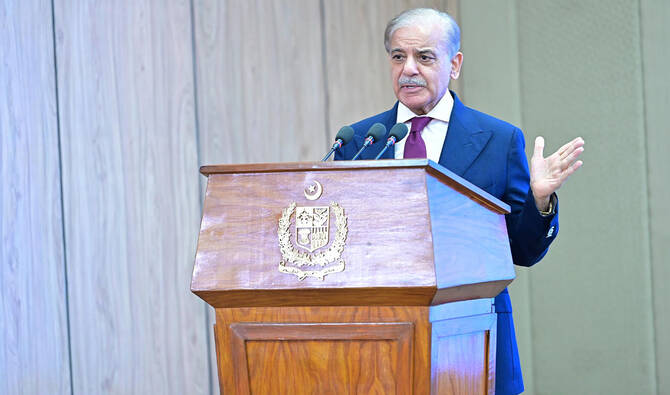
Pakistan’s Prime Minister Shehbaz Sharif is addressing a ceremony in Islamabad, Pakistan, on Jue 29, 2025. (PID/File)
Short Url
Updated 10 July 2025
Follow

Pakistani PM orders urgent overhaul of tariff commission that sets trade duties

  • Third-party review planned to boost Commission’s performance
  • Automated research capacity seen as key to solving business challenges

ISLAMABAD: Pakistan’s Prime Minister Shehbaz Sharif on Thursday ordered an urgent overhaul of a top government body responsible for regulating customs duties on imports and exports, aiming to strengthen its legal, administrative and institutional powers amid growing calls to modernize the country’s trade policy.

Announcing its federal budget for 2025-26, Pakistan said it planned to cut the overall tariff regime by more than 4 percent over the next five years, as part of reforms aimed at shifting the country toward an export-led growth model. 

As per the National Tariff Policy 2025–30, the government plans to abolish additional customs duties, regulatory duties, and the fifth schedule of the Customs Act, 1969. The policy envisions a streamlined customs structure with just four duty slabs ranging from 0 to 15 percent, which would become the maximum rate. The move is part of Pakistan’s push not just to boost its exports and protect its local industry but also meet international obligations, including aligning with the government’s commitments under a $7 billion IMF program approved last year.

“Reorganization of the National Tariff Commission along modern lines is indispensable to fully meet the requirements of the new tariff regime,” a statement quoted Sharif as saying after he chaired a high-level review meeting on the NTC’s performance.

The PM’s proposed reforms aim to modernize the NTC so it can better support businesses, collect real-time market data and align with the country’s new tariff regime.

The premier directed that a third-party review be conducted to identify weaknesses in the Commission’s performance and make it “more effective.” He also stressed the importance of strengthening the NTC’s research and data-gathering abilities.

“The National Tariff Commission must have an effective capacity to gather all ground realities related to domestic business, imports, and exports market,” Sharif said. 

“The automated and effective research capacity of the National Tariff Commission can play a key role in resolving the problems faced by domestic business.”

He also ordered the immediate activation of the NTC’s Appellate Tribunal, which handles disputes on tariff decisions, a step aimed at improving transparency and efficiency.

The NTC plays a crucial role in Pakistan’s trade policy. In the 2025–26 federal budget, customs duties are projected to contribute around 6 percent of total tax revenue, according to the Pakistan Economic Survey 2024–25. While relatively small, these duties are politically sensitive and impact competitiveness for domestic industries that rely on protection from cheaper imports.

Pakistan’s economic managers are under pressure to balance protection of local industry with commitments under international trade agreements and IMF-backed fiscal targets. The government says the NTC must adapt to “modern requirements” and be given adequate training and resources to support economic stabilization and export-led growth.

“The government is committed to addressing the lack of training and resources for the National Tariff Commission and to aligning its work with modern requirements,” Sharif said at Thursday’s meeting. 


Pakistan, UK sign £35 million Green Compact to strengthen climate resilience

Updated 21 December 2025
Follow

Pakistan, UK sign £35 million Green Compact to strengthen climate resilience

  • Pakistan ranks among nations most vulnerable to climate change and has seen erratic changes in its weather patterns
  • UK will help Pakistan mobilize climate finance, strengthen regulatory frameworks and develop bankable climate projects

ISLAMABAD: Pakistan and the United Kingdom (UK) have formalized a comprehensive climate partnership with the launch of a Green Compact that aims to enhance climate resilience, accelerate clean energy transition and scale up nature-based solutions, including mangrove conservation, Pakistani state media reported on Sunday.

The agreement, signed in Islamabad by Federal Minister for Climate Change and Environmental Coordination Dr. Musadik Malik and UK Minister for International Development Jennifer Chapman, unlocks £35 million in targeted support for green development and long-term climate action, according to Radio Pakistan broadcaster.

Pakistan ranks among nations most vulnerable to climate change and has seen erratic changes in its weather patterns that have led to frequent heatwaves, untimely rains, storms, cyclones, floods and droughts in recent years. In 2022, monsoon floods killed over 1,700 people, displaced another 33 million and caused over $30 billion losses, while another 1,037 people were killed in floods this year.

Mohammad Saleem Shaikh, a spokesperson for Pakistan’s Ministry of Climate Change, described the compact as a “decisive move toward action-oriented climate cooperation,” noting that its implementation over the next decade will be critical for Pakistan which regularly faces floods, heatwaves and water stress.

“The Compact is structured around five core pillars: climate finance and investment, clean energy transition, nature-based solutions, innovation and youth empowerment, and adaptation and resilience,” the report read.

“Under the agreement, the UK will work with Pakistan to mobilize public and private climate finance, strengthen regulatory frameworks for green investment, and develop bankable climate projects.”

Clean energy forms a central component of Pakistan’s transition, with Islamabad planning to expand solar and wind generation to reduce fossil fuel dependence, improve energy security and stabilize power costs, according to Shaikh.

“Renewable energy is now economically competitive, making the transition both environmentally and financially viable,” he was quoted as saying.

“Nature-based solutions, particularly large-scale mangrove restoration, will protect coastal communities from storm surges and erosion while enhancing biodiversity and carbon sequestration.”

Under the Compact, technical support, mentoring and access to investors will be provided to climate-smart startups and young innovators, reflecting Pakistan’s recognition of youth-led initiatives as central to future climate solutions.

On the occasion, Chapman, on her first official visit to Pakistan, underscored the urgency of climate action, highlighting the UK’s support for renewable energy, mangrove and ecosystem restoration, early-warning systems, climate budgeting and international investment flows into Pakistan.

Shaikh described the Green Compact as “a strategic turning point” in Pakistan–UK relations on climate change, saying its effective implementation is essential for Pakistan to meet its national climate targets.