Pakistani PM orders urgent overhaul of tariff commission that sets trade duties

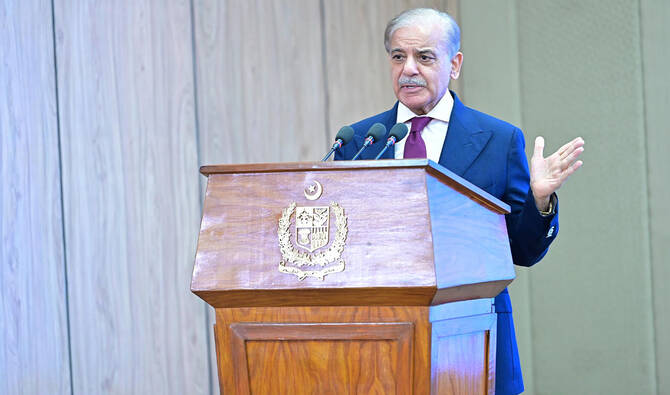
Pakistan’s Prime Minister Shehbaz Sharif is addressing a ceremony in Islamabad, Pakistan, on Jue 29, 2025. (PID/File)
Short Url
Updated 10 July 2025
Follow

Pakistani PM orders urgent overhaul of tariff commission that sets trade duties

  • Third-party review planned to boost Commission’s performance
  • Automated research capacity seen as key to solving business challenges

ISLAMABAD: Pakistan’s Prime Minister Shehbaz Sharif on Thursday ordered an urgent overhaul of a top government body responsible for regulating customs duties on imports and exports, aiming to strengthen its legal, administrative and institutional powers amid growing calls to modernize the country’s trade policy.

Announcing its federal budget for 2025-26, Pakistan said it planned to cut the overall tariff regime by more than 4 percent over the next five years, as part of reforms aimed at shifting the country toward an export-led growth model. 

As per the National Tariff Policy 2025–30, the government plans to abolish additional customs duties, regulatory duties, and the fifth schedule of the Customs Act, 1969. The policy envisions a streamlined customs structure with just four duty slabs ranging from 0 to 15 percent, which would become the maximum rate. The move is part of Pakistan’s push not just to boost its exports and protect its local industry but also meet international obligations, including aligning with the government’s commitments under a $7 billion IMF program approved last year.

“Reorganization of the National Tariff Commission along modern lines is indispensable to fully meet the requirements of the new tariff regime,” a statement quoted Sharif as saying after he chaired a high-level review meeting on the NTC’s performance.

The PM’s proposed reforms aim to modernize the NTC so it can better support businesses, collect real-time market data and align with the country’s new tariff regime.

The premier directed that a third-party review be conducted to identify weaknesses in the Commission’s performance and make it “more effective.” He also stressed the importance of strengthening the NTC’s research and data-gathering abilities.

“The National Tariff Commission must have an effective capacity to gather all ground realities related to domestic business, imports, and exports market,” Sharif said. 

“The automated and effective research capacity of the National Tariff Commission can play a key role in resolving the problems faced by domestic business.”

He also ordered the immediate activation of the NTC’s Appellate Tribunal, which handles disputes on tariff decisions, a step aimed at improving transparency and efficiency.

The NTC plays a crucial role in Pakistan’s trade policy. In the 2025–26 federal budget, customs duties are projected to contribute around 6 percent of total tax revenue, according to the Pakistan Economic Survey 2024–25. While relatively small, these duties are politically sensitive and impact competitiveness for domestic industries that rely on protection from cheaper imports.

Pakistan’s economic managers are under pressure to balance protection of local industry with commitments under international trade agreements and IMF-backed fiscal targets. The government says the NTC must adapt to “modern requirements” and be given adequate training and resources to support economic stabilization and export-led growth.

“The government is committed to addressing the lack of training and resources for the National Tariff Commission and to aligning its work with modern requirements,” Sharif said at Thursday’s meeting. 


Pakistan stocks recover as oil supply fears ease after Islamabad seeks Red Sea route— analyst

Updated 05 March 2026
Follow

Pakistan stocks recover as oil supply fears ease after Islamabad seeks Red Sea route— analyst

  • Pakistan has sought Saudi help to secure oil supplies via Red Sea port after Iran’s closure of Strait if Hormuz
  • Analyst says higher crude oil prices, expectations of IMF releasing next loan tranche also triggered bullish activity

ISLAMABAD: Pakistani stocks marked a sharp recovery when trading closed on Thursday, as institutional activity increased following Islamabad’s move to seek crude oil supplies through the Red Sea port eased oil supply fears, a financial analyst said. 

Pakistani stocks have recorded a sharp decline this week, with the benchmark KSE-100 index recording its largest-ever single-day decline on Monday when it plunged 16,089 points. Escalating conflict in the Middle East triggered panic selling at the Pakistani bourse, forcing a temporary trading halt on Monday. 

The KSE-100 index, however, gained 3.49 percent or 5,433.46 points to close at 161,210.67 when trading ended on Thursday, up from the previous close of 155,777.21 points, according to Pakistan Stock Exchange’s (PSX) data.

Pakistan’s Petroleum Minister Ali Pervaiz Malik met Saudi Ambassador Nawaf bin Said Al-Malki on Wednesday to discuss Iran’s closure of the key Strait of Hormuz, which has threatened Pakistan’s energy supply. Roughly 20 percent of the global oil and gas supply passes through the route. Saudi Arabia indicated it could facilitate shipments through the Red Sea port of Yanbu, offering an alternative route if Gulf shipping lanes remain disrupted, the petroleum ministry said on Wednesday. 

“Stocks staged a sharp recovery at PSX amid institutional activity on easing fuel supply fears after KSA [Kingdom of Saudi Arabia] commits oil supplies through the Red Sea port,” Ahsan Mehanti, chief executive officer at Arif Habib Commodities, told Arab News.

He said higher global crude oil prices and expectations of the International Monetary Fund releasing its next tranche of the $7 billion loan for Pakistan also helped bullish activity at the PSX.

An IMF mission was in Pakistan to hold talks on the third review of a $7 billion Extended Fund Facility multi-year program, and for the second review of the $1.4 billion Resilience and Sustainability Facility this week.

However, the delegation left for Türkiye amid tensions in the Gulf. Pakistani officials have said talks are likely to continue virtually in the coming days. 

Pakistani brokerage Topline Securities said in its daily market review report that strong institutional buying “turned the tide” on Thursday after the market’s recent overreaction to regional issues.

The report added that Hub Power Company (HUBC), Oil & Gas Development Company (OGDC), Fauji Fertilizer Company (FFC), Engro Corporation (ENGROH), and Meezan Bank Limited (MEBL) collectively contributed 2,197 points to the KSE benchmark’s gain.

Topline Securities said 723 million shares were traded on Thursday, with K-Electric Limited (KEL) stealing the spotlight as more than 1.17 billion shares changed hands.

Pakistani investors are closely monitoring developments in the Gulf, particularly around energy routes and further retaliatory actions, as the conflict’s trajectory remains uncertain.