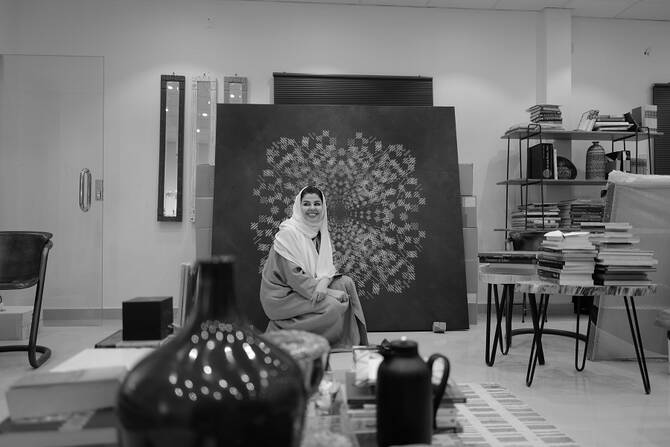

DUBAI: Despite her love for art, Lulwah AlHomoud didn’t set out to be an artist. But last month her work — rooted in geometry, Arabic calligraphy, and deep spiritual reflection — was on display at one of Europe’s most cutting-edge digital art events.
The Saudi artist was featured at this year’s edition of The Digital Art Mile in Basel, Switzerland, (which ran alongside Art Basel) presented by the Sigg Art Foundation.
Her featured work comes from her series “The Language of Existence” — a reimagined Arabic alphabet that uses geometric patterns inspired by Islamic art.
“I created different geometric shapes assigned to each letter,” Al Homoud says. “I kind of created a new language that cannot be read, but can be felt more.”
“The Language of Existence” is a perfect representation of Al Homoud’s work in general. “I was always drawn to calligraphy and Islamic geometry — we all see these beautiful (writings) and patterns, but we don’t know the meaning behind them,” she says.
It was while pursuing her master’s in arts at London’s Central Saint Martins that Al Homoud really began to dig into that meaning, studying geometry and calligraphy inspired by Islamic art and learning how they were developed over centuries by different cultures.
Her path to that master’s was not straightforward. “I was always an artist inside — always drawing portraits and landscapes — but I wanted to have a career,” she says. “My family, especially wanted me to be a woman who has a career and who helps her society and all that.” She gained a bachelor’s degree in sociology, and — in the late Nineties — began studying visual communication design in London before moving on to her master’s.
Al Homoud began her working life curating exhibitions for Middle Eastern artists and calligraphers in London, something that helped her discover her own artistic voice.
“When I learned about the sophisticated ideas behind Islamic art and geometry, I said, ‘That’s what I want to do.’ Because I felt that it was more of a universal language and it’s also where art and science meet,” she says. “I felt I wanted to do something with meaning.
“I wasn’t thinking of exhibiting my work at all, but someone discovered my sketches and said, ‘Your work is great. You have to show it.’ And that’s where it all began,” she adds.
Despite that initial encouragement, Al Homoud says it wasn’t easy to establish herself as an artist in London in the early 2000s. Partly because people often made assumptions about her before even talking to her, based on her ethnicity and religion.
“When I did exhibitions, they would come and ask me the wrong questions — they wouldn’t look at the art and relate to it,” she says. “It took time for people to realize that artists speak a universal language. Art really brings people together, while the world (wants to impose) divisions and categorization.”
While her art may have universal appeal, it is also heavily inspired by Al Homoud’s personal beliefs.
“I (learned about) and met a lot of people in the art field who were using this calligraphy and geometry,” she says. “I feel this kind of art really reflects your spirituality more than any other, and this is the reason why Muslim artists kept doing it for all these years,” she says. “That’s why people say (that creating) it feels peaceful.”
Al Homoud is also focused on helping the next generation of the Kingdom’s artists. She has founded an art center in Riyadh called Isdar, dedicated to teaching fine art and printing and to inspiring young artists.
“I feel it’s my time now to give. I had an experience that wasn’t that easy — it’s much easier now for artists in Saudi Arabia. But you need to educate them to be good artists, not just artists,” she says. “When you come to our space, you see me as a collector, as an educator, as an artist, and as a curator. I’m hoping to have a small museum in the future as well.”
Al Homoud urges aspiring artists to be patient, and to be honest about their abilities and goals. And, most importantly, she says, “Stay humble. One of the greatest things I have learned from studying Islamic art is to be humble, no matter how successful or how big your name is.”