

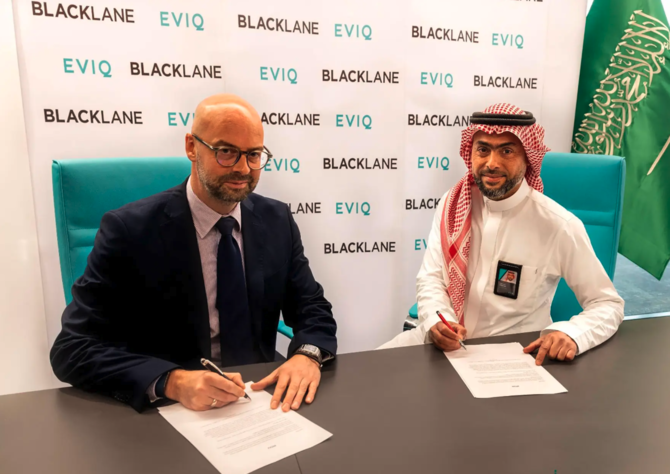
Blacklane and EVIQ partner to expand EV charging network in Saudi Arabia 

The deal includes the development of dedicated charging stations for vehicle fleets. SPA
Short Url
Updated 09 July 2025
Follow

Blacklane and EVIQ partner to expand EV charging network in Saudi Arabia 

  • Initiative aims to support development of sustainable infrastructure, focusing on clean technologies
  • Deal includes development of dedicated charging stations for vehicle fleets

JEDDAH: Electric vehicle charging infrastructure is set to expand across Saudi Arabia following a strategic partnership between Blacklane and EVIQ, accelerating the Kingdom’s shift toward clean and sustainable mobility. 

Under the agreement, EVIQ — a joint venture between the Public Investment Fund and Saudi Electricity Co. — will collaborate with the international chauffeur-driven transport firm to support the expansion of the Kingdom’s EV charging network across key cities and mobility hubs, according to a press release. 

The initiative aims to support the development of sustainable infrastructure in line with Saudi Vision 2030, focusing on clean technologies and environmental responsibility. It also supports the Kingdom’s goal to transition 30 percent of vehicles in Riyadh to electric by 2030 and achieve net-zero emissions by 2060 — a target it aims to reach ahead of schedule

Mohammed Bakr Gazzaz, CEO of EVIQ, said: “By integrating national charging infrastructure with premium fleet operations, we aim to reinforce the foundation for a scalable, future-ready transport ecosystem aligned with Saudi Arabia’s Vision 2030.” 

The deal includes the development of dedicated charging stations for vehicle fleets, most notably an integrated charging center at Blacklane’s new regional headquarters for the Gulf region in Riyadh. 

“As we rapidly scale operations across the nation, we’re thrilled to have EVIQ on-board to actively support our expanding electric fleet. Together we are setting new benchmarks for sustainable innovation and success,” said Jens Wohltorf, CEO and co-founder of Blacklane. 

Blacklane will incorporate EVIQ’s public charging network into its operations in Saudi Arabia to support its growing electric vehicle fleet. Both companies also plan to explore opportunities for system integration aimed at improving network functionality and user accessibility. 

The partnership follows Blacklane’s recent introduction of Lucid electric vehicles into its Saudi fleet, as part of efforts to expand its EV offerings. EVIQ’s fast-charging network supports the company’s goal of enhancing its electric mobility services in the Kingdom, the release added. 

As part of the partnership, the companies will co-develop training programs under Blacklane’s Chauffeur Training Academy, focusing on EV charging best practices to support service quality, safety, and sustainability. 

Blacklane’s expansion in Saudi Arabia is backed by TASARU Mobility Investments, a wholly owned investment arm of PIF.


S&P affirms UAE sovereign credit ratings at AA/A-1+ amid regional tensions

Updated 10 March 2026
Follow

S&P affirms UAE sovereign credit ratings at AA/A-1+ amid regional tensions

JEDDAH: The UAE’s sovereign credit ratings have been affirmed at AA/A-1+ with a stable outlook, as S&P Global Ratings highlighted the country’s strong fiscal buffers, diversified economy, and policy flexibility in the face of escalating regional conflict.

The agency cited the UAE’s consolidated net assets, estimated at 184 percent of gross domestic product in 2026, and its low general government debt of around 27 percent of GDP, as key buffers against economic shocks.

Sovereign credit ratings play a key role in determining a country’s borrowing costs and investor demand for its debt. A high rating signals strong fiscal health and policy stability, helping governments attract foreign investment and access global capital markets at favorable terms.

S&P noted that “our baseline forecasts carry a significant amount of uncertainty” amid heightened tensions involving Iran, Israel, and the US, including potential threats to key infrastructure.

The report added: “We also believe the authorities will deploy their substantial policy flexibility to counteract the effects of volatility stemming from geopolitical tensions in the Gulf region on economic growth, government revenue, and its external accounts.

“We believe this flexibility will enable the UAE to withstand periods of low oil prices and, more importantly, the temporary disruption of oil production and export routes.”

The UAE is facing a tense geopolitical environment amid escalating Iran-Israel-US conflicts. Threats around the Strait of Hormuz have nearly stopped vessel traffic, fueling oil market volatility and investor concern.

The ratings agency also emphasized the UAE’s diversified economic base, with non-oil sectors accounting for roughly 75 percent of GDP, as a stabilizing factor.

Strategic infrastructure, including the Abu Dhabi Crude Oil Pipeline to Fujairah, enables the country to bypass the Strait of Hormuz and safeguard oil exports, while ADNOC’s overseas storage investments further mitigate risk.

Despite the risks, S&P expects sectors such as financial services, trade, and tourism to remain resilient. It forecasts that UAE growth will moderate to 2.2 percent in 2026, down from 5 percent in 2025, reflecting potential impacts from expatriate outflows, reduced tourism revenue, and lower real estate demand.

S&P cautioned, however, that “we now expect weaker economic and external performance due to increased intensity, scope, and potential duration of conflict in the Middle East,” underscoring that prolonged disruption could weigh on fiscal and external accounts.

The affirmation underscores investor confidence in the UAE’s ability to navigate short-term geopolitical challenges while maintaining long-term stability. Analysts said the country’s large liquid asset buffer and effective policy tools will likely contain the credit impact of regional tensions and support continued economic growth.

The UAE has consistently maintained strong and stable sovereign credit ratings, reflecting a resilient and diversified economy, as well as prudent fiscal management.

Despite occasional caution during regional tensions or oil market swings, ratings have remained high, underscoring the country’s policy flexibility, fiscal strength, and appeal to global investors.