

Turkiye urges dialogue after Pakistan-India tensions, condemns Israeli attacks on Iran and Gaza

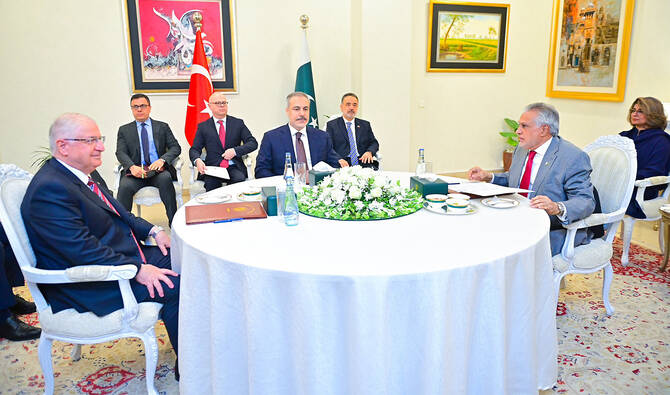
Pakistan's Foreign Minister Ishaq Dar (right) holds a meeting with Turkish Foreign Minister Hakan Fidan (center) and Defence Minister Yaşar Güler in Islamabad, Pakistan, on July 9, 2025. (Ministry of Foreign Affairs)
Short Url
Updated 09 July 2025
Follow

Turkiye urges dialogue after Pakistan-India tensions, condemns Israeli attacks on Iran and Gaza

  • Fidan praises Pakistan’s “calm attitude” during May tensions, warns of “severe results” of conflict between nuclear-armed states
  • Turkish foreign minister says Israeli strikes on Iran shift focus from Gaza “genocide,” calls for ceasefire, coordinated support for Palestinians

ISLAMABAD: Turkish Foreign Minister Hakan Fidan on Wednesday urged Pakistan and India to pursue “meaningful and efficient dialogue” to avoid future conflict, warning that an air war between the neighbors earlier this year highlighted the “severe” risks of escalation between two nuclear-armed states. 

In May 2025, the most intense India–Pakistan military confrontation in decades erupted following an April 22 attack in Indian-administered Kashmir, which killed 26 people. New Delhi, without providing evidence, said Islamabad was behind the assault, which denies the charge.

India responded on May 7 by launching a series of airstrikes targeting what it called suspected militant infrastructure in Pakistan. Pakistan retaliated with its own drone, artillery, and missile strikes. After four days of hostilities, a US-mediated ceasefire was agreed on May 10, halting the confrontation amid global alarm over the risk of escalation.

“In April-May, there has been tension experienced between Pakistan and India, which we closely followed, and all the international society has seen the wisdom-oriented and calm attitude of Pakistan,” Fidan said during a press conference in Islamabad.

“This tension has been an important indicator that when two nuclear powers come face to face that this is going to have very severe results,” he added. 

“We have actually seen this ceasefire as an important decision, and in order to eliminate similar tensions, we believe that there has to be meaningful and efficient dialogue between the parties. As Turkiye, we’re always ready to support this so that there will be peace and there will not be any clashes.”

Fidan, along with the Turkish defense minister, is visiting Pakistan as part of efforts to deepen bilateral ties and discuss regional security challenges, including the ongoing war in Gaza and rising tensions in the Middle East after Israel’s attacks on Iranian nuclear facilities and other targets last month.

“Unfortunately, the attacks have actually shaken the trust first toward the international regime on the prevention of nuclear expansions, and we have actually conveyed our messages to the parties [US, Iran] for the restart of the nuclear negotiations,” Fidan said.

“We’re in constant contact with Pakistan, and both countries are contacting both parties of the conflict. Turkiye believes that there has to be peaceful resolutions through negotiations, and we will continue to have a constructive contribution to this.”

Commenting on the Israeli military campaign in Gaza, which began in October 2023, Fidan said Turkiye condemned the ongoing Israeli attacks and supported an immediate and lasting ceasefire.

“Israel attacks are, and aggressions are, not just a risk for our region but for the whole world. At this current status quo, we do hope that the ceasefire will be permanent,” he said.

He added that the Israeli strikes on Iran had diverted international attention from what he described as the “massacre in Gaza and the genocide in Gaza.”

“Today, we [Turkiye and Pakistan] also discussed about the joint steps that we can take for our Palestinian brothers,” Fidan said.

“Within this plan, the Israel attacks and aggression should end, and we hope that peace will be brought to Gaza and calm will be established. We will continue to support the Palestinian people and the Palestinian cause.”


World Bank approves $700 million for Pakistan’s economic stability

Updated 20 December 2025
Follow

World Bank approves $700 million for Pakistan’s economic stability

  • Of this, $600 million will go for federal programs and $100 million will ⁠support a provincial program in Sindh
  • The results-based design ensures that resources are only disbursed once program objectives are achieved

ISLAMABAD: The World Bank has approved $700 million in ​financing for Pakistan under a multi-year initiative aimed at supporting the country’s macroeconomic stability and service delivery, the bank said on Friday.

The funds will be released under the bank’s Public ‌Resources for Inclusive ‌Development — Multiphase ‌Programmatic ⁠Approach (PRID-MPA) that ‌could provide up to $1.35 billion in total financing, according to the lender.

Of this amount, $600 million will go for federal programs and $100 million will ⁠support a provincial program in ‌the southern Sindh province. The results-based design ensures that resources are only disbursed once program objectives are achieved.

“Pakistan’s path to inclusive, sustainable growth requires mobilizing more domestic resources and ensuring they are used efficiently and transparently to deliver results for people,” World Bank country director Bolormaa Amgaabazar said in a statement.

“Through this MPA, we are working with the Federal and Sindh governments to deliver tangible impacts— more predictable funding for schools and clinics, fairer tax systems, and stronger data for decision‑making— while safeguarding priority social and climate investments and strengthening public trust.”

The approval ‍follows a $47.9 ‍million World Bank grant ‍in August to improve primary education in Pakistan’s most populous Punjab province.

In November, an IMF-World Bank ​report, uploaded by Pakistan’s finance ministry, said Pakistan’s fragmented ⁠regulation, opaque budgeting and political capture are curbing investment and weakening revenue.

Regional tensions may surface over international financing for Pakistan. In May, Reuters reported that India would oppose World Bank funding for Pakistan, citing a senior government ‌source in New Delhi.

“Strengthening Pakistan’s fiscal foundations is essential to restoring macroeconomic stability, delivering results and strengthening institutions,” said Tobias Akhtar Haque, Lead Country Economist for the World Bank in Pakistan.

“Through the PRID‑MPA, we are launching a coherent nationwide approach to support reforms that expand fiscal space, bolster investments in human capital and climate resilience, and strengthen revenue administration, budget execution, and statistical systems. These reforms will ensure that resources reach the frontline and deliver better outcomes for people across Pakistan with greater efficiency and accountability.”

In Sindh, the program is expected to increase provincial revenues, enhance the speed and transparency of payments, and broaden the use of data to guide provincial decision making. The program will directly support the increase of public resources for inclusive development, including more equitable and responsive financing for primary health care facilities and more funding for schools.