Pakistan to launch targeted polio vaccination drive in northern districts next week

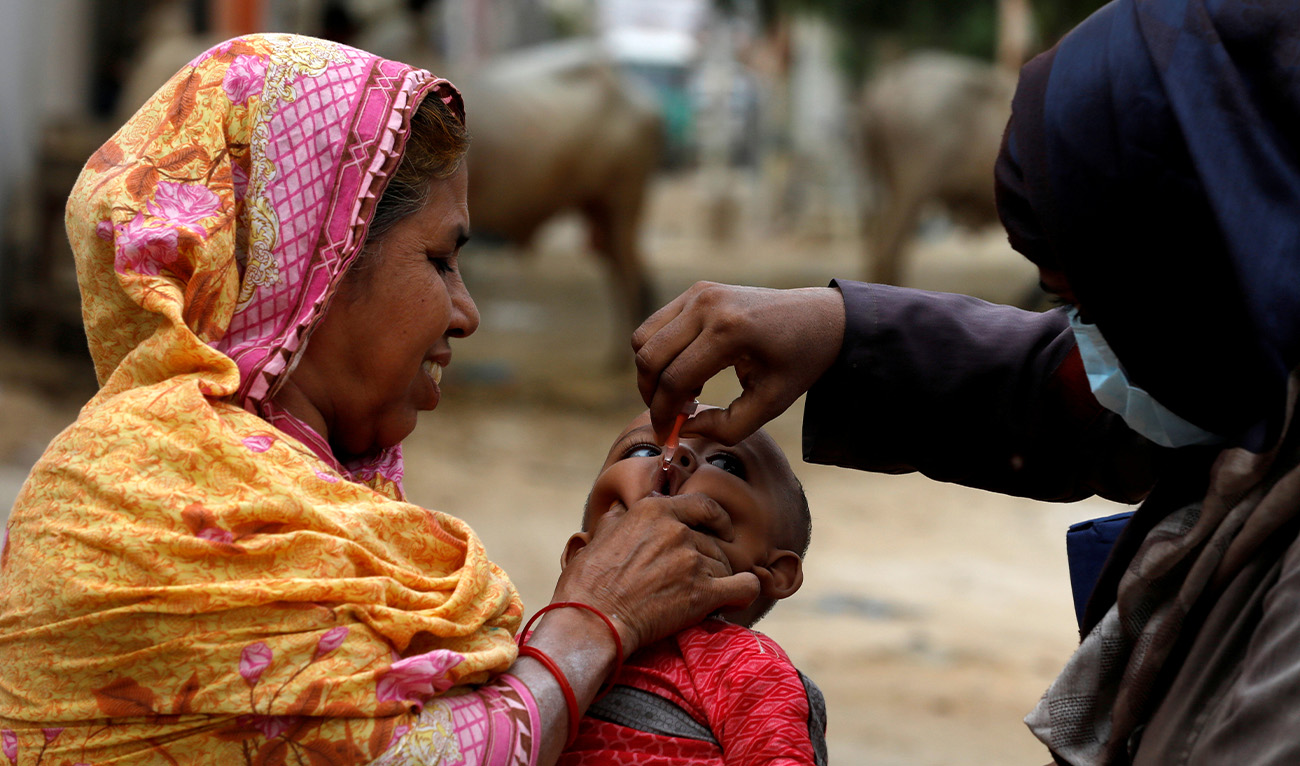
A boy receives polio vaccine drops, during an anti-polio campaign in Karachi, Pakistan, on July 20, 2020. (Reuters/File)
Short Url
Updated 09 July 2025
Follow

Pakistan to launch targeted polio vaccination drive in northern districts next week

  • More than 158,000 children to be immunized in four high-risk areas from July 14 to 18
  • Surge in cases raises alarm as Pakistan remains one of two countries where polio is still endemic

KARACHI: Pakistan will launch a targeted five-day polio vaccination campaign next week, aiming to immunize more than 158,000 children in high-risk districts of the northern Gilgit-Baltistan region and northwestern Khyber Pakhtunkhwa province, health authorities said on Wednesday.

The campaign will be conducted exclusively in the Diamer district of Gilgit-Baltistan and the Upper Kohistan, Lower Kohistan, and Kolai-Palas districts of Khyber Pakhtunkhwa, according to the National Emergency Operations Center (NEOC), which oversees Pakistan’s polio eradication efforts.

“Special focus and effective strategies are being applied in high-risk union councils,” the NEOC said in a statement, referring to administrative units where access and vaccine acceptance remain challenging. 

The drive will take place from July 14 to 18.

Polio is a highly infectious viral disease that primarily affects young children and can cause permanent paralysis. There is no cure, but it can be prevented through multiple doses of the oral polio vaccine and a complete routine immunization schedule, experts say.

Pakistan, one of only two countries in the world where polio remains endemic, the other being neighboring Afghanistan, has made significant gains in recent decades. Annual cases have fallen dramatically from an estimated 20,000 in the early 1990s to single digits by 2018.

However, the country has witnessed a worrying resurgence recently. As of July 2025, Pakistan has reported 14 polio cases, including eight in Khyber Pakhtunkhwa, four in Sindh, and one each in Punjab and Gilgit-Baltistan, according to official data. The country reported 74 cases in 2024, raising alarms among health officials and global partners supporting the eradication campaign.

In contrast, only six cases were recorded in 2023 and just one in 2021. 

The latest targeted drive follows smaller vaccination efforts in high-risk areas. A special campaign was conducted last month in six union councils of Khyber Pakhtunkhwa’s Bannu district, where approximately 17,500 children were vaccinated. A similar operation is planned for 11 union councils in North Waziristan, another district with a history of polio transmission.

The government conducted three nationwide polio campaigns earlier this year, in February, April, and May, aiming to reach around 45 million children with the help of over 400,000 frontline workers, including 225,000 women vaccinators.

Despite decades of effort, Pakistan’s eradication drive has faced persistent challenges, including misinformation about vaccines and resistance from conservative religious and militant groups who view immunization campaigns with suspicion. Some clerics have claimed the vaccines are a Western conspiracy to sterilize Muslim children or part of intelligence operations.

Vaccination teams and police providing security have also been targeted in militant attacks, particularly in remote and conflict-affected areas of Khyber Pakhtunkhwa and Balochistan. These threats have at times forced the suspension of campaigns and restricted access to vulnerable populations.

Pakistan launched its national polio eradication program in 1994.


Pakistan digital authority partners with Swiss-based group on sovereign cloud, AI systems

Updated 9 sec ago
Follow

Pakistan digital authority partners with Swiss-based group on sovereign cloud, AI systems

  • Deal aims to keep sensitive data in-country as Pakistan seeks to reduce reliance on foreign cloud providers
  • Partnership includes national messaging app, AI platform access and plans for a local DFINITY presence

ISLAMABAD: Pakistan’s digital regulator has signed a partnership with Swiss-based non-profit DFINITY Foundation to develop sovereign cloud infrastructure and AI-native software systems, according to an official statement issued on Tuesday.

The agreement between the Pakistan Digital Authority, the government body overseeing the country’s digital transformation, and DFINITY seeks to ensure sensitive public data remains within the country while enabling tamper-resistant software, national-scale digital services and artificial intelligence applications without reliance on foreign cloud providers.

As part of the collaboration, DFINITY will support the creation of a Pakistan-specific subnet on its Internet Computer Platform, a sovereign cloud network designed to host secure government applications and AI-powered systems.

The partnership also includes plans to pilot a national messaging application, expand access to DFINITY’s AI software platform Caffeine, and roll out capacity-building initiatives across government, education and entrepreneurship.

“This partnership marks an important step in Pakistan’s digital evolution,” said Dr. Sohail Munir, chairperson of the Pakistan Digital Authority, in the statement issued by the authority.

“By investing in sovereign cloud infrastructure and modern AI‑ready platforms, we are strengthening national resilience, supporting innovation, and creating new opportunities for our public institutions, students, and entrepreneurs,” he continued.

DFINITY, which describes itself as a research organization, said the agreement would allow Pakistan to develop and operate cloud and AI services under its own control.

The foundation has also committed to establishing a local presence in Pakistan and providing 1,500 licenses for its Caffeine platform, which enables users to build and deploy applications using natural language commands.

“Pakistan is taking a forward‑looking approach to digital infrastructure,” said Dominic Williams, founder and chief scientist at the organization.

“By establishing a Pakistan Subnet and investing in sovereign, tamper‑proof systems, the country is laying the groundwork for software and AI applications that are secure, verifiable, and built to serve national priorities,” he added.

The Pakistan Digital Authority was established under the Digital Nation Pakistan Act 2025 and is mandated to oversee digital policy, data and AI governance and national digital infrastructure across federal and provincial institutions.

DFINITY, founded in 2016, operates from Zurich and San Francisco and focuses on distributed systems, cryptography and advanced computing.