

US reaffirms Trump’s role in India-Pakistan ceasefire, contradicting New Delhi’s denials

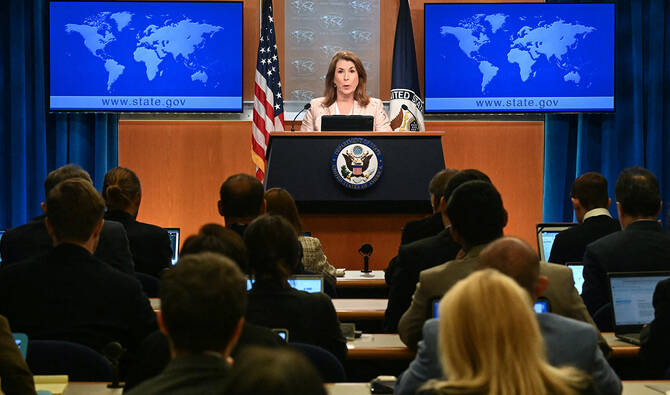
US State Department spokesperson Tammy Bruce speaks during a press briefing at the State Department in Washington, DC, on April 15, 2025. (AFP/File)
Short Url
Updated 09 July 2025
Follow

US reaffirms Trump’s role in India-Pakistan ceasefire, contradicting New Delhi’s denials

  • Tammy Bruce says people today can see events unfold for themselves and don’t need official statements to know what really happened
  • New Delhi has denied any US role in the ceasefire with Pakistan, while Islamabad has acknowledged and praised American involvement

ISLAMABAD: A US State Department official reaffirmed on Tuesday President Donald Trump and his top administration officials were involved in negotiations that led to a ceasefire between India and Pakistan earlier this year, contradicting repeated statements from Indian officials denying any American role.

Speaking at a State Department media briefing in Washington, spokesperson Tammy Bruce responded to a question about New Delhi’s rejection of Trump’s involvement in the truce.

Indian Prime Minister Narendra Modi and members of his cabinet have insisted that the ceasefire was achieved bilaterally, without third-party mediation.

“So many comments speak for themselves,” she said. “That’s one of the good-news aspects of our modern world — people can see what’s really occurring. You’re not reliant on a comment to know what has really happened.”

She maintained “Secretary [of State] Marco Rubio ... the Vice President of the United States [JD Vance were] also involved in the negotiations with Pakistan and India,” which was announced by President Donald Trump on May 10.

Bruce’s comments came amid continued tension between Indian and American narratives about the circumstances that led to the ceasefire after four days of intense military conflict between the two South Asian nuclear rivals.

The Trump administration announced the two countries had agreed to halt hostilities and engage in talks at a neutral venue.

While the Trump administration publicly claimed credit for defusing the crisis, New Delhi maintained silence initially. In recent weeks, however, Indian officials have pushed back against suggestions of US mediation.

Suggestions of foreign involvement in Indian foreign policy engagements in the region, particularly with Pakistan, are often politically sensitive.

The Ministry of External Affairs in New Delhi announced in a statement after last month’s G7 meeting in Canada that Modi had challenged the American perspective, saying there was no US mediation in the Pakistan truce.

Subsequently, India’s Foreign Minister Subrahmanyam Jaishankar made similar remarks to clarify India’s position on the issue.

Pakistan, in contrast, has openly acknowledged and praised US involvement, with the government even nominating Trump for a Nobel Peace Prize following the ceasefire announcement.


Pakistan announces oil, gas discovery in northwest as it seeks to cut energy imports

Updated 6 sec ago
Follow

Pakistan announces oil, gas discovery in northwest as it seeks to cut energy imports

  • Exploratory well in Khyber Pakhtunkhwa flows 4,100 barrels of oil, 10.5 MMSCFD of gas
  • The find adds to recent discoveries as Pakistan pushes to boost domestic energy output

KARACHI: Pakistan on Thursday announced the discovery of oil and gas in the northwestern Khyber Pakhtunkhwa province, saying the find could help reduce the country’s energy supply gap by adding to domestic production.

The discovery was made in the Datta Formation at an exploratory well drilled by the state-run Oil and Gas Development Company Limited (OGDCL) in Kohat district. The Datta Formation is a rock layer known to hold oil and gas in parts of northern Pakistan and has been a key focus of exploration activity.

Pakistan faces a widening energy gap due to rising demand and limited domestic output, forcing it to rely heavily on costly fuel imports that leave the economy exposed to global price swings.

“During case-hole Drill Stem Test (DST-02) in Datta Formation (Jurassic age), the well flowed at the rate of 4,100 barrels of oil per day (BOPD) and 10.5 million standard cubic feet per day (MMSCFD) of gas,” OGDCL Company Secretary Wasim Ahmad said in a letter to the Pakistan Stock Exchange.

A drill stem test is carried out to assess how much oil and gas a well can produce after drilling, helping companies evaluate whether a discovery is commercially viable.

OGDCL said the well was drilled to a depth of 5,170 meters and encountered oil- and gas-bearing zones at multiple levels. Earlier testing in a deeper geological layer had also resulted in a discovery, strengthening the overall prospects of the well.

“This oil and gas discovery will contribute toward mitigating the energy supply-demand gap through indigenous resources and will add to the hydrocarbon reserves base of OGDCL, its joint partners and the country,” the letter added.

Pakistan has reported several oil and gas finds in recent months as it steps up efforts to boost domestic output.

In September, Pakistan Petroleum Limited announced a discovery in Attock district of Punjab, while Mari Energies reported a new gas find in North Waziristan earlier this year.