Cabinet commends HRC adoption of resolution to protect children in cyberspace

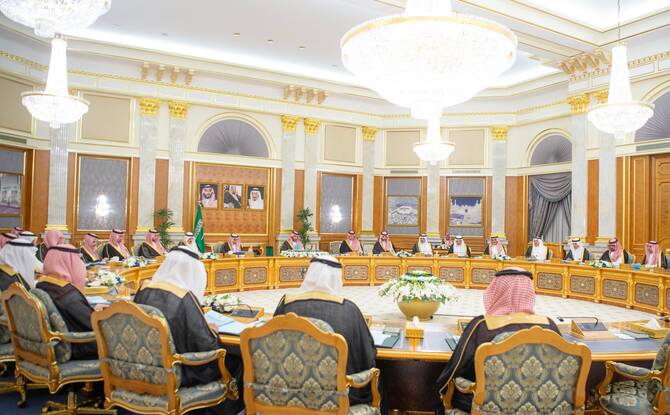
Saudi Arabia’s Cabinet held a session on Tuesday. (SPA)
Short Url
Updated 08 July 2025
Follow

Cabinet commends HRC adoption of resolution to protect children in cyberspace

  • Crown prince briefed the Cabinet on the contents of his discussions with Indonesian president and phone call he received from German Chancellor Friedrich Merz

RIYADH: The Cabinet commended on Tuesday the Human Rights Council’s unanimous adoption of a resolution submitted by the Kingdom to protect children in cyberspace.

The resolution, submitted by Saudi Arabia, aims to protect children in cyberspace and is rooted in the global initiative “Child Protection in Cyberspace” launched by Crown Prince Mohammed bin Salman in October 2024.

The Cabinet said that Saudi Arabia maintaining its position as the top-ranked country in global cybersecurity according to this year’s edition of the International Institute for Management Development World Competitiveness Yearbook adds to a series of achievements made by this sector in record time.

Saudi Minister of State and Cabinet member Issam bin Saad bin Saeed said the Kingdom’s first-place ranking globally in the ICT Development Index 2025 issued by the International Telecommunication Union is a confirmation of the strength of the its digital infrastructure.

It was also testament to the attractiveness of its investment environment and the development of the local digital economy, which has reached SR 495 billion ($132 billion) in size, he added.

The Cabinet also discussed the Kingdom’s efforts and contributions at the international level to support multilateral action and enhance global economic growth rates, including continued cooperation with OPEC+ producers to maintain stability in oil markets.

The crown prince also briefed the Cabinet on the contents of his discussions with the President of Indonesia Prabowo Subianto and a phone call he received from German Chancellor Friedrich Merz.


Musaned confirms mandatory salary transfers for domestic workers via official channels

Updated 9 sec ago
Follow

Musaned confirms mandatory salary transfers for domestic workers via official channels

  • Move aims to protect wage-related rights, enhance transparency

RIYADH: All employers in Saudi Arabia have been informed they must transfer domestic workers’ salaries through official channels, starting from Jan. 1, 2026.

The move, confirmed through Musaned platform’s X account, aims to protect wage-related rights, enhance transparency and simplify employer-worker relationships.

The electronic payment service provided through Musaned will use approved digital wallets and participating banks to ensure reliability, security and consistency in wage transfers.

Lawyer Majed Garoub told Arab News that the new regulation would help tackle persistent issues in employer-worker relationships, especially disputes over unpaid wages.

He said: “This regulation will significantly help resolve many problems that arise when domestic workers leave the country without proper verification of receiving their full rights.”

Garoub explained that informal salary payments were common in the past, often made without proper documentation or signatures.

This, he added, made it challenging for Saudi employers to prove they had paid all wages if workers later filed claims after returning to their home countries.

The new regulation, which has been rolled out in stages, began with domestic workers newly arriving in the Kingdom on July 1, 2024.

It was then extended to employers with four or more domestic workers in January 2025, followed by those employing three or more by July 2025.

The latest stage, which took effect on Oct. 1, applies to employers with two or more domestic workers. This phased approach has ensured a smooth adoption of the system for all employers.

Garoub said the regulation would bring broader legal and security benefits. He explained that informal salary payments had, at times, enabled illegal practices.

He added: “Workers might have falsely claimed unpaid wages or engaged in activities outside their employment.”

Such funds, he added, could even have contributed to crimes like money laundering or the financing of terrorism.

He said: “By mandating official payment channels, this regulation protects the Saudi economy, national security, and international financial systems.”

The Musaned platform offers significant advantages for both employers and workers. Employers gain a reliable salary verification mechanism that simplifies end-of-contract and travel-related procedures, while workers benefit from consistent, secure and timely payments.

The system also allows domestic workers to transfer their earnings to family members abroad through trusted channels.

For those who prefer cash withdrawals, a Mada card will be issued for secure and convenient access to salaries.

According to Musaned, salary transfers for workers covered under the Wage Protection System must be made through authorized channels.

This regulatory change marks a significant step forward in protecting the rights of domestic workers, ensuring transparency in employer-employee relationships, and bolstering the Kingdom’s economic and security interests.