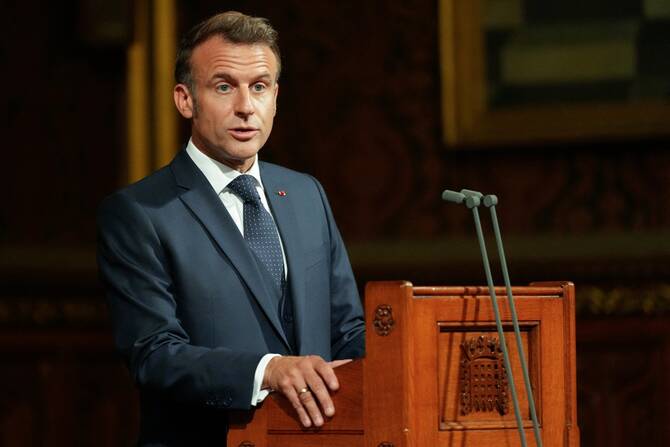
WINDSOR: President Emmanuel Macron argued Tuesday that France and Britain must work together to defend the post-World War II “international order,” as he addressed parliament on the first day of his UK state visit.
The first such visit by an EU head of state since Brexit, Macron said in a wide-ranging speech that the two countries must renew their century-old alliance to face down an array of threats.
“As permanent members of the United Nations Security Council, deeply committed to multilateralism, the United Kingdom and France must once again show the world that our alliance can make all the difference,” he told British lawmakers, speaking in English.
“Clearly, we have to work together... to protect the international order as we fought (for) it after the Second World War,” Macron added.
Touching on various thorny issues, from global conflicts to irregular cross-Channel migration, he insisted European countries will “never abandon Ukraine” in its war with Russia while demanding an unconditional ceasefire in Gaza.
Hours earlier, the French president and his wife Brigitte had received a warm, pomp-filled welcome from King Charles III and Queen Camilla in Windsor as the three-day visit got underway.
They had been greeted off the presidential plane at an air base northwest of London by heir-to-the-throne Prince William and his wife Catherine, Princess of Wales.
After a 41-gun salute sounded from Windsor’s Home Park and a royal carriage procession through the town, which was decked out in French Tricolores and British Union flags, the group entered its castle for lunch.
First visit since 2008
The first state visit by an EU head of state since the UK’s acrimonious 2020 departure from the European Union, it is also the first by a French president since Nicolas Sarkozy in 2008.
Touching on Brexit in his speech in parliament, which follows in the footsteps of predecessors Charles de Gaulle and Francois Mitterrand, Macron said it was “deeply regrettable” but the result of its 2016 referendum was respected.
Macron will hold several meetings with UK Prime Minister Keir Starmer starting Wednesday.
After taking power in 2024, the British leader has been making good on his pledge to reset relations with European capitals following years of Brexit-fueled tensions.
Their discussions are expected to focus on aid to war-torn Ukraine and bolstering defense spending, as well as joint efforts to stop migrants from crossing the Channel in small boats — a potent political issue in Britain.
Starmer is under intense pressure to curb the cross-Channel arrivals, as Euroskeptic Nigel Farage’s hard-right Reform UK party uses the issue to fuel its rise.
London has for years pressed Paris to do more to halt the boats leaving from northern French beaches, welcoming footage last Friday showing French police stopping one such boat from departing.
In his parliamentary address Macron called it “a burden for our two countries,” stressing the need for better “cooperation” to “fix” it.
Later Tuesday, Britain’s Francophile king, who is believed to enjoy a warm rapport with Macron, will host a lavish banquet in his honor in the vast medieval St. George’s Hall.
Charles is set to laud the vital partnership between France and the UK amid a “multitude of complex threats.”
“As friends and as allies, we face them together,” he will say, according to Buckingham Palace.
Trade and business ties
The visit also aims to boost trade and business ties, with Paris and London announcing Tuesday that French energy giant EDF will have a 12.5-stake in new British nuclear power plant Sizewell C.
There is also a cultural dimension, with another announcement that France will loan the 11th century Bayeux Tapestry to the British Museum for 10 months from September 2026.
The loan of the embroidery depicting the 1066 Norman conquest of England will be made in exchange for ancient “treasures” mainly from the Anglo-Saxon Sutton Hoo site, one of England’s most important archaeological sites.
Wednesday will see Macron have lunch with Starmer ahead of the two leaders on Thursday co-hosting the 37th Franco-British Summit, where they are set to discuss opportunities to strengthen defense ties.
Britain and France are spearheading talks among a 30-nation coalition on how to support a possible ceasefire in Ukraine, including potentially deploying peacekeeping forces.
The two leaders will dial in to a meeting of the coalition on Thursday “to discuss stepping up support for Ukraine and further increasing pressure on Russia,” Starmer’s office confirmed on Monday.
They will speak to Ukrainian President Volodymyr Zelensky, German Chancellor Friedrich Merz and Italian Prime Minister Giorgia Meloni, according to the French presidency.

Macron urges new era of Anglo-French unity in address to UK parliament
Short Url
https://arab.news/mrjje
Macron urges new era of Anglo-French unity in address to UK parliament
- The french president visit to the UK is the first by an EU head of state since Brexit in 2020
- He insisted European countries will ‘never abandon Ukraine’ in its war with Russia while demanding an unconditional ceasefire in Gaza
Women fleeing Mali’s conflict say they were sexually assaulted but silence hides many more
DOUANKARA: The girl lay in a makeshift health clinic, her eyes glazed over and her mouth open, flies resting on her lips. Her chest barely moved. Drops of fevered sweat trickled down her forehead as medical workers hurried around her, attaching an IV drip.
It was the last moment to save her life, said Bethsabee Djoman Elidje, the women’s health manager, who led the clinic’s effort as the heart monitor beeped rapidly. The girl had an infection after a sexual assault, Elidje said, and had been in shock, untreated, for days.
Her family said the 14-year-old had been raped by Russian fighters who burst into their tent in Mali two weeks earlier. The Russians were members of Africa Corps, a new military unit under Russia’s defense ministry that replaced the Wagner mercenary group six months ago.
Men, women and children have been sexually assaulted by all sides during Mali’s decade-long conflict, the UN and aid workers say, with reports of gang rape and sexual slavery. But the real toll is hidden by a veil of shame that makes it difficult for women from conservative, patriarchal societies to seek help.
The silence that nearly killed the 14-year-old also hurts efforts to hold perpetrators accountable.
The AP learned of the alleged rape and four other alleged cases of sexual violence blamed on Africa Corps fighters, commonly described by Malians as the “white men,” while interviewing dozens of refugees at the border about other abuses such as beheadings and abductions.
Other combatants in Mali have been blamed for sexual assaults. The head of a women’s health clinic in the Mopti area told the AP it had treated 28 women in the last six months who said they had been assaulted by militants with the Al-Qaeda affiliated JNIM, the most powerful armed group in Mali.
The silence among Malian refugees has been striking.
In eastern Congo, which for decades has faced violence from dozens of armed groups, “we didn’t have to look for people,” said Mirjam Molenaar, the medical team leader in the border area for Doctors Without Borders, or MSF, who was stationed there last year. The women “came in huge numbers.”
It’s different here, she said: “People undergo these things and they live with it, and it shows in post-traumatic stress.”
Speechless after an assault
The aunt of the 14-year-old girl said the Africa Corps fighters marched everyone outside at gunpoint. The family couldn’t understand what they wanted. The men made them watch as they tied up the girl’s uncle and cut off his head.
Then two of the men took the 14-year-old into the tent as she tried to defend herself, and raped her. The family waited outside, unable to move.
“We were so scared that we were not even able to scream anymore,” the aunt recalled, as her mother sobbed quietly next to her. She, like other women, spoke on condition of anonymity for fear of retaliation, and the AP does not name victims of rape unless they agree to be named.
The girl emerged over a half-hour later, looking terrified. Then she saw her uncle’s body and screamed. She fainted. When she woke up, she had the eyes of someone “who was no longer there,” the aunt said.
The next morning, JNIM militants came and ordered the family to leave. They piled onto a donkey cart and set off toward the border. At any sound, they hid in the bushes, holding their breath.
The girl’s condition deteriorated during the three-day journey. When they arrived in Mauritania, she collapsed.
The AP came across her lying on the ground in the courtyard of a local family. Her family said they had not taken her to a clinic because they had no money.
“If you have nothing, how can you bring someone to a doctor?” the girl’s grandmother said between sobs. The AP took the family to a free clinic run by MSF. A doctor said the girl had signs of being raped.
The clinic had been functioning for barely a month and had seen three survivors of sexual violence, manager Elidje said.
“We are convinced that there are many cases like this,” she said. “But so far, very few patients come forward to seek treatment because it’s still a taboo subject here. It really takes time and patience for these women to open up and confide in someone so they can receive care. They only come when things have already become complicated, like the case we saw today.”
As Elidje tried to save the girl’s life, she asked the family to describe the incident. She did not speak Arabic and asked the local nurse to find out how many men carried out the assault. But the nurse was too ashamed to ask.
Scratch marks are part of story she could not tell
Thousands of new refugees from Mali, mostly women and children, have settled just inside Mauritania in recent weeks, in shelters made of fabric and branches. The nearest refugee camp is full, complicating efforts to treat and report sexual assaults.
Two recently arrived women discreetly pulled AP journalists aside, adjusting scarves over their faces. They said they had arrived a week ago after armed white men came to their village.
“They took everything from us. They burned our houses. They killed our husbands,” one said. “But that’s not all they did. They tried to rape us.”
The men entered the house where she was by herself and undressed her, she said, adding that she defended herself “by the grace of Allah.”
As she spoke, the second woman started crying and trembling. She had scratch marks on her neck. She was not capable of telling her story.
“We are still terrified by what we went through,” she said.
Separately, a third woman said that what the white men did to her in Mali last month when she was alone at home “stays between God and me.”
A fourth said she watched several armed white men drag her 18-year-old daughter into their house. She fled and has not seen her daughter again.
The women declined the suggestion to speak with aid workers, some of whom are locals. They said they were not ready to talk about it with anyone else.
Russia’s Defense Ministry did not respond to questions, but an information agency that the US State Department has called part of the “Kremlin’s disinformation campaign” called the AP’s investigation into Africa Corps fake news.
Wagner has a legacy of sexual abuse
Allegations of rapes and other sexual assaults were already occurring before Wagner transformed into Africa Corps.
One refugee told the AP she witnessed a mass rape in her village in March 2024.
“The Wagner group burned seven men alive in front of us with gasoline.” she said. Then they gathered the women and raped them, she said, including her 70-year-old mother.
“After my mother was raped, she couldn’t bear to live,” she said. Her mother died a month later.
In the worst-known case of sexual assault involving Russian fighters in Africa, the UN in a 2023 report said at least 58 women and girls had been raped or sexually assaulted in an attack on Moura village by Malian troops and others that witnesses described as “armed white men.”
In response, Mali’s government expelled the UN peacekeeping mission. Since then, gathering accurate data on the ground about conflict-related sexual violence has become nearly impossible.
The AP interviewed five of the women from Moura, who now stay in a displacement camp. They said they had been blindfolded and raped for hours by several men.
Three of the women said they hadn’t spoken about it to anyone apart from aid workers. The other two dared to tell their husbands, months later.
“I kept silent with my family for fear of being rejected or looked at differently. It’s shameful,” one said.
The 14-year-old whose family fled to Mauritania is recovering. She said she cannot remember anything since the attack. Her family and MSF said she is speaking to a psychiatrist — one of just six working in the country.
Aid workers are worried about others who never say a thing.
“It seems that conflict over the years gets worse and worse and worse. There is less regard for human life, whether it’s men, women or children,” said MSF’s Molenaar, and broke into tears. “It’s a battle.”
It was the last moment to save her life, said Bethsabee Djoman Elidje, the women’s health manager, who led the clinic’s effort as the heart monitor beeped rapidly. The girl had an infection after a sexual assault, Elidje said, and had been in shock, untreated, for days.
Her family said the 14-year-old had been raped by Russian fighters who burst into their tent in Mali two weeks earlier. The Russians were members of Africa Corps, a new military unit under Russia’s defense ministry that replaced the Wagner mercenary group six months ago.
Men, women and children have been sexually assaulted by all sides during Mali’s decade-long conflict, the UN and aid workers say, with reports of gang rape and sexual slavery. But the real toll is hidden by a veil of shame that makes it difficult for women from conservative, patriarchal societies to seek help.
The silence that nearly killed the 14-year-old also hurts efforts to hold perpetrators accountable.
The AP learned of the alleged rape and four other alleged cases of sexual violence blamed on Africa Corps fighters, commonly described by Malians as the “white men,” while interviewing dozens of refugees at the border about other abuses such as beheadings and abductions.
Other combatants in Mali have been blamed for sexual assaults. The head of a women’s health clinic in the Mopti area told the AP it had treated 28 women in the last six months who said they had been assaulted by militants with the Al-Qaeda affiliated JNIM, the most powerful armed group in Mali.
The silence among Malian refugees has been striking.
In eastern Congo, which for decades has faced violence from dozens of armed groups, “we didn’t have to look for people,” said Mirjam Molenaar, the medical team leader in the border area for Doctors Without Borders, or MSF, who was stationed there last year. The women “came in huge numbers.”
It’s different here, she said: “People undergo these things and they live with it, and it shows in post-traumatic stress.”
Speechless after an assault
The aunt of the 14-year-old girl said the Africa Corps fighters marched everyone outside at gunpoint. The family couldn’t understand what they wanted. The men made them watch as they tied up the girl’s uncle and cut off his head.
Then two of the men took the 14-year-old into the tent as she tried to defend herself, and raped her. The family waited outside, unable to move.
“We were so scared that we were not even able to scream anymore,” the aunt recalled, as her mother sobbed quietly next to her. She, like other women, spoke on condition of anonymity for fear of retaliation, and the AP does not name victims of rape unless they agree to be named.
The girl emerged over a half-hour later, looking terrified. Then she saw her uncle’s body and screamed. She fainted. When she woke up, she had the eyes of someone “who was no longer there,” the aunt said.
The next morning, JNIM militants came and ordered the family to leave. They piled onto a donkey cart and set off toward the border. At any sound, they hid in the bushes, holding their breath.
The girl’s condition deteriorated during the three-day journey. When they arrived in Mauritania, she collapsed.
The AP came across her lying on the ground in the courtyard of a local family. Her family said they had not taken her to a clinic because they had no money.
“If you have nothing, how can you bring someone to a doctor?” the girl’s grandmother said between sobs. The AP took the family to a free clinic run by MSF. A doctor said the girl had signs of being raped.
The clinic had been functioning for barely a month and had seen three survivors of sexual violence, manager Elidje said.
“We are convinced that there are many cases like this,” she said. “But so far, very few patients come forward to seek treatment because it’s still a taboo subject here. It really takes time and patience for these women to open up and confide in someone so they can receive care. They only come when things have already become complicated, like the case we saw today.”
As Elidje tried to save the girl’s life, she asked the family to describe the incident. She did not speak Arabic and asked the local nurse to find out how many men carried out the assault. But the nurse was too ashamed to ask.
Scratch marks are part of story she could not tell
Thousands of new refugees from Mali, mostly women and children, have settled just inside Mauritania in recent weeks, in shelters made of fabric and branches. The nearest refugee camp is full, complicating efforts to treat and report sexual assaults.
Two recently arrived women discreetly pulled AP journalists aside, adjusting scarves over their faces. They said they had arrived a week ago after armed white men came to their village.
“They took everything from us. They burned our houses. They killed our husbands,” one said. “But that’s not all they did. They tried to rape us.”
The men entered the house where she was by herself and undressed her, she said, adding that she defended herself “by the grace of Allah.”
As she spoke, the second woman started crying and trembling. She had scratch marks on her neck. She was not capable of telling her story.
“We are still terrified by what we went through,” she said.
Separately, a third woman said that what the white men did to her in Mali last month when she was alone at home “stays between God and me.”
A fourth said she watched several armed white men drag her 18-year-old daughter into their house. She fled and has not seen her daughter again.
The women declined the suggestion to speak with aid workers, some of whom are locals. They said they were not ready to talk about it with anyone else.
Russia’s Defense Ministry did not respond to questions, but an information agency that the US State Department has called part of the “Kremlin’s disinformation campaign” called the AP’s investigation into Africa Corps fake news.
Wagner has a legacy of sexual abuse
Allegations of rapes and other sexual assaults were already occurring before Wagner transformed into Africa Corps.
One refugee told the AP she witnessed a mass rape in her village in March 2024.
“The Wagner group burned seven men alive in front of us with gasoline.” she said. Then they gathered the women and raped them, she said, including her 70-year-old mother.
“After my mother was raped, she couldn’t bear to live,” she said. Her mother died a month later.
In the worst-known case of sexual assault involving Russian fighters in Africa, the UN in a 2023 report said at least 58 women and girls had been raped or sexually assaulted in an attack on Moura village by Malian troops and others that witnesses described as “armed white men.”
In response, Mali’s government expelled the UN peacekeeping mission. Since then, gathering accurate data on the ground about conflict-related sexual violence has become nearly impossible.
The AP interviewed five of the women from Moura, who now stay in a displacement camp. They said they had been blindfolded and raped for hours by several men.
Three of the women said they hadn’t spoken about it to anyone apart from aid workers. The other two dared to tell their husbands, months later.
“I kept silent with my family for fear of being rejected or looked at differently. It’s shameful,” one said.
The 14-year-old whose family fled to Mauritania is recovering. She said she cannot remember anything since the attack. Her family and MSF said she is speaking to a psychiatrist — one of just six working in the country.
Aid workers are worried about others who never say a thing.
“It seems that conflict over the years gets worse and worse and worse. There is less regard for human life, whether it’s men, women or children,” said MSF’s Molenaar, and broke into tears. “It’s a battle.”
© 2025 SAUDI RESEARCH & PUBLISHING COMPANY, All Rights Reserved And subject to Terms of Use Agreement.


