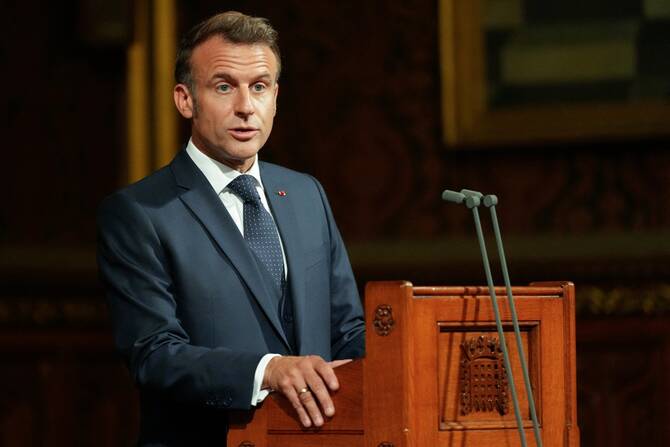
WINDSOR: President Emmanuel Macron argued Tuesday that France and Britain must work together to defend the post-World War II “international order,” as he addressed parliament on the first day of his UK state visit.
The first such visit by an EU head of state since Brexit, Macron said in a wide-ranging speech that the two countries must renew their century-old alliance to face down an array of threats.
“As permanent members of the United Nations Security Council, deeply committed to multilateralism, the United Kingdom and France must once again show the world that our alliance can make all the difference,” he told British lawmakers, speaking in English.
“Clearly, we have to work together... to protect the international order as we fought (for) it after the Second World War,” Macron added.
Touching on various thorny issues, from global conflicts to irregular cross-Channel migration, he insisted European countries will “never abandon Ukraine” in its war with Russia while demanding an unconditional ceasefire in Gaza.
Hours earlier, the French president and his wife Brigitte had received a warm, pomp-filled welcome from King Charles III and Queen Camilla in Windsor as the three-day visit got underway.
They had been greeted off the presidential plane at an air base northwest of London by heir-to-the-throne Prince William and his wife Catherine, Princess of Wales.
After a 41-gun salute sounded from Windsor’s Home Park and a royal carriage procession through the town, which was decked out in French Tricolores and British Union flags, the group entered its castle for lunch.
First visit since 2008
The first state visit by an EU head of state since the UK’s acrimonious 2020 departure from the European Union, it is also the first by a French president since Nicolas Sarkozy in 2008.
Touching on Brexit in his speech in parliament, which follows in the footsteps of predecessors Charles de Gaulle and Francois Mitterrand, Macron said it was “deeply regrettable” but the result of its 2016 referendum was respected.
Macron will hold several meetings with UK Prime Minister Keir Starmer starting Wednesday.
After taking power in 2024, the British leader has been making good on his pledge to reset relations with European capitals following years of Brexit-fueled tensions.
Their discussions are expected to focus on aid to war-torn Ukraine and bolstering defense spending, as well as joint efforts to stop migrants from crossing the Channel in small boats — a potent political issue in Britain.
Starmer is under intense pressure to curb the cross-Channel arrivals, as Euroskeptic Nigel Farage’s hard-right Reform UK party uses the issue to fuel its rise.
London has for years pressed Paris to do more to halt the boats leaving from northern French beaches, welcoming footage last Friday showing French police stopping one such boat from departing.
In his parliamentary address Macron called it “a burden for our two countries,” stressing the need for better “cooperation” to “fix” it.
Later Tuesday, Britain’s Francophile king, who is believed to enjoy a warm rapport with Macron, will host a lavish banquet in his honor in the vast medieval St. George’s Hall.
Charles is set to laud the vital partnership between France and the UK amid a “multitude of complex threats.”
“As friends and as allies, we face them together,” he will say, according to Buckingham Palace.
Trade and business ties
The visit also aims to boost trade and business ties, with Paris and London announcing Tuesday that French energy giant EDF will have a 12.5-stake in new British nuclear power plant Sizewell C.
There is also a cultural dimension, with another announcement that France will loan the 11th century Bayeux Tapestry to the British Museum for 10 months from September 2026.
The loan of the embroidery depicting the 1066 Norman conquest of England will be made in exchange for ancient “treasures” mainly from the Anglo-Saxon Sutton Hoo site, one of England’s most important archaeological sites.
Wednesday will see Macron have lunch with Starmer ahead of the two leaders on Thursday co-hosting the 37th Franco-British Summit, where they are set to discuss opportunities to strengthen defense ties.
Britain and France are spearheading talks among a 30-nation coalition on how to support a possible ceasefire in Ukraine, including potentially deploying peacekeeping forces.
The two leaders will dial in to a meeting of the coalition on Thursday “to discuss stepping up support for Ukraine and further increasing pressure on Russia,” Starmer’s office confirmed on Monday.
They will speak to Ukrainian President Volodymyr Zelensky, German Chancellor Friedrich Merz and Italian Prime Minister Giorgia Meloni, according to the French presidency.


![]()

Macron urges new era of Anglo-French unity in address to UK parliament
Short Url
https://arab.news/mrjje
Macron urges new era of Anglo-French unity in address to UK parliament
- The french president visit to the UK is the first by an EU head of state since Brexit in 2020
- He insisted European countries will ‘never abandon Ukraine’ in its war with Russia while demanding an unconditional ceasefire in Gaza


Latest updates


Recommended


© 2026 SAUDI RESEARCH & PUBLISHING COMPANY, All Rights Reserved And subject to Terms of Use Agreement.