

Pakistan deadline for registration of intending Hajj pilgrims to expire today

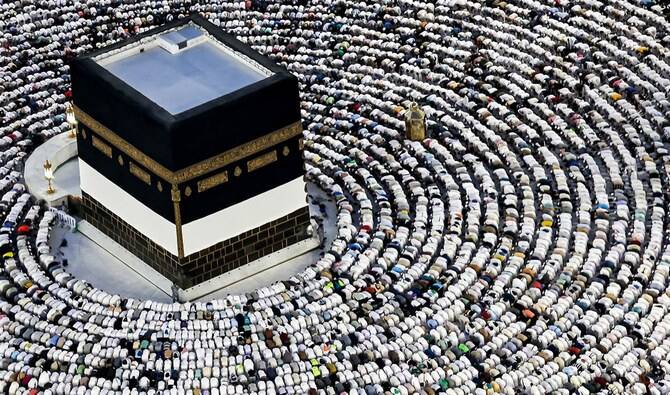
Muslim pilgrims pray around the Kaaba, Islam's holiest shrine, at the Grand Mosque in the holy city of Mecca on June 16, 2024, as they perform the farewell circumambulation or "tawaf", circling seven times around the large black cube, which is the focal point on the final day of the hajj. (AFP/File)
Short Url
Updated 08 July 2025
Follow

Pakistan deadline for registration of intending Hajj pilgrims to expire today

  • Intending pilgrims can register for Hajj 2026 through approved banks or online
  • Registration is also mandatory for pilgrims left out of private scheme this year

ISLAMABAD: A deadline for intending Pakistani pilgrims to register for next year’s Hajj pilgrimage will expire on Wednesday, according to the Pakistani religious affairs ministry.

Intending pilgrims can register themselves through 15 approved banks and only registered candidates will be considered eligible for Hajj 2026, according to the ministry.

After the registration, intending pilgrims will be able to opt for the government or private Hajj scheme. No fee will have to be paid for Hajj registration.

“One day is left for mandatory registration of pilgrims for Hajj 2026,” the religious affairs ministry said on Tuesday. “Intending Hajj pilgrims can also complete registration online from home.”

The expenses and other terms and conditions of Hajj 2026 will be issued separately as per the Hajj policy, according to the statement.

Registration is mandatory for pilgrims who were left out of the private scheme this year as well as Pakistanis residing abroad.

Pakistan received a quota of 179,210 pilgrims from Saudi Arabia for Hajj 2025, which was evenly divided between the government and private Hajj operators.

While the government filled its full allocation of over 88,000 pilgrims, a major portion of the private quota remained unutilized due to delays by companies in meeting payment and registration deadlines.


Pakistani president arrives in Iraq to deepen trade, energy cooperation

Updated 20 December 2025
Follow

Pakistani president arrives in Iraq to deepen trade, energy cooperation

  • Visit follows recent high-level contacts as Islamabad seeks to expand limited commercial ties with Baghdad
  • Talks are expected to cover investment, manpower and facilitation of Pakistani pilgrims visiting holy sites in Iraq

ISLAMABAD: President Asif Ali Zardari arrived in Iraq on Saturday on an official visit aimed at expanding cooperation in trade, energy and investment, as Pakistan seeks to deepen ties with Baghdad after years of limited engagement.

Pakistan and Iraq established diplomatic relations in 1947 and have traditionally maintained cordial ties, though commercial links remain modest, with officials and business groups identifying scope for cooperation in construction services, pharmaceuticals, manpower and agricultural exports.

“President Asif Ali Zardari arrived in Baghdad on a four-day official visit to Iraq,” his office said in a post on X. “He was received by Culture Minister Dr. Ahmed Fakkak Al-Badrani. During the visit, meetings with senior Iraqi leadership are expected to advance cooperation and further strengthen Pakistan-Iraq relations.”

Zardari’s visit follows a series of recent high-level contacts between the two countries, reflecting efforts to broaden bilateral engagement beyond traditional diplomatic ties and explore collaboration across economic, political and people-to-people domains.

According to Pakistan’s foreign office, the president is expected to hold meetings with Iraq’s senior leadership to discuss cooperation in various areas such as trade and investment, energy, technology, education and manpower.

He is also expected to discuss regional and international issues with Iraqi officials.

Earlier this month, Pakistan’s Interior Minister Mohsin Naqvi met his Iraqi counterpart, Abdul Ameer Al-Shammari, on the sidelines of meetings in Brussels, where both sides agreed to enhance cooperation on security and facilitate travel for Pakistani Shia pilgrims to Najaf and Karbala.

The two officials discussed measures to ensure the smoother movement of these pilgrims and their compliance with visa regulations.