

Pakistan expresses solidarity as 12 Turkish soldiers die in Iraq cave gas incident

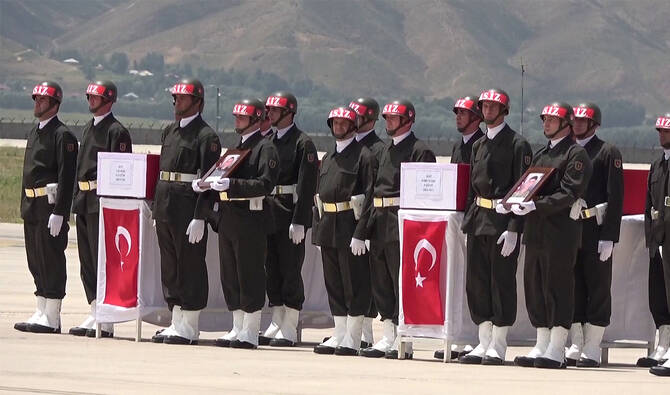
Officials pay tribute to the 12 soldiers killed in Iraq cave gas incident at a military ceremony in Yüksekova, Turkey, on July 7, 2025. (Turkish Defense Ministry/REUTERS/Screengrab)
Short Url
Updated 08 July 2025
Follow

Pakistan expresses solidarity as 12 Turkish soldiers die in Iraq cave gas incident

  • Incident occurred during a mission to locate the remains of a soldier killed earlier in operations against PKK group 
  • In past years, Turkish forces have reported discovering elaborate tunnel networks used by PKK fighters in northern Iraq

ISLAMABAD: Pakistan on Tuesday said it was saddened over the deaths of 12 Turkish soldiers who were killed after being exposed to methane gas during a military search operation in northern Iraq, offering condolences and reaffirming solidarity with Turkiye.

According to the Turkish defense ministry, the incident occurred on Sunday during a mission to locate the remains of a soldier killed earlier in operations against the Kurdistan Workers Party (PKK), which is designated a terrorist organization by Turkiye, the United States, and the European Union.

The soldiers were operating in the Claw-Lock Operation zone, part of a broader Turkish cross-border military campaign launched in April 2022 to root out PKK fighters from northern Iraq’s mountainous terrain. The ministry said several other soldiers exposed to methane gas in the same cave were hospitalized for treatment.

“We are deeply saddened to learn that 12 Turkish soldiers were martyred, after being exposed to methane gas during a search mission in the Claw-Lock Operation zone,” the Pakistani Ministry of Foreign Affairs said in a statement.

“We wish Allah’s mercy upon the martyrs and express deepest condolences to the bereaved families. Pakistan stands in firm solidarity with brotherly Turkiye in this moment of grief.”

While fatal gas exposure incidents in combat zones are relatively rare, the risk of methane buildup in enclosed or underground spaces such as caves or tunnels is well documented in both military and mining contexts. Methane is a colorless, odorless, and highly flammable gas that can displace oxygen, leading to suffocation in confined environments.

In past years, Turkish forces have reported discovering elaborate tunnel networks used by PKK fighters in northern Iraq, often rigged with explosives or hazardous substances. In 2021, three Turkish soldiers were killed in a suspected chemical exposure during clashes in a cave complex in the same region, though Turkish authorities did not publicly confirm the substance involved.

The latest incident underscores the continuing dangers faced by Turkish troops deployed in high-risk terrain as part of ongoing security operations. Turkiye has maintained a network of military bases in Iraq’s Kurdistan region for years, a policy that has drawn criticism from Baghdad but is defended by Ankara as necessary for national defense.

Pakistan and Turkiye share close defense and diplomatic ties, with regular high-level exchanges and joint military cooperation. Islamabad has consistently voiced support for Ankara’s security concerns, including its fight against the PKK.


Pakistan’s deputy PM says country will not send forces to Gaza to disarm Hamas

Updated 9 sec ago
Follow

Pakistan’s deputy PM says country will not send forces to Gaza to disarm Hamas

  • Ishaq Dar says Pakistan open to peacekeeping but Gaza’s internal security is Palestinian responsibility
  • Pakistan’s top religious clerics from different schools have warned against sending forces to Palestine

ISLAMABAD: Deputy Prime Minister Ishaq Dar said on Saturday Pakistan was willing to contribute to an international peacekeeping force in Gaza, though it would not deploy troops to disarm or de-weaponize Hamas.

The statement follows media reports saying Washington views Pakistan as a potentially significant contributor given its battle-hardened military and wants it to be part of International Stabilization Force (ISF), which is part of United States President Donald Trump’s 20-point framework for a Gaza peace plan.

The plan announced by Trump at the White House on September 29 was formally adopted at the Sharm El-Sheikh Peace Summit in October. Co-chaired by Trump and Egyptian President Abdel Fattah El-Sisi, the summit brought together leaders from 27 countries to sign the “Trump Declaration for Enduring Peace and Prosperity.”

Deployment of troops from Muslim-majority countries during a transitional stabilization phase is a key part of the plan before the war-ravaged Palestinian territory moves toward reconstruction and a longer-term political settlement.

“If they say that we should go and start fighting, disarm Hamas, de-weaponize them, and go and destroy the tunnels that Hamas has built until now, that is not our job,” Dar, who is also the country’s foreign minister, told reporters during a year-end briefing in Islamabad.

He emphasized there was clarity between Pakistan’s civil and military leadership over the matter.

“We have a very complete understanding on this matter that we cannot do that kind of work,” he added.

The deputy prime minister said Pakistan had been using the term “peacekeeping” and had never used the phrase “peace enforcement” while discussing the force.

“I have been very clear: Pakistan will be happy to join if the mandate is not peace enforcement and disarming and de-weaponizing Hamas.”

The government’s stance comes amid growing domestic pressure over the issue.

On Monday, a group of Pakistan’s top religious leaders, chaired by prominent scholar Mufti Taqi Usmani, warned the government against yielding to what they described as international pressure to send forces to Gaza.

In a joint statement from Karachi, the clerics — representing Deobandi, Barelvi, Ahl-e-Hadees and Shia schools of thought — said that Washington wanted Muslim countries to send their forces to Gaza to disarm Hamas.

“Several Muslim governments have already refused this, and pressure is being increased on Pakistan,” it added.

Addressing such concerns, Dar said Pakistan would not land its forces in Palestine to “fight Muslims.”

Israel has repeatedly called for the disarmament of Hamas as a precondition for any long-term settlement, and the United Nations Security Council has also endorsed the ISF framework in November.

However, Dar maintained during the media briefing the internal security of Gaza was the Palestinian responsibility.

“The Palestinian Authority, their government, it is their job, it is the job of their law enforcement agency,” he said

The deputy prime minister also highlighted Pakistan’s involvement in the “Arab Islamic Group of Eight,” including Saudi Arabia, Jordan, Egypt, the United Arab Emirates, Qatar, Turkiye and Indonesia, which has been coordinating on the crisis.

He said the efforts of these countries had brought some peace to Palestine and reduced bloodshed.

“Our declared policy is that there should be an independent two-state solution,” he continued while calling for pre-1967 borders.