Pakistan, UAE eye enhanced media collaboration to promote mutual understanding

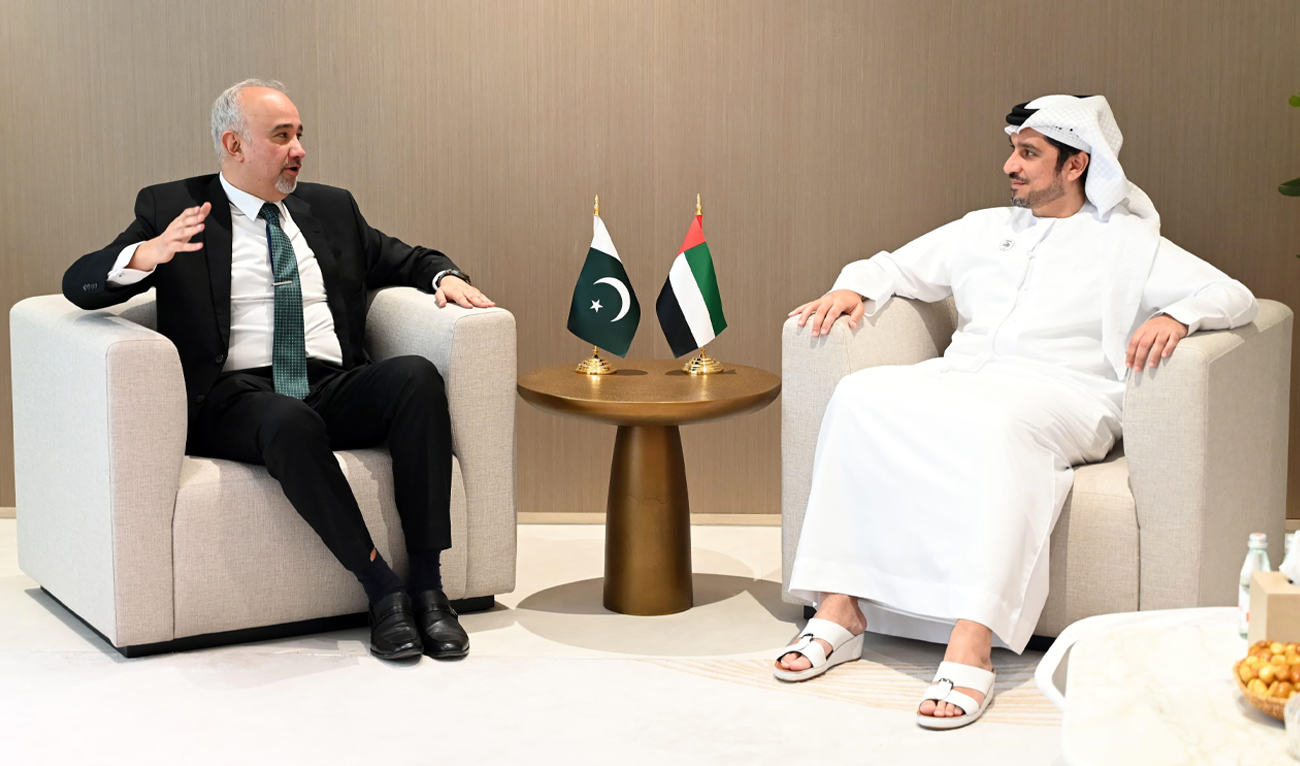
Pakistan’s Ambassador to the UAE, Faisal Niaz Tirmizi, speaks during a meeting with the UAE Media Council’s secretary-general, Mohammed Saeed Al Shehhi (right), in Dubai on July 7, 2025. (Pakistan Embassy Abu Dhabi)
Short Url
Updated 08 July 2025
Follow

Pakistan, UAE eye enhanced media collaboration to promote mutual understanding

  • Pakistan’s envoy meets UAE Media Council secretary-general Mohammed Saeed Al Shehhi in Dubai
  • Al Shehhi acknowledges Pakistan’s rich cultural heritage, tourism potential, says Pakistani embassy

ISLAMABAD: Pakistan and the UAE agreed to enhance collaboration in the media sector to promote mutual understanding and “positive narratives” between the two nations, the Pakistani embassy in Abu Dhabi said this week. 

Pakistan and the UAE enjoy cordial ties rooted in shared religion and culture. The two nations enjoy cooperation in defense, economic, trade, commerce, tourism and several other sectors of the economy. 

Pakistan’s Ambassador to the UAE Faisal Niaz Tirmizi met Mohammed Saeed Al Shehhi, the UAE Media Council’s secretary-general, in Dubai on Monday. Tirmizi underscored brotherly ties between the two states, highlighting the Pakistani expatriate community’s significant role in the UAE’s development, the Pakistan embassy in Abu Dhabi said. 

“The meeting focused on exploring avenues for collaboration in the media sector, aimed at promoting mutual understanding and positive narratives between the two nations,” the embassy said. 

Al Shehhi reaffirmed the UAE Media Council’s commitment to strengthening cooperation with Pakistan, the embassy said. He acknowledged Islamabad’s rich cultural heritage, natural beauty and tourism potential, particularly in its northern regions, it added. 

The development takes place as a senior Pakistani government delegation is in Dubai to participate in a two-day experience exchange program, aiming to learn from the UAE’s governance and public sector innovation models.

The program, running from July 8–9, includes sessions with various UAE ministries and authorities and focuses on innovative approaches to public service delivery, competitiveness, and institutional reform. 

The UAE is an important ally for Pakistan, given it is the South Asian nation’s third-largest trading partner after China and the United States. It is also considered a critical market due to its geographic proximity and logistical advantages to Pakistan.

The Gulf state is also Pakistan’s second-largest source of foreign remittances, after Saudi Arabia, with over 1.8 million Pakistani expatriates living and working there.
OIC’s COMSTECH stresses academic collaborations across Muslim world in Islamabad meeting

Updated 4 sec ago
Follow

OIC’s COMSTECH stresses academic collaborations across Muslim world in Islamabad meeting

  • COMSTECH holds annual meeting in Islamabad featuring 30 delegates from Iran, Somalia, Palestine, Indonesia and other OIC states
  • Limited pool of skilled professionals one of the foremost challenges facing Muslim world, notes COMSTECH secretary general 

ISLAMABAD: The OIC Standing Committee on Scientific and Technological Cooperation (COMSTECH) called for stronger academic collaboration across Islamic states to secure the future of higher education in the Muslim world, state-run media reported on Saturday. 

COMSTECH’s Coordinator General Prof. Dr. Muhammad Iqbal Choudhary was speaking at the Annual Meeting of the COMSTECH Consortium of Excellence at the organization’s Secretariat in Islamabad. The event brought together vice chancellors, rectors, and senior representatives from leading universities across OIC member and observer states. 

Nearly 30 international delegates representing universities from Iran, Somalia, Palestine, Indonesia, Malaysia, Thailand, Uganda, Bangladesh, Benin, Cameroon, Gabon, Côte d’Ivoire, and Senegal joined their counterparts from several Pakistani institutions at the meeting. Participants attempted to chart a collective path forward for tertiary education in OIC countries.

“Collaborations, knowledge sharing, best practices, exchange of scholars, technology transfer and joint academic programs are vital for overcoming the educational challenges faced across the OIC region,” Choudhary said, according to the state-run Associated Press of Pakistan (APP).

The COMSTECH secretary general noted that one of the foremost developmental challenges facing OIC nations remains the limited pool of skilled professionals and workforce. 

He said this gap can only be bridged through strengthened tertiary education systems and expanded opportunities for knowledge transfer.

Discussions at the event highlighted the urgent need for competency-driven education, modern pedagogical tools, university–industry partnerships and collaborative training programs designed to equip graduates with the skills necessary to address emerging global challenges.

“The Annual Meeting served as a vital platform for reviewing progress achieved over the past year, identifying future priorities, and deepening academic cooperation to promote scientific excellence and sustainable development across the OIC region,” the APP said.