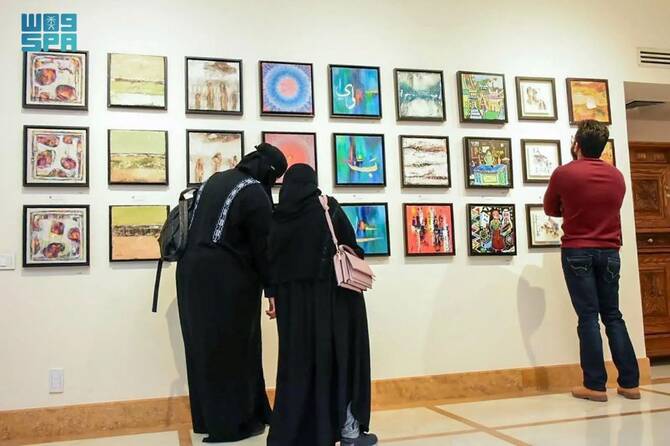
700 works entered for Dammam’s small-format art exhibition

More than 700 works have been submitted for the Saudi Arabian Society for Culture and Arts’ annual showcase. (SPA)
Short Url
Updated 08 July 2025
Follow

700 works entered for Dammam’s small-format art exhibition

  • Event seeks to ‘bridge the gap between artists and the public,’ organizer says
  • Successful pieces to be announced on July 17

DAMMAM: Artists from across the country have submitted more than 700 works for the Saudi Arabian Society for Culture and Arts in Dammam’s annual showcase.

Now in its sixth year, the “Endless Possibilities for Art” exhibition focuses exclusively on works measuring 30 cm by 30 cm and seeks to deepen connections between artists and viewers by creating interactive display environments.

A total of 705 pieces from 235 artists in 25 cities were entered for this year’s show and the submission process is now closed, the Saudi Press Agency reported.

Youssef Al-Harbi, the society’s director, said: “This initiative seeks to bridge the gap between artists and the public by making original artworks more attainable and fostering a deeper connection between creators and collectors through deeper sensory and visual readings of artistic works.

“It also showcases the richness of techniques and diversity of artistic schools, reflecting the cultural and visual diversity of the Kingdom’s regions and their aesthetic uniqueness.”

The show built on the society’s ongoing efforts to champion visual arts and encouraged artists and collectors to find common ground through ownership, he said.

The society will announce which works have been chosen for the exhibition on July 17.


Saudi designer Njoud Alghamdi: ‘We want to sustain our cultural identity in a new form’ 

Updated 18 December 2025
Follow

Saudi designer Njoud Alghamdi: ‘We want to sustain our cultural identity in a new form’ 

  • The Saudi designer on revamping the date-serving experience with Muntj Studio 

DUBAI: Saudi product designer Njoud Alghamdi brought a culturally rooted product to last month’s Dubai Design Week with “Nawat” — showcased under the Designed in Saudi initiative by the Saudi Architecture and Design Commission. 

Alghamdi is the co-founder and lead product designer of Muntj Studio, which she describes as “a cultural design studio where we focus on sustaining our cultural identity.” 

But Alghamdi isn’t interested in simply reproducing products from the past. “I am passionate about cultural innovation,” she told Arab News.  

“Nawat” — which she describes as the studio’s “signature piece” — is a perfect example of that innovation. It was created to address an issue that occurs in gatherings across Saudi Arabia and the Gulf. 

“Nawat” is the studio’s “signature piece,” according to Njoud Alghamdi. (Supplied) 

 “As you know, dates hold a very special place for us,” she said. But Alghamdi and her team identified a common concern. “Usually when people eat dates, they are embarrassed dealing with the pits themselves,” she explained. “So usually, they hide it in their pockets or in a tissue.  

“We asked ourselves, ‘How we can solve this problem to make the experience easier for the users?’” she continued. The elegant result is “Nawat,” a rounded wooden vessel with openings designed to store date pits out of sight.  

Those openings were inspired by traditional Najdi architectural elements, with a particular focus on the motifs used in old Najdi doors. During the research phase, she and her team reviewed a range of patterns but chose not to use the sharper shapes found in older houses.  

“We didn’t want to use motifs like the triangle,” she said. “So, we found the perfect circular motif and used that. Najdi doors are also a symbol of welcoming.” 

This connection aligned naturally with the social role of dates in Khaleeji culture. “The date pit holds a very special place for us at every table,” she said. “We hope that reflects how friendly this object is.” 

The final product was crafted in Riyadh by local artisans, she explained. “They used natural wood with natural finishes as well.”  

The final product was crafted in Riyadh by local artisans. (Supplied) 

The studio is now developing an entire “Nawat” range, Alghamdi said, explaining that the collection will include different sizes and dimensions to fit a wider range of occasions.  

Alghamdi described the studio’s broader focus as creating contemporary objects that sustain cultural identity. “Most of our products reflect our Saudi identity in a new format,” she said. “We want to sustain our cultural identity in a new form that can share our story with the whole world.” 

Current projects include an incense burner inspired by the camel hump, intended to “support a more comfortable daily incense ritual.” She added that the studio is also working on “cultural games,” which she described as ways to express Saudi identity in an interactive way.  

“Playing a game is the perfect way to communicate,” she said. “We believe that by expressing our identities through these games, it will help us to spread our identity and culture to the whole world.” 

Dubai Design Week was a small step towards that goal.  

“Actually, this is one of my proudest moments, to be honest,” Alghamdi said. “Exhibiting with the Architecture and Design Commission is something really special to me. 

“We’re always grateful for all the support and empowerment that (the commission is) giving us,” she continued. “As a Saudi designer, they always ensure that we get the best (opportunities) to present our work. This is something that makes every Saudi designer super-excited to come up with the best designs, because (we have the chance to) reflect our identity and the (wider design) scene.”