

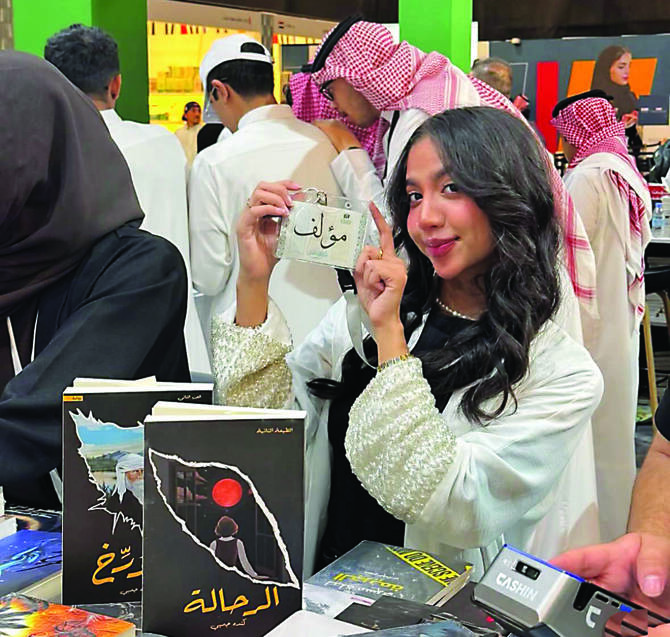


RIYADH: When Saudi writer Kendah Jambi released “The Epic of Frost” in 2024, she wrapped up a fantasy trilogy that had been nearly a decade in the making.
Spanning three titles published by Adab Book — “The Voyagers” (2021), “The Historian” (2023), and “The Epic of Frost” (2024) — the trilogy reflects a growing interest in Arabic speculative fiction and highlights her steady rise within the Kingdom’s evolving literary scene.
With the series complete, the 25-year-old has turned the page with a new project: “Khalil,” a standalone novel rooted in Saudi heritage and slated for release this year.

Author Kendah Jambi sees the current moment in Saudi Arabia as particularly significant for writers, with growing cultural initiatives under Vision 2030. (Supplied/AN photo)
Reflecting on her journey, she told Arab News: “In comparison to when I first started, it has definitely become a lot easier to write and complete a novel in shorter amount of time.”
Her works have resonated with readers across Saudi Arabia who seek her out at the region’s various book fairs. Jambi said that she is touched by the kindness they express and their connection to her works. “I have young authors flooding my socials daily talking about how my work inspired them to write and stay persistent.”
HIGHLIGHTS
• Kendah Jambi’s ‘The Voyager’ fantasy trilogy gained momentum through its Manga Arabia adaptation.
• The writer’s next project ‘Khalil’ is a stand-alone novel rooted in Saudi heritage and slated for release this year.
• Her works have resonated with readers across Saudi Arabia who seek her out at the region’s various book fairs.
She added that her goal has always been “to make the world fall in love with the Arabic language.”

Jambi’s trilogy was published in Manga Arabia magazine’s print and digital versions. (AN Photo Basheer Saleh)
Her trilogy also gained momentum through its Manga Arabia adaptation, which Jambi said brought new attention to the original novels.
This, she said, brings the story full circle as “The Voyagers” was written originally to be a manga series and ended up becoming a novel.
Her advice to aspiring writers is grounded in experience: “Always chase what you believe in, no matter how long it takes. It took me seven years to write my first book, and I never regret taking my time,” she said.

Jambi’s trilogy gained momentum through its Manga Arabia adaptation, which Jambi said brought new attention to the original novels. (Supplied/AN photo)
While her earlier work leaned heavily into fantasy, her upcoming novel “Khalil” represents a shift in setting and tone.
“‘Khalil’ takes place in our modern-day Saudi Arabia across different regions. It reflects our heritage and traditions while being completely inspired by Arabian mythology,” she explained.
One such reimagining involves the folklore figure “Um Al-Saaf wa Al-Leef,” whom she described as “a witch who sits atop palm trees and eats children.”

Jambi participated in numerous book fairs in the MENA region, including the Riyadh International Book Fair. (AN Photo Abdulrahman Shalhoub)
In Jambi’s version, the character is still a deranged witch, but she does not eat children — instead, she has children named Al-Saaf and Al-Leef.
Jambi emphasized the importance of cultural accuracy in portraying southern Saudi characters, noting that her work “stays true to the people … I definitely made sure of that with help from friends native to that region.
“The characters are people whom Saudi readers can relate to as they hold similar values and have a familiar upbringing,” she added.
Explaining the shift from fantasy to a narrative more grounded in reality, Jambi said: “My pen is free and can go wherever it wants.”
She sees the current moment in Saudi Arabia as particularly significant for writers, with growing cultural initiatives under Vision 2030.
Maram Al-Samman, who read Jambi’s trilogy, told Arab News: “I see in Kendah Jambi a new and promising voice in Arabic fantasy literature … There are some moments that might lack narrative coherence, but her boldness in introducing new ideas and her creation of complex characters distinguish her work.”
Reflecting on her overall impression, Al-Samman added: “Personally, I believe her writing is worth reading, especially for those who enjoy novels that expand the imagination and open the door to deep thought.”
With the trilogy and her upcoming standalone novel sharing the same narrative universe, Jambi has created an expansive literary ecosystem where the fantastical and the familiar coexist.


