

Pakistan issues fresh alert for floods as heavy rains kill 66 since June 26

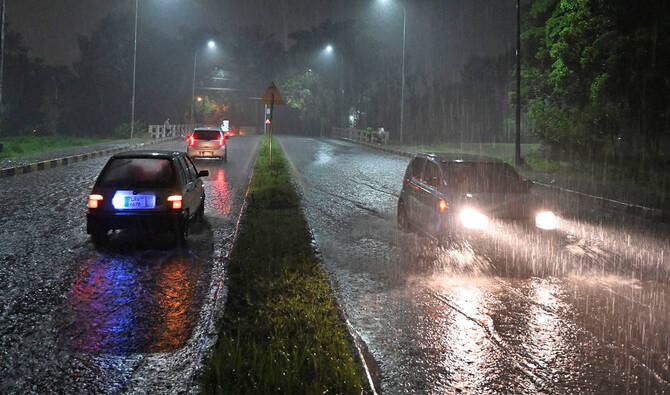
Commuters make their way through a flooded street during heavy rainfall in Islamabad on July 5, 2025. (AFP)
Short Url
Updated 06 July 2025
Follow

Pakistan issues fresh alert for floods as heavy rains kill 66 since June 26

  • Pakistan warns of floods and high water levels in four provinces, Azad Kashmir and Gilgit-Baltistan till July 10 
  • Pakistan, home to over 240 million people, is consistently ranked among countries most vulnerable to climate change

KARACHI: Pakistan’s National Disaster Management Authority (NDMA) on Sunday issued a fresh alert, warning that heavy downpours are likely to cause flooding in several parts of the country till July 10. 

Monsoon rains in Pakistan have killed at least 66 people and injured 127 in rain-related incidents such as electrocutions, house collapses, landslides and drownings since June 26, according to the NDMA’s latest situation report. 

Pakistan, home to over 240 million people, is consistently ranked among the countries most vulnerable to climate change. In 2022, record-breaking monsoon rains and glacier melt caused catastrophic floods that affected 33 million people and killed more than 1,700.

“There is a risk of heavy rainfall and flooding across the country until July 10,” the NDMA said in its press release, warning that flash flooding and increased water levels are expected in streams and rivers across Pakistan’s four provinces, Azad Kashmir, and Gilgit-Baltistan regions. 

It warned of increased water levels and flash floods in the country’s Chenab, Jhelum, Indus, Kabul, and Hunza rivers.

“Additionally, there is a risk of localized flooding in northeastern Punjab, southern Balochistan (including Awaran, Khuzdar, Jhal Magsi), and Azad Kashmir,” the statement said. 

The authority warned the masses against crossing streams and bridges during this period, urging residents in low-lying areas to take protective measures to prevent urban flooding.

The NDMA urged citizens to stay updated on the weather conditions and monitor its mobile application. 


Rating firm S&P says it won’t rush Iran war downgrades, sees risks for countries like Pakistan

Updated 12 March 2026
Follow

Rating firm S&P says it won’t rush Iran war downgrades, sees risks for countries like Pakistan

  • Agency says it is monitoring indebted energy importers as higher oil prices strain finances
  • Gulf economies seen better placed to weather shock, though Bahrain flagged as vulnerable

LONDON: S&P Global ‌said it would not make any knee-jerk sovereign rating cuts following the outbreak of war in the ​Middle East, but warned on Thursday that soaring oil and gas prices were putting a number of already cash-strapped countries at risk.

The firm’s top analysts said in a webinar that the conflict, which has involved US and Israeli strikes ‌against Iran and Iranian ‌strikes against Israel, ​US ‌bases ⁠and Gulf ​states, ⁠was now moving from a low- to moderate-risk scenario.

Most Gulf countries had enough fiscal buffers, however, to weather the crisis for a while, with more lowly rated Bahrain the only clear exception.

Qatar’s banking sector could ⁠also struggle if there were significant ‌deposit outflows in ‌reaction to the conflict, although there ​was no evidence ‌of such strains at the moment, they ‌said.

“We don’t want to jump the gun and just say things are bad,” S&P’s head global sovereign analyst, Roberto Sifon-Arevalo, said.

The longer the crisis ‌was prolonged, though, “the more difficult it is going to be,” he ⁠added.

Sifon-Arevalo ⁠said Asia was the second-most exposed region, due to many of its countries being significant Gulf oil and gas importers.

India, Thailand and Indonesia have relatively lower reserves of oil, while the region also had already heavily indebted countries such as Pakistan, Bangladesh and Sri Lanka whose finances would be further hurt by rising energy prices.

“We ​are closely monitoring ​these (countries) to see how the credit stories evolve,” Sifon-Arevalo said.