

Nearly 450,000 Afghans left Iran since June 1: UN migration agency

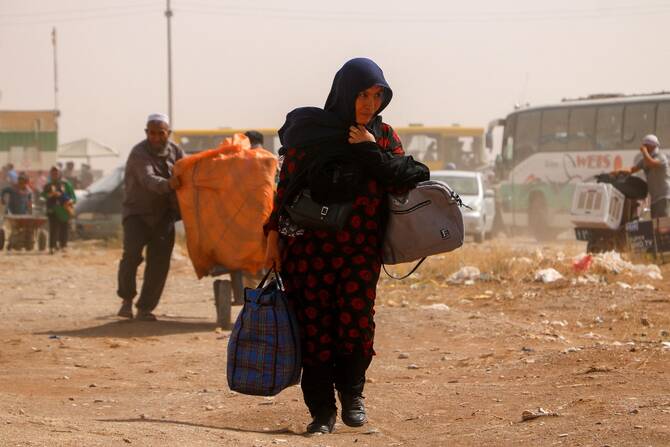
Afghan refugees arrive from Iran at Islam Qala border between Afghanistan and Iran. (AFP)
Short Url
Updated 07 July 2025
Follow

Nearly 450,000 Afghans left Iran since June 1: UN migration agency

  • IOM spokesman: From June 1 to July 5, 449,218 Afghans returned from Iran

ISLAM QALA/KABUL: Nearly 450,000 Afghans have returned from Iran since the start of June, the United Nations’ migration agency said on Monday, after Tehran ordered those without documentation to leave by July 6.

From June 1 to July 5, 449,218 Afghans returned from Iran, a spokesman for the International Organization for Migration said, adding that the total for the year so far was 906,326.

Tens of thousands of Afghans streamed over the border from Iran in the days before a return deadline set for Sunday, the United Nations said, sparking an “emergency” situation at border points.

In late May, Iran said undocumented Afghans must leave the country by July 6, potentially impacting four million people, out of the six million Afghans Tehran says live in the country.

Numbers of people crossing the border have surged since mid-June, with a peak of more than 43,000 people crossing at Islam Qala in western Herat province on July 1, the UN refugee agency UNHCR said on Friday.

The UN migration agency IOM said more than 250,000 Afghans returned from Iran in June.

UNICEF country representative Tajudeen Oyewale said this was an “emergency” situation in a country already facing a “chronic returnee crisis,” with 1.4 million Afghans returning from traditional hosts Iran and Pakistan this year.

“What is concerning is that 25 percent of all these returnees are children... because the demographics have shifted” from individual men to whole families, crossing the border with scant belongings and money, he said on Thursday.

He noted Islam Qala could accommodate the vast numbers but was inadequately equipped in terms of services, saying, “When you start hitting more than 20,000 people (a day) that is completely beyond the planning scenario that we have.”

The agency has engaged emergency processes to ramp up water and sanitation systems built for 7-10,000 people a day, along with vaccinations, nutrition and child-friendly spaces.

Many people crossing reported pressure from authorities or even arrest and deportation.

“Some people are so afraid that they don’t leave the house themselves... They send their young children out just for a piece of bread, and even those children get arrested sometimes,” said 38-year-old Aref Atayi of the pressures Afghans face in Iran.

“Even if I have to beg in my own country, it’s still better than staying in a place where we’re treated like this,” he told AFP on Saturday, as he waited at the IOM-run reception center for some support to help his family resettle.

Massive foreign aid cuts have impacted the response to the crisis, with the UN, international non-governmental groups and Taliban officials calling for more funding to support the returnees.

The UN has warned the influx could destabilize the country already grappling with entrenched poverty, unemployment and climate change-related shocks and urged countries not to forcibly return Afghans.


US, Ukraine hail ‘productive’ Miami talks but no breakthrough

Updated 6 sec ago
Follow

US, Ukraine hail ‘productive’ Miami talks but no breakthrough

  • Representatives from Ukraine, Russia, and Kyiv’s European allies, held separate talks hosted by US special envoy Steve Witkoff
  • Russia's delegation said recent proposed changes to Trump's “20-point plan”  to end the war were a non-starter

MIAMI, Florida: US and Ukrainian envoys issued a joint statement on Sunday that hailed “productive and constructive” talks in Miami but did not announce any apparent breakthrough in efforts to end the war with Russia.

Top representatives from both Ukraine and Russia, as well as Kyiv’s European allies, have been in southern Florida over the past several days for a series of separate talks hosted by US President Donald Trump’s special envoy, Steve Witkoff.
The meetings were the latest in a weeks-long diplomatic blitz over plans to end the war, after Washington last month presented a 28-point proposal widely seen as echoing the Kremlin’s demands.
It has since been redrafted following Ukraine and Europe’s involvement, though its contents have not been publicly disclosed.
“Over the last three days in Florida, the Ukrainian delegation held a series of productive and constructive meetings with American and European partners,” Witkoff and Ukraine’s top negotiator, Rustem Umerov, said in separate statements on X.
They said a bilateral US-Ukraine meeting focused on developing and aligning positions on “four key documents” — a “20-point plan,” a “Multilateral security guarantee framework,” a “US Security guarantee framework for Ukraine” and an “economic & prosperity plan.”
“Particular attention was given to discussing timelines and the sequencing of next steps,” they said, without announcing any further meetings.
National security advisers from Kyiv’s European allies “also joined the discussions to align on a shared strategic approach between Ukraine, the United States, and Europe,” the statements added.
Russian envoy Kirill Dmitriev was also in southern Florida and met with the US delegation, which included billionaire real estate developer Witkoff and Trump’s son-in-law Jared Kushner.
Witkoff on Sunday similarly said that the meetings with Dmitriev were “productive and constructive.”
Earlier, the Kremlin said recent proposed changes to the plan to end the war were a non-starter.
Dmitriev “should receive information about what has been developed by the Americans and Europeans” in the plan and report that back to Moscow later, Kremlin’s spokesman Dmitry Peskov told state TV.
Moscow, which invaded Ukraine in February 2022, sees Europe as pro-war and argues that its participation in the talks only hinders them.

War rages on 

While little is known of the latest peace plans, Kyiv is likely to be expected to surrender some territory — a prospect resented by many Ukrainians — in exchange for US security guarantees.
Though envoys from both Moscow and Kyiv were in town, the Kremlin had earlier ruled out three-way talks.
Ukrainian President Volodymyr Zelensky earlier described the talks as “constructive” and said they were “moving at a fairly rapid pace.”
He nevertheless cautioned that “much depends on whether Russia feels the need to end the war for real.”
He also hailed this week as “historic” for Ukraine, thanking Europe for pledging $100 billion of funding over the next two years.
Moscow’s troops have been steadily advancing at the eastern front in recent months. Putin on Friday hailed the Russian army’s territorial gains — and threatened more in the coming weeks.
Just over the week, “Russia has launched approximately 1,300 attack drones, nearly 1,200 guided aerial bombs, and 9 missiles of various types” against Ukraine, Zelensky said.
Most of them have pummeled the Black Sea region of Odesa, where relentless strikes wrought havoc on ports, bridges and energy facilities, killing eight people Saturday.
In the eastern Sumy region, Russian troops attempted a breakthrough in an area previously spared from an intense ground offensive. Russian forces forcibly moved 50 people from a local village, said Kyiv.
“Russian invaders have stolen five dozen civilian people, mostly elderly women, from a tiny Ukrainian village Grabovske, right across the state border in the Sumy region,” Foreign Minister Andriy Sybiga said.
Russia made no comment on the matter.