

Pakistan PM highlights shared climate risks as Texas flash floods kill dozens

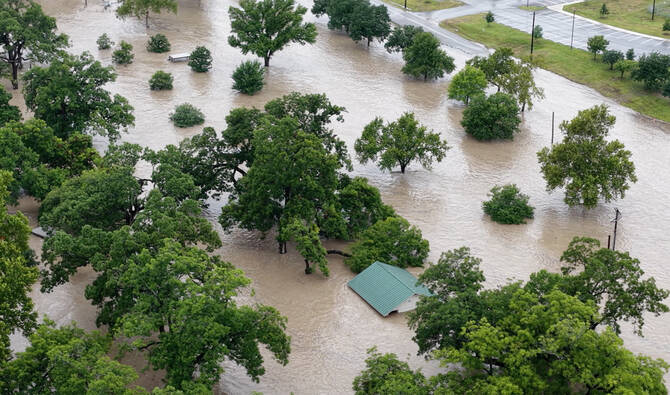
A drone view shows an area flooded by the swollen San Gabriel river, in Georgetown, Texas, U.S. July 5, 2025 in this screen grab from social media video. (Adam Grumbo/via REUTERS)
Short Url
Updated 06 July 2025
Follow

Pakistan PM highlights shared climate risks as Texas flash floods kill dozens

  • Floods in Texas began on Friday as months’ worth of rain fell in a matter of hours
  • Shehbaz Sharif hopes ongoing rescue efforts help save more lives from calamity 

ISLAMABAD: Pakistan’s Prime Minister Shehbaz Sharif offered condolences to US President Donald Trump this week as the death toll from flash floods in Texas rose to 50, with American rescuers continuing the search for missing persons. 

The flooding began in Texas on Friday — the start of the Fourth of July holiday weekend — as months’ worth of rain fell in a matter of hours.

The National Weather Service (NWS) has warned that more rain has been forecast, and that “excessive runoff may result in flooding of rivers, creeks, streams and other low-lying and flood-prone locations.”

“Deeply saddened by the loss of precious lives in the tragic flash floods in Texas, USA,” Sharif wrote on the social media platform X on Saturday night.

“Hope the ongoing rescue efforts will be successful in saving more people from this natural calamity.”


Monsoon rains have wreaked havoc in several parts of Pakistan since June 26, with the country reporting at least 66 deaths and 127 injuries due to rain-related incidents. 

A deadly flash flood in the scenic Swat Valley, caused by a sudden rise in water levels due to monsoon rains, killed 13 members of a single tourist family last week.

“Having suffered a similar incident in northwest Pakistan just a few days ago, we can fully understand the pain and suffering of the bereaved families,” Sharif said. 

“Our thoughts and prayers are with President Trump @realDonaldTrump and the American nation at this difficult time,” he added. 

Flash floods, which occur when the ground is unable to absorb torrential rainfall, are not unusual.

But scientists say that in recent years that human-driven climate change has made extreme weather events such as floods, droughts, and heatwaves more frequent and more intense.

With additional input from AFP 


Pakistan, UK sign £35 million Green Compact to strengthen climate resilience

Updated 21 December 2025
Follow

Pakistan, UK sign £35 million Green Compact to strengthen climate resilience

  • Pakistan ranks among nations most vulnerable to climate change and has seen erratic changes in its weather patterns
  • UK will help Pakistan mobilize climate finance, strengthen regulatory frameworks and develop bankable climate projects

ISLAMABAD: Pakistan and the United Kingdom (UK) have formalized a comprehensive climate partnership with the launch of a Green Compact that aims to enhance climate resilience, accelerate clean energy transition and scale up nature-based solutions, including mangrove conservation, Pakistani state media reported on Sunday.

The agreement, signed in Islamabad by Federal Minister for Climate Change and Environmental Coordination Dr. Musadik Malik and UK Minister for International Development Jennifer Chapman, unlocks £35 million in targeted support for green development and long-term climate action, according to Radio Pakistan broadcaster.

Pakistan ranks among nations most vulnerable to climate change and has seen erratic changes in its weather patterns that have led to frequent heatwaves, untimely rains, storms, cyclones, floods and droughts in recent years. In 2022, monsoon floods killed over 1,700 people, displaced another 33 million and caused over $30 billion losses, while another 1,037 people were killed in floods this year.

Mohammad Saleem Shaikh, a spokesperson for Pakistan’s Ministry of Climate Change, described the compact as a “decisive move toward action-oriented climate cooperation,” noting that its implementation over the next decade will be critical for Pakistan which regularly faces floods, heatwaves and water stress.

“The Compact is structured around five core pillars: climate finance and investment, clean energy transition, nature-based solutions, innovation and youth empowerment, and adaptation and resilience,” the report read.

“Under the agreement, the UK will work with Pakistan to mobilize public and private climate finance, strengthen regulatory frameworks for green investment, and develop bankable climate projects.”

Clean energy forms a central component of Pakistan’s transition, with Islamabad planning to expand solar and wind generation to reduce fossil fuel dependence, improve energy security and stabilize power costs, according to Shaikh.

“Renewable energy is now economically competitive, making the transition both environmentally and financially viable,” he was quoted as saying.

“Nature-based solutions, particularly large-scale mangrove restoration, will protect coastal communities from storm surges and erosion while enhancing biodiversity and carbon sequestration.”

Under the Compact, technical support, mentoring and access to investors will be provided to climate-smart startups and young innovators, reflecting Pakistan’s recognition of youth-led initiatives as central to future climate solutions.

On the occasion, Chapman, on her first official visit to Pakistan, underscored the urgency of climate action, highlighting the UK’s support for renewable energy, mangrove and ecosystem restoration, early-warning systems, climate budgeting and international investment flows into Pakistan.

Shaikh described the Green Compact as “a strategic turning point” in Pakistan–UK relations on climate change, saying its effective implementation is essential for Pakistan to meet its national climate targets.