

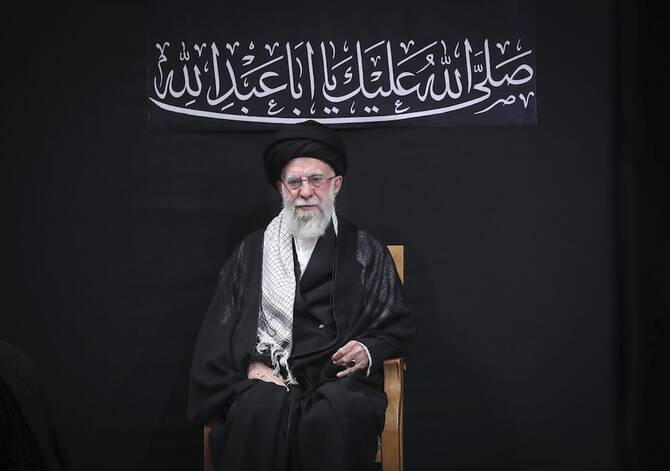

Iran’s Supreme Leader Ayatollah Ali Khamenei on Saturday made his first public appearance since the 12-day war between Israel and Iran began, attending a mourning ceremony on the eve of Ashoura.
Khamenei’s absence during the war suggested the Iranian leader, who has final say on all state matters, had been in seclusion in a bunker — something not acknowledged by state media. State TV in Iran showed him waving and nodding to the chanting crowd, which rose to its feet as he entered and sat at a mosque next to his office and residence in the capital, Tehran.
There was no immediate report on any public statement made. Iranian officials such as the parliament speaker were present. Such events are always held under heavy security.
After the US inserted itself into the war by bombing three key nuclear sites in Iran, US President Donald Trump sent warnings via social media to the 86-year-old Khamenei that the US knew where he was but had no plans to kill him, “at least for now.”
On June 26, shortly after a ceasefire began, Khamenei made his first public statement in days, saying in a prerecorded statement that Tehran had delivered a “slap to America’s face” by striking a US air base in Qatar, and warning against further attacks by the US or Israel on Iran.
Trump replied, in remarks to reporters and on social media: “Look, you’re a man of great faith. A man who’s highly respected in his country. You have to tell the truth. You got beat to hell.”
Iran has acknowledged the deaths of more than 900 people in the war, as well as thousands of injured. It also has confirmed serious damage to its nuclear facilities, and has denied access to them for inspectors with the UN nuclear watchdog.
Iran’s president on Wednesday ordered the country to suspend its cooperation with the watchdog, the International Atomic Energy Agency, further limiting inspectors’ ability to track a program that had been enriching uranium to near weapons-grade levels. Israel launched the war fearing that Iran was trying to develop atomic weapons.
It remains unclear just how badly damaged the nuclear facilities are, whether any enriched uranium or centrifuges had been moved before the attacks, and whether Tehran still would be willing to continue negotiations with the United States over its nuclear program.
Israel also targeted defense systems, high-ranking military officials and atomic scientists. In retaliation, Iran fired more than 550 ballistic missiles at Israel, most of them intercepted, killing 28 people and causing damage in many areas.
Ceremony commemorates a death that caused rift in Islam
The ceremony that Khamenei hosted Saturday was a remembrance of the 7th century martyrdom of the Prophet Muhammad’s grandson, Hussein.
Shiites represent over 10 percent of the world’s 1.8 billion Muslims, and they view Hussein as the rightful successor to the Prophet Muhammad. Hussein’s death in battle at the hands of Sunnis at Karbala, south of Baghdad, created a rift in Islam and continues to play a key role in shaping Shiite identity.
In predominantly Shiite Iran, red flags represented Hussein’s blood and black funeral tents and clothes represented mourning. Processions of chest-beating and self-flagellating men demonstrated fervor. Some sprayed water over the mourners in the intense heat.
Reports of problems accessing the Internet
NetBlocks, a global Internet monitor, reported late Saturday on X that there was a “major disruption to Internet connectivity” in Iran. It said the disruption corroborated widespread user reports of problems accessing the Internet. The development comes just weeks after authorities shut down telecoms during the war. NetBlocks later said Internet access had been restored after some two hours.


