

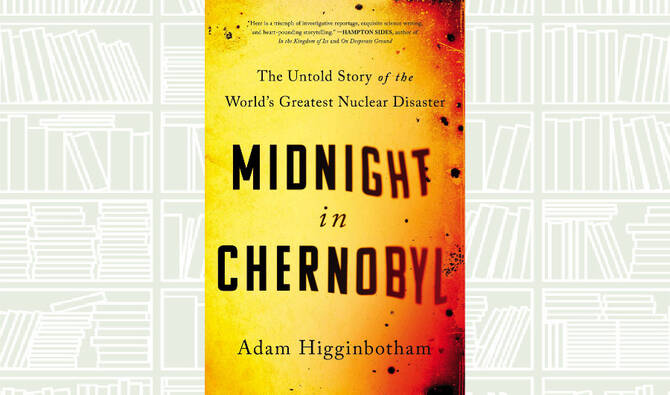
What We Are Reading Today: Midnight in Chernobyl by Adam Higginbotham

Short Url
Updated 05 July 2025
Follow

What We Are Reading Today: Midnight in Chernobyl by Adam Higginbotham

“Midnight In Chernobyl” offers a harrowing and compelling narrative of the 1986 Chernobyl disaster through the eyes of the men and women who witnessed it firsthand. 

Chernobyl has become lodged in the collective nightmares of the world. The book is an indelible portrait of history’s worst nuclear disaster, of human resilience and ingenuity and the lessons learned when mankind seeks to bend the natural world to his will remain not just vital but necessary.

This book makes for a masterful non-fiction thriller, according to a review on goodreads.com.


What We Are Reading Today: ‘I Who Have Never Known Men’

Photo/Supplied
Updated 58 sec ago
Follow

What We Are Reading Today: ‘I Who Have Never Known Men’

  • The story follows a nameless main character, the youngest of 39 women who have been trapped in a bunker for an X amount of years, guarded by men in rotation for reasons unknown

Author: Jacqueline Harpman

“I Who Have Never Known Men” is a tale of resilience and an inquiry into the human condition. 

The book, by Jacqueline Harpman, had little to no reception in 1995 when it was first published, but it has seen a revival like no other, becoming one of the most-read novels in recent years. 

The story follows a nameless main character, the youngest of 39 women who have been trapped in a bunker for an X amount of years, guarded by men in rotation for reasons unknown. In this dystopian, post-apocalyptic world, they are given minimal supplies to sustain themselves and have learned to coexist with the fact that they may live the rest of their lives in entrapment. 

The other captives are older and faintly remember their past, but having been taken at the age of 4 or 5, the “Child” — as they call her — has no recollection of her past; not even her name. The women are all numb to their condition. 

“For a very long time, the days went by, each just like the day before. Then I began to think, and everything changed,” a section of the book reads. 

All she knows is life inside these walls, and the stories women tell her. “My memory begins with my anger,” she narrates. She is isolated from the rest, but eventually forms a bond with Anthea, who teaches her most of what she knows about the world. With a stroke of luck, and the girl’s cleverness, they finally see the day they get to leave the cage. 

But what happens now? How will they survive on their own? What chaos induced their abduction? Why were they chosen as captives? Why were they the ones lucky enough to escape? Were they still on Earth? What happened to their families? Why was the electricity still on? They ponder many questions throughout their journey. 

But one thing the book doesn’t do is provide answers. 

If you’re looking for a read that’s tied with a neat little bow at the end, this may not be the book for you. 

Although the novel is a quick read, less than 200 pages, it is by no means a light one. But it does provide an important, yet bleak, contemplation of the lengths humanity will go to in order to find hope.