

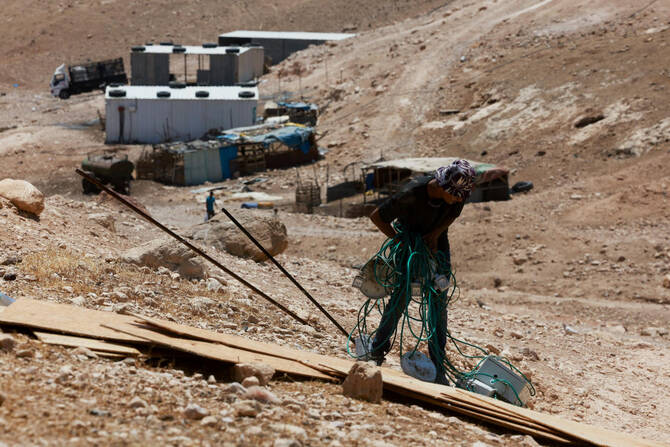

JORDAN VALLEY, West Bank: Thirty Palestinian families left their home in a remote area of the Israeli-occupied West Bank on Friday, saying they were forced out after years of persistent harassment and violence by Israeli settlers.
The families, members of the Bedouin Mleihat tribe from a shepherding community in the Jordan Valley, began dismantling homes built with iron sheets and wooden boards on Friday, overwhelmed by fears of further attacks.
“The settlers are armed and attack us, and the (Israeli) military protects them. We can’t do anything to stop them. We can’t take it anymore, so we decided to leave,” said Mahmoud Mleihat, a 50-year-old father of seven from the community.
As the Palestinians took down their encampment, an Israeli settler armed with a rifle and several Israeli soldiers looked on.
Palestinian communities in the Jordan Valley, a sparsely populated region near the Jordan River, have faced escalating harassment from settlers in recent years, including violence.
Israeli human rights group B’Tselem has documented repeated acts of violence by Israeli settlers against Palestinians in Mu’arrajat, near Jericho, where the Mleihat tribe lives. In 2024, settlers armed with clubs stormed a Palestinian school, while in 2023, armed settlers blocked the path of vehicles carrying Palestinians, with some firing into the air and others hurling stones at the vehicles.
“We want to protect our children, and we’ve decided to leave,” Mahmoud said, describing it as a great injustice.
He had lived in the community since he was 10, Mahmoud said.
Israel’s military did not immediately respond to Reuters questions about the settler harassment faced by the Bedouin families or about the families leaving their community.
Asked about settler violence in the West Bank, Israeli Foreign Minister Gideon Saar told reporters on Monday that any acts of violence by civilians were unacceptable and that individuals should not take the law into their own hands.
Activists say Israeli settlement expansion has accelerated in recent years, displacing Palestinians, who have remained on their land under military occupation since Israel captured the West Bank in a 1967 war.
B’Tselem representative Sarit Michaeli said the Mleihat tribe had faced “intense settler violence” that included, theft, vandalism, and assault. This week, she said, the settlers had established an informal outpost near the Palestinians’ home.
The military was failing to protect Palestinians from attacks by settlers, who she said acted with impunity.
Aaliyah Mleihat, 28, said the Bedouin community, which had lived there for 40 years, would now be scattered across different parts of the Jordan Valley, including nearby Jericho.
“People are demolishing their own homes with their own hands, leaving this village they’ve lived in for decades, the place where their dreams were built,” she said, describing the forced displacement of 30 families as a “new Nakba.”
The Nakba, meaning “catastrophe” in Arabic, refers to the mass displacement of hundreds of thousands of Palestinians from their homes during 1948 at the birth of the state of Israel.
Most countries consider Israeli settlements a violation of the Geneva Conventions which ban settling civilians on occupied land; Israel says the settlements are lawful and justified by historic and biblical Jewish ties to the land.


