

At least 24 dead in Texas floods, more than 20 children missing from girls summer camp

1 / 4
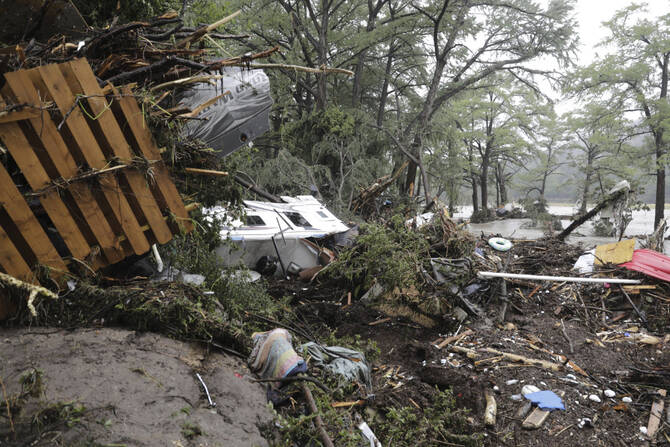
Damaged vehicles and debris are seen roped off near the banks of the Guadalupe River after flooding in Ingram, Texas, on July 4, 2025. (The San Antonio Express-News via AP)
2 / 4
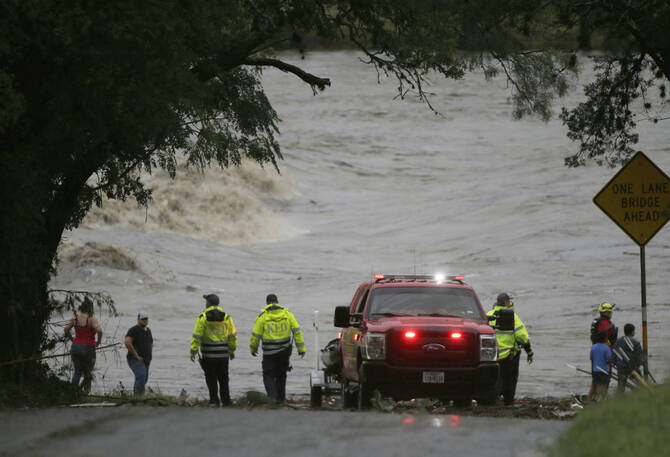
First responders scan the banks of the Guadalupe River for individuals swept away by flooding in Ingram, Texas,on July 4, 2025. (The San Antonio Express-News via AP)
3 / 4
Authorities stressed that the situation was still developing. (AP)
4 / 4
Two employees from HTR RV Park look over the area where dozens of trailers were swept away by rising flood waters on the Guadalupe River in Ingram, Texas, on July 4, 2025. (The San Antonio Express-News via AP)
Short Url
Updated 05 July 2025
Follow

At least 24 dead in Texas floods, more than 20 children missing from girls summer camp

  • Missing girls were among 750 attending summer camp at Camp Mystic in Kerr County
  • Flooded site is in an area of Texas known as “flash flood alley”

KERRVILLE, Texas: Heavy rains have caused devastating flash floods in Texas Hill Country, killing about two dozen people and leaving many others missing.
At a news conference late Friday Kerr County Sheriff Larry Leitha said “about 24” people were dead after least 10 inches (25 centimeters) of rain poured down overnight, causing flash flooding of the Guadalupe River.
Authorities said 237 people had been recued so far, including 167 by helicopter.
Among the missing are more than 20 girls from a summer camp. Officials say the death toll may rise as rescue operations continue. The area, known as “flash flood alley,” is prone to sudden flooding due to its thin soil.

“Some are adults, some are children,” Patrick said during a news conference. “Again, we don’t know where those bodies came from.”
Judge Rob Kelly, the chief elected official in Kerr County, said authorities were still working to identify those who died.
“Most of them, we don’t know who they are,” Kelly said during a news conference.

Pleading for information after flash flood
On the Kerr County sheriff’s office Facebook page, people pleaded for help finding loved ones and posted pictures of them. Patrick said at least 400 people were on the ground helping in the response. Nine rescue teams, 14 helicopters and 12 drones were being used in the search, and Patrick said some people were being rescued from trees.
About 23 of the roughly 750 girls attending Camp Mystic were among those who were unaccounted for, Patrick said.
Search crews were doing “whatever we can do to find everyone we can,” he said.
At Hunt, where the Guadalupe forks, a river gauge recorded a 22 foot rise  in about two hours, according to Bob Fogarty, meteorologist with the National Weather Service’s Austin/San Antonio office. Fogarty said the gauge failed after recording a level of 29 and a half feet .
“The water’s moving so fast, you’re not going to recognize how bad it is until it’s on top of you,” Fogarty said.
‘Pitch black wall of death’
In Ingram, Erin Burgess woke to thunder and rain at 3:30 a.m. Just 20 minutes later, water was pouring into her home directly across from the river, she said. She described an agonizing hour clinging to a tree and waiting for the water to recede enough so they could walk up the hill to a neighbor’s home.
“My son and I floated to a tree where we hung onto it, and my boyfriend and my dog floated away. He was lost for a while, but we found them,” she said.
Of her 19-year-old son, Burgess said: “Thankfully he’s over 6 feet tall. That’s the only thing that saved me, was hanging on to him.”
Matthew Stone, 44, of Kerrville, said police came knocking on doors at 5:30 a.m. but that he had received no warning on his phone.
“We got no emergency alert. There was nothing,” Stone said. Then: “a pitch black wall of death.”
Stone said police used his paddle boat to help rescue a neighbor. Stone said he and the rescuers thought they heard someone yelling “help!” from the water but couldn’t see anyone.
At a reunification center set up in Ingram, families cried and cheered as loved ones got off vehicles loaded with evacuees. Two soldiers carried an older woman who could not get down a ladder. Behind her, a woman in a soiled T-shirt and shorts clutched a small white dog.
Later, a girl in a white “Camp Mystic” T-shirt arrived. Standing in white socks in a puddle, she sobbed in her mother’s arms.


‘No one knew this kind of flood was coming’
The forecast had called for rain, with a flood watch upgraded to a warning overnight for at least 30,000 people. But totals in some places exceeded expectations, Fogarty said.
Patrick noted that the potential for heavy rain and flooding covered a large area.
“Everything was done to give them a heads up that you could have heavy rain, and we’re not exactly sure where it’s going to land,” Patrick said. “Obviously as it got dark last night, we got into the wee morning of the hours, that’s when the storm started to zero in.”
Asked about how people were notified in Kerr County so that they could get to safety, Kelly said, “We do not have a warning system.”
When reporters pushed on why more precautions weren’t taken, he responded: “Rest assured, no one knew this kind of flood was coming.”
“We have floods all the time,” he added. “This is the most dangerous river valley in the United States.”
Popular tourism area prone to flooding
It’s in an area of Texas known as “flash flood alley” because of the hills’ thin layer of soil, said Austin Dickson, CEO of the Community Foundation of the Texas Hill Country, which was collecting donations to help nonprofits responding to the disaster.
“When it rains, water doesn’t soak into the soil,” Dickson said. “It rushes down the hill.”
River tourism industry is a key part of the Hill Country economy, said Dickson. Well-known, century-old summer camps bring in kids from all over the country, he said. Between Hunt and Ingram are many river homes and cabins for rent.
“It’s generally a very tranquil river with really beautiful clear blue water that people have been attracted to for generations,” Dickson said.
Deaths in New Jersey blamed on thunderstorms
The flooding in Texas occurred as severe weather moved through central New Jersey, where thunderstorms were blamed for at least three deaths.
Among them were two men in Plainfield who died after a tree fell onto their vehicle, according to a city Facebook post.
The city canceled its July Fourth parade, concert and fireworks show.


Japan prepares to restart world’s biggest nuclear plant, 15 years after Fukushima

Updated 7 sec ago
Follow

Japan prepares to restart world’s biggest nuclear plant, 15 years after Fukushima

NIIGATA: Japan took the final step to allow the world’s largest nuclear power plant to ​resume operations with a regional vote on Monday, a watershed moment in the country’s return to nuclear energy nearly 15 years after the Fukushima disaster. Kashiwazaki-Kariwa, located about 220 km (136 miles) northwest of Tokyo, was among 54 reactors shut after the 2011 earthquake and tsunami crippled the Fukushima Daiichi plant in the worst nuclear disaster since Chernobyl.
Since then, Japan has restarted 14 of the 33 that remain operable, as it tries to wean itself off imported fossil fuels. Kashiwazaki-Kariwa will be the first operated by Tokyo Electric Power Co. (TEPCO), which ran the doomed Fukushima plant. On Monday, Niigata prefecture’s assembly passed a vote of confidence on Niigata Governor Hideyo Hanazumi, who backed the restart last month, effectively allowing for the plant to begin operations again.
“This is a milestone, but this is not the end,” Hanazumi told reporters after the vote. “There is no end in terms of ensuring the safety of Niigata residents.”
While lawmakers voted in support of Hanazumi, the assembly session, the ‌last for the year, ‌exposed the community’s divisions over the restart, despite new jobs and potentially lower electricity bills.
“This is nothing ‌other ⁠than ​a political settlement ‌that does not take into account the will of the Niigata residents,” an assembly member opposed to the restart told fellow lawmakers as the vote was about to begin.
Outside, around 300 protesters stood in the cold holding banners reading ‘No Nukes’, ‘We oppose the restart of Kashiwazaki-Kariwa’ and ‘Support Fukushima’. “I am truly angry from the bottom of my heart,” Kenichiro Ishiyama, a 77-year-old protester from Niigata city, told Reuters after the vote. “If something was to happen at the plant, we would be the ones to suffer the consequences.”
TEPCO is considering reactivating the first of seven reactors at the plant on January 20, public broadcaster NHK reported.
Kashiwazaki-Kariwa’s total capacity is 8.2 GW, enough to power a few million homes. The pending restart would bring one 1.36 GW unit online next year and start another one with the same capacity around 2030.
“We remain firmly committed to never ⁠repeating such an accident and ensuring Niigata residents never experience anything similar,” said TEPCO spokesperson Masakatsu Takata. Takata declined to comment on timing. TEPCO shares closed up 2 percent in afternoon trade in Tokyo, higher than the wider ‌Nikkei index, which was up 1.8 percent.

RELUCTANT RESIDENTS WARY OF RESTART
TEPCO earlier this year pledged to ‍inject 100 billion yen ($641 million) into the prefecture over the next ‍10 years as it sought to win the support of Niigata residents.
But a survey published by the prefecture in October found 60 percent of residents did ‍not think conditions for the restart had been met. Nearly 70 percent were worried about TEPCO operating the plant.
Ayako Oga, 52, settled in Niigata after fleeing the area around the Fukushima plant in 2011 with 160,000 other evacuees. Her old home was inside the 20 km irradiated exclusion zone.
The farmer and anti-nuclear activist has joined the Niigata protests.
“We know firsthand the risk of a nuclear accident and cannot dismiss it,” said Oga, adding that she still struggles with post-traumatic stress-like symptoms from what happened at Fukushima.
Even Niigata Governor Hanazumi ​hopes that Japan will eventually be able to reduce its reliance on nuclear power. “I want to see an era where we don’t have to rely on energy sources that cause anxiety,” he said last month.

STRENGTHENING ENERGY SECURITY
The Monday vote was seen as the ⁠final hurdle before TEPCO restarts the first reactor, which alone could boost electricity supply to the Tokyo area by 2 percent, Japan’s trade ministry has estimated. Prime Minister Sanae Takaichi, who took office two months ago, has backed nuclear restarts to strengthen energy security and to counter the cost of imported fossil fuels, which account for 60 percent to 70 percent of Japan’s electricity generation.
Japan spent 10.7 trillion yen ($68 billion) last year on imported liquefied natural gas and coal, a tenth of its total import costs.
Despite its shrinking population, Japan expects energy demand to rise over the coming decade due to a boom in power-hungry AI data centers. To meet those needs, and its decarbonization commitments, it has set a target of doubling the share of nuclear power in its electricity mix to 20 percent by 2040.
Joshua Ngu, vice chairman for Asia Pacific at consultancy Wood Mackenzie, said public acceptance of the restart of Kashiwazaki-Kariwa would represent “a critical milestone” toward reaching those goals. In July, Kansai Electric Power, Japan’s top nuclear power operator, said it would begin conducting surveys for a reactor in western Japan, the first new unit since the Fukushima disaster.
But for Oga, who was in the crowd outside the assembly on Monday chanting ‘Never forget Fukushima’s lessons!’, the nuclear revival is a terrifying reminder of the potential risks. “At the time (2011), I never thought that TEPCO would operate a nuclear power ‌plant again,” she said.
“As a victim of the Fukushima nuclear accident, I wish that no one, whether in Japan or anywhere in the world, ever again suffers the damage of a nuclear accident.”