Pakistan PM, Azerbaijan president vow to boost trade and investment on ECO summit sidelines

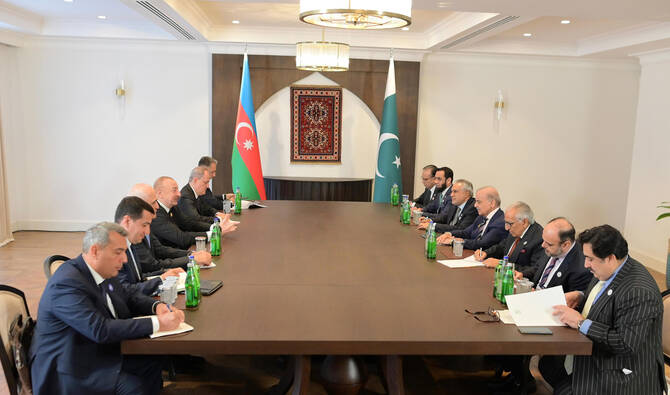
Pakistan Prime Minister Shehbaz Sharif meets Azerbaijan President Ilham Aliyev in Khankendi, Azerbaijan on July 4, 2025, on the sidelines of 17th ECO Summit. (Handout/PMO)
Short Url
Updated 04 July 2025
Follow

Pakistan PM, Azerbaijan president vow to boost trade and investment on ECO summit sidelines

  • The summit brought together heads of government from ECO member states to discuss economic and political cooperation
  • Pakistan, bolstered by an IMF program, is looking to capitalize on its geostrategic location as a major trade and transit hub

ISLAMABAD: Pakistan Prime Minister Shehbaz Sharif on Friday met with Azerbaijan President Ilham Aliyev on the sidelines of the 17th Economic Cooperation Organization (ECO) summit, Sharif’s office said, with the two leaders agreeing to boost bilateral trade and investment.

The prime minister led Pakistan’s delegation at the ECO summit in Khankendi, Azerbaijan on July 3-4, which focused on the promotion of trade, sustaining development and enhancing regional connectivity.

Sharif noted that recent interactions between leaders of the two countries had helped strengthen relations and invited President Ilham to visit Pakistan at his earliest convenience, according to the Pakistan PM’s office.

“The two leaders agreed to enhance their cooperation in the fields of trade and investment while expressing satisfaction over the progress made regarding the investment prospects,” Sharif’s office said.

“Both leaders reiterated their resolve to strengthen the economic partnership, especially Azerbaijan’s investment in Pakistan.”

This is Sharif’s third visit to Azerbaijan in 2025. He last traveled to Baku in May as part of a broader push at economic diplomacy with the Central Asian republics, to whom Pakistan has offered access to its southern ports in Karachi and Gwadar.

The ECO summit, themed as “New ECO Vision for a Sustainable and Climate Resilient Future,” brought together heads of state and government from ECO member states to discuss economic and political cooperation.

Founded in 1985 by Iran, Pakistan and Turkiye, the Eurasian intergovernmental organization included Afghanistan, Azerbaijan, Kazakhstan, Kyrgyzstan, Tajikistan, Turkmenistan and Uzbekistan in 1992, aiming to establish a single market for goods and services.

Pakistan, slowly recovering from a macroeconomic crisis under a $7 billion International Monetary Fund (IMF) deal, has been looking to capitalize on its geostrategic location to boost transit trade and foreign investment for a sustainable economic recovery.

In July 2024, Azerbaijan announced a $2 billion investment in Pakistan during a visit by President Ilham Aliyev to Islamabad. In September last year, Pakistan signed a contract to supply JF-17 Block III fighter jets to Azerbaijan, marking the deepening of defense cooperation.


Islamabad offers skilled manpower to help Iraq in reconstruction, development efforts

Updated 21 December 2025
Follow

Islamabad offers skilled manpower to help Iraq in reconstruction, development efforts

  • The development comes during Pakistan President Asif Ali Zardari’s four-day visit to Iraq to strengthen bilateral cooperation
  • Zardari says current levels of bilateral trade do not reflect true potential of Pakistan-Iraq ties, highlights opportunities

ISLAMABAD: Pakistan has offered to provide skilled manpower to support Iraq’s reconstruction and development efforts, the Pakistani government said on Sunday, signaling Islamabad’s willingness to deepen cooperation with Baghdad in sectors including infrastructure, technical services and human resource development.

The development comes during Pakistan President Asif Ali Zardari’s four-day visit to Iraq to strengthen cooperation in trade, investment, religious tourism, energy and other sectors.

Zardari held a one-on-one meeting with his Iraqi counterpart, Dr. Abdul Latif Jamal Rashid, at Baghdad Palace, which was followed by delegation-level talks to review the state of bilateral relations.

“President Zardari reiterated Pakistan’s willingness to support Iraq’s reconstruction and development efforts through the provision of skilled and semi-skilled manpower under the existing Memorandum of Understanding on manpower transmission,” Pakistan’s Press Information Department (PID) said in a statement.

“He also highlighted Pakistan’s capacity in medical services, financial expertise and digital governance, and expressed readiness to share technical experience, including in secure data management, to support institutional capacity-building in Iraq.”

Iraq has been working to rebuild its economy and infrastructure after decades of conflict, including the 2003 US-led invasion and years of instability caused by sectarian violence and the fight against Daesh group. Although security conditions have improved in recent years, large parts of the country still face damaged roads, power plants, hospitals and housing, requiring large-scale reconstruction and public service delivery.

During Sunday’s meeting, Zardari noted that the current levels of bilateral trade do not reflect the true potential of Pakistan-Iraq economic, cultural and security relations, highlighting opportunities in agriculture, defense production, information technology, construction, pharmaceuticals and other sectors. He underscored the importance of business-to-business engagement and the establishment of direct banking channels to facilitate trade and commercial activity, according to the PID.

Zardari also requested improved facilitation for Pakistani pilgrims visiting Iraq and expressed hope for early finalization and implementation of a proposed Memorandum of Understanding on Zaireen (pilgrims) Management, aimed at ensuring orderly travel. He expressed his firm resolve to work with the Iraqi government to stop illegal entry and overstay of those Pakistanis who violate Iraqi law.

“Both Presidents expressed their resolve to fight extremism, terrorism and narco trade and enhance bilateral cooperation,” the PID said. “The two leaders reaffirmed their commitment to further deepening bilateral cooperation across political, economic and social domains.”

Pakistan and Iraq established diplomatic relations in 1947 and have traditionally maintained cordial ties, though commercial links remain modest. The volume of trade between both countries stood at $268 million in 2023.

Pakistan’s major exports to Iraq include machinery and mechanical appliances, pharmaceutical products, fish, cereals, essential oils and resinoids. Islamabad’s imports from Iraq include mineral fuels, mineral, organic chemicals, edible fruit and nuts.