

Tensions rise for Imran Khan’s party as Punjab speaker signals opposition disqualifications

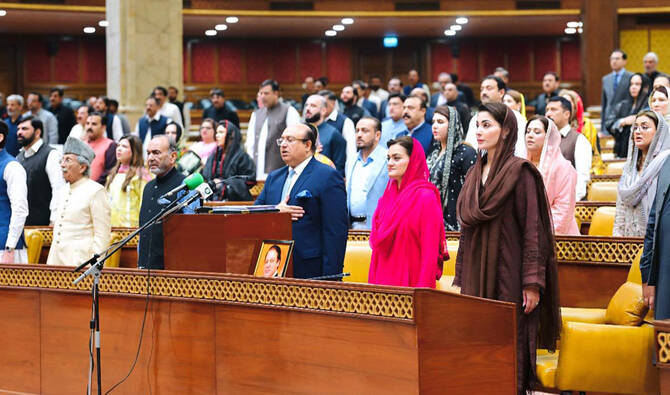
This handout photo, released on June 16, 2025, shows provincial lawmakers ahead of the budget session at the Provincial Assembly of Punjab in Lahore. (Photo courtesy: Handout/Maryam Nawaz-Sharif)
Short Url
Updated 03 July 2025
Follow

Tensions rise for Imran Khan’s party as Punjab speaker signals opposition disqualifications

  • Malik Ahmad Khan says lawmakers violating constitution have no place in the provincial assembly
  • KP Governor Faisal Kundi has also hinted at a no-trust move against PTI-backed CM Gandapur

ISLAMABAD: Political temperatures rose on Thursday as Speaker of the Punjab Assembly, Malik Ahmad Khan, suggested opposition lawmakers backed by Pakistan’s jailed former Prime Minister Imran Khan could be disqualified from the provincial legislature.

Earlier, the speaker had suspended the membership of 26 lawmakers supported by the former premier’s Pakistan Tehreek-e-Insaf (PTI) party for 15 sessions following chaotic scenes during Chief Minister Maryam Nawaz’s speech during budget proceedings last month.

However, the issue of their disqualification gained traction a day after PTI announced a nationwide protest movement against the government in response to a Supreme Court ruling that denied the party reserved seats for women and minorities in national and provincial legislatures.

“Lawmakers violating the Constitution have no right to remain part of the provincial assembly,” the speaker told reporters on Thursday.

He maintained creating disruption in an assembly was wrong for any political party.

“I will fight this case to uphold the Constitution,” he continued. “I have exercised restraint for over a year and a half as speaker … I now have to fulfill my responsibilities as speaker.”

Last month, Pakistan’s top court upheld a verdict by the Peshawar High Court, ruling that the PTI was not entitled to reserved seats for women and minorities in national or provincial assemblies. The Supreme Court’s constitutional bench ruled that since PTI candidates had contested the February 8 general elections as independents after losing their electoral symbol, they could not claim reserved seats under proportional representation.

The fallout from the Supreme Court verdict has also rattled the PTI’s traditional power base in Khyber Pakhtunkhwa (KP) province where the party managed to form its government.

KP Governor Faisal Karim Kundi, who represents the federal government, has warned that a no-confidence motion could be tabled against PTI-backed Chief Minister Ali Amin Gandapur, a close aide of the jailed former prime minister.

Gandapur, however, has dismissed concerns about his government’s stability, saying there is no constitutional way to remove him from office.


Pakistani, Bangladeshi officials discuss trade, investment and aviation as ties thaw

Updated 28 December 2025
Follow

Pakistani, Bangladeshi officials discuss trade, investment and aviation as ties thaw

  • Pakistan and Bangladesh were once one nation, but they split in 1971 as a result of a bloody civil war
  • Ties between Pakistan, Bangladesh have warmed up since last year and both nations have resumed sea trade

ISLAMABAD: Pakistan's High Commissioner to Bangladesh Imran Haider on Sunday met Chief Adviser Muhammad Yunus in Dhaka, the latter's office said on, with the two figures discussing trade, investment and aviation.

Pakistan and Bangladesh were once one nation, but they split in 1971 as a result of a bloody civil war, which saw the part previously referred to as East Pakistan seceding to form the independent nation of Bangladesh.

Ties between Pakistan and Bangladesh have warmed up since former prime minister Sheikh Hasina’s ouster as a result of a student-led uprising in August 2024. Relations remain frosty between Dhaka and New Delhi over India’s decision to grant asylum to Hasina.

Pakistan has attempted to forge closer ties with Bangladesh in recent months and both South Asian nations last year began sea trade, followed by efforts to expand government-to-government commerce.

"During the meeting, both sides discussed ways to expand cooperation in trade, investment, and aviation as well as scaling up cultural, educational and medical exchanges to further strengthen bilateral relations between the two South Asian nations," Yunus's office said in a statement on X.

In 2023-24 Pakistan exported goods worth $661 million to Bangladesh, while its imports were only $57 million, according to the Trade Development Authority of Pakistan. In Aug. this year, the Pakistani and Bangladeshi commerce ministries signed a memorandum of understanding to establish a Joint Working Group on Trade, aiming to raise their bilateral trade volume to $1 billion in the financial year that began in July.

The Pakistani high commissioner noted that bilateral trade has recorded a 20 percent growth compared to last year, with business communities from both countries actively exploring new investment opportunities, according to the statement.

He highlighted a significant increase in cultural exchanges, adding that Bangladeshi students have shown strong interest in higher education opportunities in Pakistan, particularly in medical sciences, nanotechnology, and artificial intelligence. Haider also said that Dhaka-Karachi direct flights are expected to start in January.

"Chief Adviser Professor Muhammad Yunus welcomed the growing interactions between the two countries and emphasized the importance of increased visits as well as cultural, educational and people-to-people exchanges among SAARC (South Asian Association for Regional Cooperation) member states," the statement read.

"Professor Yunus also underscored the need to further boost Bangladesh–Pakistan trade and expressed hope that during Mr. Haider’s tenure, both countries would explore new avenues for investment and joint venture businesses."