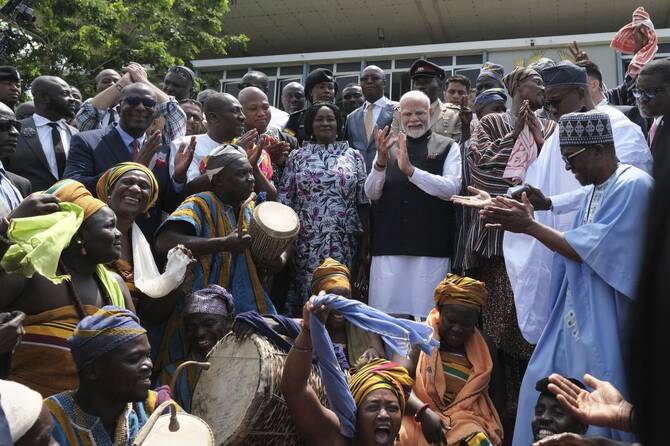

ACCRA: Indian Prime Minister Narendra Modi on Thursday outlined plans for deeper ties between his country and Africa, as New Delhi increasingly vies for a stronger economic presence on the continent along with China and Russia.
In a speech to Ghana’s parliament, Modi highlighted a major rail project that opened in the west African nation last year, financed by the India Export-Import Bank.
He also underlined his country’s expanding diplomatic development and business footprint in Africa.
“Over 200 projects across the continent enhance connectivity, infrastructure and industrial capacity,” Modi said. On the political front he welcomed “the establishment of Ghana-India Parliamentary Friendship Society in your parliament.”
Modi’s visit is the first to Ghana by an Indian leader in three decades.
But India’s rival China remains the most important backer of infrastructure across the continent, a position only strengthened as the United States and other Western powers slash aid programs.
In a meeting Wednesday, Modi and Ghanaian President John Mahama agreed to deepen security and mining ties.
In November 2024, the Indian prime minister visited Nigeria, discussing trade and security at a time when Indian companies had expressed interest in investing in Nigerian industries including steel.
The Indian prime minister also on Thursday called for a greater global diplomatic role for both his country and Africa, warning that “the world order created after the Second World War is changing fast.”
Modi noted that the African Union had been admitted as a permanent member to the G20 while India held the rotating presidency of the bloc.
Progress on worldwide challenges including climate change, diplomacy, “terrorism” and pandemics “cannot come without giving voice to the Global South,” he added.
India, the world’s most populous country and a nuclear-armed power, has close ties with Russia but is often in rivalry with China.
Resource-rich Ghana is Modi’s first stop in a tour that will take the Indian premier to four other countries in Africa, the Caribbean and South America.
The visit to Accra came as he made his way to Brazil for a summit of the BRICS group of emerging economies on Sunday and Monday.
Highlighting his own country’s economic development aspirations to become a “developed nation by 2047,” Modi said “India remains a committed partner in Africa’s development journey.”