

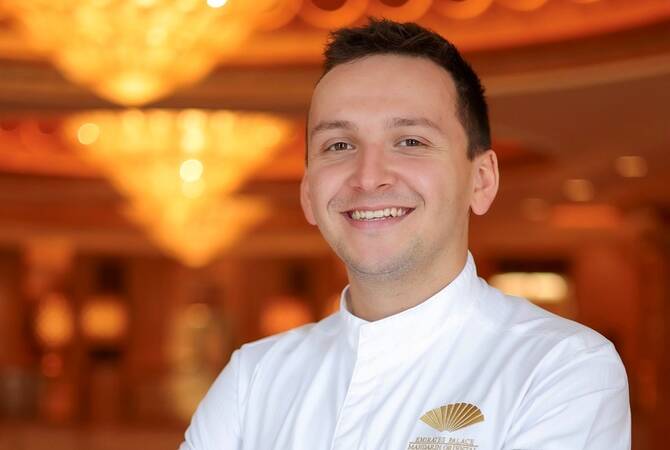

DUBAI: At just 26 years old, Alexandre Thabard is responsible for the pastry program at one of the most high-profile kitchens in the UAE.
As executive pastry chef at Emirates Palace Mandarin Oriental in Abu Dhabi, Thabard manages everything from banquets and afternoon tea to the hotel’s cake shop, and has created custom desserts for members of the Abu Dhabi royal family.

As executive pastry chef at Emirates Palace Mandarin Oriental in Abu Dhabi, Thabard manages everything from banquets to afternoon tea. (Supplied)
Originally from Paris, Thabard trained at Maison Lenôtre, where he also taught pastry courses and honed his technical skills across pastry, chocolate and ice cream. In 2018, he received the “Best Young Pastry Hope” award from Relais Desserts.
Thabard told Arab News his goal is “to reduce sugar as much as possible and celebrate the natural flavors of each ingredient” when it comes to pastries.
“To maintain consistency and lower glycemic impact, I often use Nascita date sugar and allulose as alternatives,” he said.
Here, Thabard talks about learning to slow down in the kitchen, why balance matters more than sweetness, and offers a honey lemon pollen recipe.
When you started out, what was the most common mistake you made?
In the early days, I often found myself rushing — eager to be efficient and to see the final result. That sometimes meant I overlooked crucial steps. I’ve learned that great desserts demand patience and precision. Quality takes time. Cooking should be a joyful, sensory experience, not a race.
What’s your top tip for amateur chefs?
Keep it simple and let the quality of your ingredients shine. Follow the recipe and, most importantly, taste along the way.
What one ingredient can instantly improve any dish?
Lime, or any good source of acidity. A touch of lime zest can instantly lift a dessert, bringing balance, freshness and vibrancy. It can transform something pleasant into something memorable.
When you go out to eat, do you find yourself critiquing the food?
I try to enjoy the experience as any guest would, but, naturally, I tend to view things through a professional lens.
What’s the most common issue that you find in other restaurants?
Often, I see desserts that are visually stunning but not well-balanced in flavor. They’re either too sweet, lacking contrast, or missing freshness. For me, the priority should be flavor and emotional connection, not just presentation.
What’s your favorite dish to order?
I have a deep appreciation for plated desserts, especially those paired with sorbets or ice cream. The interplay of temperatures and textures — warm and cold, smooth and crisp — creates a dynamic and refined end to a meal.
What’s your go-to pastry when you want to make something quick at home?
A quick pavlova. I usually have baked meringues on hand, made from leftover egg whites. So, I top them with vanilla cream, fresh seasonal fruits, and a touch of lime zest. It’s a simple yet elegant dessert that delivers texture, flavor and freshness in under 20 minutes.
What customer request most annoys you?
When a guest asks to change a dessert entirely before tasting it, or dismisses it based on appearance. While we aim to accommodate, I believe in trusting the chef’s vision. Occasionally, I receive feedback that my desserts aren’t sweet enough, which I actually take as a compliment — it means I’ve succeeded in creating something balanced.
What’s your favorite pastry to make?
I particularly enjoy working with chocolate-based desserts. There’s a refined technicality and sensory depth to chocolate that allows for endless creativity — whether you’re exploring bitterness, sweetness, or contrasting temperatures and textures. I’ve had the opportunity to collaborate with (chocolate brand) Valrhona on a bespoke couverture, crafted specifically to reflect the luxury and distinct identity of Emirates Palace. The result is a unique chocolate with complex notes that elevates our plated desserts. I also work extensively with camel milk chocolate, which has become really popular in the region. Its naturally tangy flavor, combined with the use of date sugar as a sweetener, creates a beautifully balanced profile is perfect for guests seeking lighter, more mindful indulgence.
What’s the most difficult dessert for you to get right?
The soufflé. It’s technically demanding, time-sensitive and allows no margin for error. When executed well, it’s a true testament to skill and discipline.
As an executive chef, what are you like?
I’d say I’m demanding but nurturing. I believe in building strong, collaborative teams and mentoring young talent. A good dessert is often the result of a unified, motivated kitchen. My style is modern and refined, with a strong focus on health-conscious and sustainable practices — no additives, no artificial colors, and a respectful use of sugar. I aim to create pastries that are elegant, balanced, and meaningful — desserts that not only please the palate but tell a story.
Chef Alexandre’s honey lemon pollen recipe
Honey sponge
Ingredients:
Butter: 150 g
Egg yolks: 220 g
Whole eggs: 90 g
Honey: 270 g
Sugar: 170 g
Almond powder: 30 g
Sour cream: 170 g
Cream: 30 g
Flour: 350 g
Salt: 2 g
Baking powder: 10 g
Method:
Whip the egg yolks, whole eggs, sugar, and honey until light and airy.
Add the sour cream and cream.
Incorporate the melted butter (at 45°C).
Fold in the dry ingredients.
Pour into a frame or mould and bake at 170°C for 18 minutes. Cool and cut to fit your insert mould.
Honey mousse
Ingredients:
Milk: 72 g
Honey: 14 g
Egg yolk: 10 g
Gelatin: 2 g
Water: 9 g
Whipped cream: 143 g
Method:
Soak the gelatin in cold water.
Heat the milk.
Mix the honey and egg yolk, then combine with the milk and cook to 83°C.
Remove from heat and add the gelatin.
Cool to 25°C, then fold in the whipped cream.
Use immediately for assembly.
Lemon confit:
Lemon juice: 308 g
Sugar: 115 g
Lemon zest: as needed
Additional lemon juice: 77 g
Method:
Blanch the lemon zest three times to remove bitterness.
Cook the zest with sugar and lemon juice until translucent and candied.
Blend into a smooth confit.
Pollen shortbread:
Icing sugar: 40 g
Butter: 35 g
Egg: 20 g
Almond powder: 12 g
Flour: 92 g
Salt: 1 g
Pollen: 15 g
Method:
Mix all ingredients until combined.
Roll out to 2 mm thickness.
Bake at 160°C for 12 minutes. Cool completely.
Assembly:
Spread a thin layer of lemon confit on the honey sponge.
Pipe or pour the honey mousse into a mould.
Insert the sponge with confit into the mousse.
Freeze until solid, then unmould.
Place the entremets on the pollen shortbread.
Decorate with bee pollen, chocolate garnishes, and edible flower petals.


