Pakistan says citizens can register for Hajj 2026 through online portal, 15 designated banks

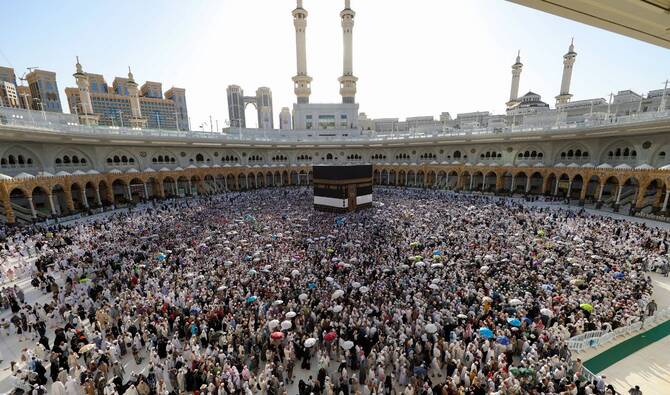
Muslims pray around the Kaaba, Islam's holiest shrine, at the Grand Mosque complex in in the holy city of Mecca on the first day of Eid Al-Adha, the feast of the sacrifice, early on June 6, 2025. (AFP/ file)
Short Url
Updated 02 July 2025
Follow

Pakistan says citizens can register for Hajj 2026 through online portal, 15 designated banks

  • Religion ministry advises overseas Pakistanis holding Pakistani passport to complete registration through online portal at the earliest
  • Pilgrims can register for Hajj next year till July 9, says ministry, after which they can choose to opt for government or private scheme

ISLAMABAD: The registration process for Hajj 2026 is underway, Pakistan’s religion ministry said on Wednesday, informing citizens that they can do so via its online portal and 15 designated banks across the country. 

Pakistan’s Ministry of Religious Affairs (MoRA) said last week it has begun the registration process for next year’s Hajj pilgrimage. After the registration, which will continue till July 9, pilgrims will be able to opt for government or private Hajj scheme. No fee will have to be paid for Hajj registration.

“Overseas Pakistanis holding a valid Pakistani passport are also advised to complete their registration through the online portal as soon as possible,” MoRA said in a statement. 

The ministry further said it was mandatory for anyone who intended to travel from Pakistan for the pilgrimage to get themselves registered.

“The costs of the Hajj package and other terms and conditions will be announced separately in accordance with the Hajj Policy 2026,” the statement said. 

Pakistan received a quota of 179,210 pilgrims from Saudi Arabia for Hajj 2025, which was evenly divided between government and private Hajj operators.

While the government filled its full allocation of over 88,000 pilgrims, a major portion of the private quota remained unutilized due to delays by companies in meeting payment and registration deadlines.

Last month, Prime Minister Shehbaz Sharif directed the religious affairs ministry to begin preparations for the 2026 Hajj immediately, calling for urgent reforms to the country’s private Hajj scheme.



EU, Pakistan sign €60 million loan agreement for clean drinking water in Karachi

Updated 17 December 2025
Follow

EU, Pakistan sign €60 million loan agreement for clean drinking water in Karachi

  • Project will finance rehabilitation, construction of water treatment facilities in Karachi city, says European Investment Bank
  • As per a report in 2023, 90 percent of water samples collected from various places in city was deemed unfit for drinking

ISLAMABAD: The European Investment Bank (EIB) and Pakistan’s government on Wednesday signed a €60 million loan agreement, the first between the two sides in a decade, to support the delivery of clean drinking water in Karachi, the EU said in a statement. 

The Karachi Water Infrastructure Framework, approved in August this year by the EIB, will finance the rehabilitation and construction of water treatment facilities in Pakistan’s most populous city of Karachi to increase safe water supply and improve water security. 

The agreement was signed between the two sides at the sidelines of the 15th Pak-EU Joint Commission in Brussels, state broadcaster Radio Pakistan reported. 

“Today, the @EIB signed its first loan agreement with Pakistan in a decade: a €60 million loan supporting the delivery of clean drinking water for #Karachi,” the EU said on social media platform X. 

Radio Pakistan said the agreement reflects Pakistan’s commitment to modernize essential urban services and promote climate-resilient infrastructure.

“The declaration demonstrates the continued momentum in Pakistan-EU cooperation and highlights shared priorities in sustainable development, public service delivery, and climate and environmental resilience,” it said. 

Karachi has a chronic clean drinking water problem. As per a Karachi Water and Sewerage Corporation (KWSC) study conducted in 2023, 90 percent of water from samples collected from various places in the city was deemed unsafe for drinking purposes, contaminated with E. coli, coliform bacteria, and other harmful pathogens. 

The problem has forced most residents of the city to get their water through drilled motor-operated wells (known as ‘bores’), even as groundwater in the coastal city tends to be salty and unfit for human consumption.

Other options for residents include either buying unfiltered water from private water tanker operators, who fill up at a network of legal and illegal water hydrants across the city, or buying it from reverse osmosis plants that they visit to fill up bottles or have delivered to their homes.

The EU provides Pakistan about €100 million annually in grants for development and cooperation. This includes efforts to achieve green inclusive growth, increase education and employment skills, promote good governance, human rights, rule of law and ensure sustainable management of natural resources.