

Pakistan arrests alleged land route agent linked to deadly Morocco boat tragedy

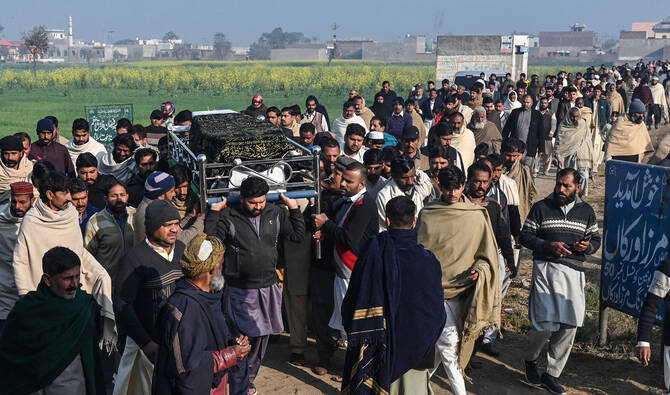
Family members and residents carry the coffin of Arslan Khan, a victim of migrant boat capsizing off North Africa, during his funeral ceremony in Mirza Virkan village, in eastern Punjab province, on February 6, 2025. (AFP/File)
Short Url
Updated 01 July 2025
Follow

Pakistan arrests alleged land route agent linked to deadly Morocco boat tragedy

  • Migrant boat, which set off from Mauritania for Spain in January with 86 on board, mostly Pakistanis, drowned near coast of Morocco
  • Land route agent Ghulam Mustafa had been sending people to Europe since 2023 via maritime routes through Morocco, says FIA

ISLAMABAD: The Federal Investigation Agency (FIA) on Tuesday announced it had arrested an agent involved in the Morocco boat tragedy, in which dozens of Pakistanis attempting to travel illegally to Europe had drowned near the African country’s coast earlier this year.

The boat had set off from Mauritania in January with 86 migrants on board, among them 66 Pakistanis, for the Canary Islands administered by Spain, international rights group Walking Borders had said. Moroccan authorities said on January 16 that 36 people were rescued from the vessel, while Pakistan confirmed survivors of the tragedy included 22 of its nationals.

Pakistani authorities have launched a crackdown against agents involved in illegally sending impoverished migrants through dangerous sea routes by offering them a chance at a better life in Europe. The FIA said its Faisalabad chapter arrested Ghulam Mustafa, a land route agent who was wanted for his involvement in the Morocco boat tragedy.

“Since 2023, the suspect had been working as a land route agent to send people to Europe via the maritime route through Morocco,” the FIA said in a press release.

It said Mustafa was part of the same network of human smugglers Abdul Ghaffar and Muhammad Sarfaraz, who were arrested by the FIA in February, for smuggling the migrants on the same boat that met an accident near Morocco.

The FIA said Mustafa, Ghaffar and Sarfraz were in contact with notorious African human smuggler Abubakar.

“The suspects were involved in extorting millions of rupees from Pakistani citizens under the pretext of sending them to Spain,” the statement said. “They were found to be facilitating the illegal transport of citizens to Spain via sea routes.”

A record 10,457 migrants, or 30 people a day, died trying to reach Spain in 2024. Most of them died while attempting to cross the Atlantic route from West African countries such as Mauritania and Senegal to the Canary Islands, according to Walking Borders.

In 2023, hundreds of migrants, including 262 Pakistanis, drowned when an overcrowded vessel sank in international waters off the southwestern Greek town of Pylos, marking one of the deadliest boat disasters ever recorded in the Mediterranean Sea.

The Pakistani government has ramped up efforts in recent months to combat human smugglers facilitating dangerous journeys for illegal immigrants to Europe, resulting in several arrests.

Prime Minister Shehbaz Sharif has also urged increased collaboration with international agencies like Interpol to ensure swift action against human trafficking networks.


Pakistan raises fuel prices by Rs55 per liter as Middle East conflict drives oil surge

Updated 06 March 2026
Follow

Pakistan raises fuel prices by Rs55 per liter as Middle East conflict drives oil surge

  • Government says adequate fuel stocks in place despite global energy shock
  • Oil prices jump from about $78 to over $106 per barrel amid regional conflict

ISLAMABAD: Pakistan on Friday increased petrol and diesel prices by Rs55 ($0.20) per liter each as escalating conflict in the Middle East sent global oil prices sharply higher and disrupted energy supply routes, officials said.

Global oil markets have been rattled since coordinated strikes by the United States and Israel against Iran began last week, triggering retaliatory attacks across the region, raising fears of disruption to key energy shipping routes and pushing petroleum prices sharply upward.

The price adjustment in Pakistan was announced after a joint press conference by Finance Minister Muhammad Aurangzeb, Deputy Prime Minister and Foreign Minister Ishaq Dar and Petroleum Minister Ali Pervaiz Malik, who said the government was monitoring international energy markets and domestic supply conditions amid the crisis.

“So, the decision we have made by changing the levy a little bit is that we are going ahead with increasing the price of both fuels, petrol and diesel, by Rs55 ($0.20),” Malik told reporters. 

“And as soon as this matter settles, we will revise the prices downward with the same speed and take steps on how to increase people’s income and purchasing power.”

He said Pakistan entered the crisis with “comfortable energy reserves” due to earlier planning but rising global prices had forced the government to adjust domestic fuel rates to maintain supply continuity.

He said international petrol prices had climbed from roughly $78 per barrel on March 1 to around $106.8 per barrel, while diesel prices had risen to about $150 per barrel.

Malik added that the government had taken steps to minimize the burden on consumers, noting diesel plays a critical role in agriculture, transportation and public mobility.

Malik also warned that authorities would take strict action against anyone attempting to hoard fuel or manipulate supply for profiteering.

The minister said Pakistan was working with international partners to secure additional energy supplies, including arrangements with Saudi Aramco and the use of Pakistan National Shipping Corporation vessels to transport crude oil imports.

Finance Minister Aurangzeb said a high-level government committee formed by Prime Minister Shehbaz Sharif had been meeting daily to review developments in global petroleum markets and their potential impact on Pakistan’s economy.

“Pakistan currently maintains adequate energy stocks and macroeconomic stability,” Aurangzeb said, adding that the government’s response was based on preparedness rather than panic.

He said the committee, which includes senior ministers, the governor of the State Bank of Pakistan and other officials, was assessing short-, medium- and long-term implications of the crisis for inflation, foreign exchange reserves and broader economic indicators.

Deputy PM Dar said the regional conflict had significantly disrupted global energy markets, with international petroleum prices rising by as much as 50–70 percent in recent days.

The deputy prime minister added that Pakistan was also engaged in diplomatic efforts aimed at de-escalating tensions and restoring stability in the region.

Petroleum prices will now be reviewed more frequently, potentially on a weekly basis, and any reduction in global oil prices would be passed on to consumers.

Pakistan, which relies heavily on imported fuel to meet its energy needs, is particularly vulnerable to global oil price shocks that can quickly feed into inflation and pressure the country’s external accounts.