

Review: ‘Holes’ is a prime example of quiet, impactful storytelling

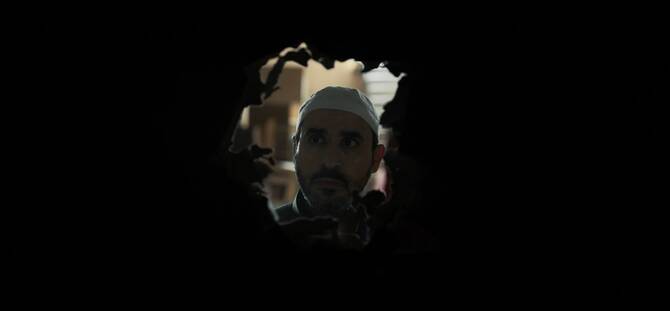
The quietly arresting drama follows Rakan, a man in his mid-40s, as he returns to his hometown to be with his wife, Reem. (Supplied)
Short Url
Updated 30 June 2025
Follow

Review: ‘Holes’ is a prime example of quiet, impactful storytelling

DHAHRAN: Saudi film “Holes” continues to make its mark with screenings at film festivals around the world. The quietly arresting drama follows Rakan, a man in his mid-40s, as he returns to his hometown to be with his wife, Reem. He struggles to re-enter a society that no longer trusts him — and one that he also does not fit into.

The film starts with a literal clock — which we don’t see — persistently ticking in the otherwise vacant interior of a residence, the loud but constant sound in the midst of silence sets the tone.

With a fiery but contained temper, eyes welling with sadness, we find out that Rakan is prone to fits of rage. He is portrayed as only having a soft spot for his aging mother and his wife, all while dodging men from his past who haunt him.

The film doesn’t linger on the specifics — there are many gaping holes in the story. Instead, it centers on how the weight of reputation, judgment and suffocating silence shapes a person trying to begin again.

It stars Mariam Abdulrahman and Meshal Almutairi and was produced by Ayman Alnaqeeb and Abdulrahman Altikhais.

Abdulmohsen Aldhabaan, the director of “Holes,” is an independent Saudi writer and filmmaker. He co-founded Talashi Films in 2008 and has directed several shorts and a TV series.

Aldhabaan‘s debut feature film, “Last Visit” (2019), gained international recognition, becoming the first Arab film selected for the East of the West Competition at the Karlovy Vary International Film Festival. It also earned the Jury Award at the Marrakech International Film Festival.

With “Holes,” Aldhabaan continues his signature style of quiet, impactful storytelling marked by restraint and emotional depth.

In “Holes,” Aldhabaan crafts a slow, thoughtful narrative. Rather than relying on heavy dialogue or exposition, the film builds its emotional landscape through atmosphere — solitary walks at night, avoiding tiny puddles in the alleyways, prolonged pauses and distant glances — to explore isolation and inner conflict. The pacing may feel slow to some, but it seems deliberate — offering space for reflection and tension to build.

A persistent image in the film is a literal hole in the wall of Rakan and Reem’s new home. It is never ignored but also never fixed, and that choice is telling. At one point, it gushes water as Reem tries to stuff pretty-colored cloths to stop it — to no avail. It floods their bedroom and the couple tries to contain it together.

The hole becomes a powerful metaphor representing wounds that haven’t healed, things left unresolved, and the parts of a life that remain open to scrutiny or misunderstanding. It defines the space around it — the hole is a character all its own.



K-Pop star Jennie creates history while wearing Georges Hobeika

Updated 22 December 2025
Follow

K-Pop star Jennie creates history while wearing Georges Hobeika

  • K-pop superstar wins top honors at Melon Music Awards
  • Hobeika celebrated 30-year anniversary in October 2025

DUBAI: Jennie, the K-pop superstar best known as a member of global sensation Blackpink, delivered a landmark moment at the recent Melon Music Awards in Seoul — both musically and sartorially.

The singer arrived in Guro-gu wearing a dramatic couture creation by Lebanese designer Georges Hobeika, instantly commanding attention on the red carpet. The event, which celebrates South Korea’s top musical talent, drew major stars including G-Dragon, Zico and EXO.

Jennie emerged as the night’s biggest winner, taking home the Record of the Year (Daesang) award — a historic first for a solo artist at the awards. The win caps off a major year for the performer, following the March release of her debut solo album, “Ruby.”

For the occasion, the “Mantra” singer chose a ballgown from Hobeika’s Fall 2025 Couture collection.

The look featured a structured white corset bodice with a lace-up back, embellished with crystal accents along the straps, flowing into an oversized black tulle skirt worn low on the waist. The voluminous silhouette gave the gown a sculptural, almost theatrical presence.

Jennie kept her styling restrained, allowing the couture piece to take centerstage. She accessorized with a single statement ring set with an emerald-green stone, while her hair was pulled into a loose low ponytail, secured with a silver flower pendant.

Beyond her chart-topping success, Jennie has steadily built her fashion credentials. A longtime Chanel ambassador, she has also fronted campaigns for brands including Jean Paul Gaultier and Beats.

Meanwhile, in October this year, Hobeika celebrated 30 years since launching his namesake brand. The couturier and his son, Jad Hobeika, the brand’s creative director, took to Instagram to reflect on their journey.

To mark the occasion, the house released a short documentary in which Jad opens up about working alongside his father and continuing the brand’s legacy.

“Working with Georges, there’s definitely, you know, he created fashion like no one else in the Middle East,” Jad said in the video.

Founded in Beirut in 1995, Maison Georges Hobeika is one of Lebanon’s established fashion houses and a regular participant in the Paris Haute Couture calendar.

The brand is known for its couture and ready-to-wear collections featuring detailed craftsmanship and refined designs.