

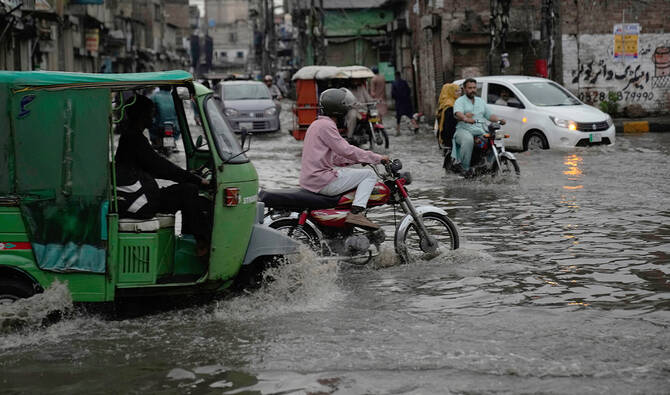
At least 45 killed, 68 injured since June 26 as monsoon rains batter Pakistan 

Motorists drive through a flooded road caused by heavy monsoon rains, in Lahore, Pakistan, on June 29, 2025. (AP)
Short Url
Updated 30 June 2025
Follow

At least 45 killed, 68 injured since June 26 as monsoon rains batter Pakistan 

  • Khyber Pakhtunkhwa reports highest casualties, 21, followed by Punjab with 13, Sindh with seven and Balochistan with four deaths
  • Pakistan has forecast widespread rain with wind and thundershowers across various regions of the country from June 29 to July 5

ISLAMABAD: At least 45 people have been killed and 68 injured across Pakistan in rain-related incidents since June 26, the National Disaster Management Authority (NDMA) said in its latest report as heavy monsoon rains continued to batter the country. 

Heavy rains have lashed Pakistan’s Khyber Pakhtunkhwa (KP), Punjab and Sindh provinces since June 26, raising water levels in rivers to alarming levels and triggering floods in various cities across the country. 

The latest casualties took place as the NDMA issued multiple impact-based weather alerts on Sunday, forecasting widespread rain with wind and thundershowers, accompanied by isolated heavy falls across various regions of Pakistan from June 29 to July 5. 

“NDMA urges all provincial and district administrations to remain on high alert, activate contingency plans, and ensure timely dissemination of warnings in local languages,” the authority said on Sunday. “Citizens, especially those in high-risk areas, are advised to stay updated through official adviseries, avoid unnecessary travel near glacial streams, riverbanks, and flooded roads, and keep emergency kits ready.”

As per the latest NDMA situation report, 45 people have been killed and 68 injured from June 26-29 in Pakistan’s KP, Punjab, Sindh and Balochistan provinces. The casualties include 23 children, 12 men and 10 women. 

KP reported the highest number of casualties from rain-related incidents, 21, followed by Punjab with 13, Sindh with seven and Balochistan with four deaths. Punjab reported the highest number of injuries at 39 followed by Sindh with 16 while KP reported 11 and Balochistan two. 

The report said flash floods claimed the highest number of casualties, followed by electrocution, drowning, lightning and other factors. Flash flooding in KP’s Swat River last week claimed the lives of 12 tourists while Rescue 1122 emergency service said it was searching for one missing boy on Sunday. 


Pakistan, home to over 240 million people, is considered one of the world’s most vulnerable countries to the effects of climate change and faces extreme weather events with increasing frequency.

These extreme and irregular weather patterns include droughts, heatwaves and torrential rains which experts have attributed to climate change. Unusually heavy rains and the melting of glaciers in June 2022 triggered cataclysmic floods that killed over 1,700 people across Pakistan, washed away swathes of crops and damaged critical infrastructure. Pakistan estimated the damages to be worth over $33 billion. 


Pakistan saw 73% increase in combat-related deaths in 2025— think tank

Updated 28 December 2025
Follow

Pakistan saw 73% increase in combat-related deaths in 2025— think tank

  • Pakistan reported 3,387 deaths thus year, among them 2,115 militants and 664 security forces personnel, says think tank
  • Civilian deaths increased by 24% to 580 in 2025, compared to 468 in 2024, as Pakistan saw 1,063 militant attacks in 2025

ISLAMABAD: Combat-related deaths in Pakistan this year increased by 73%, with both security forces and militants suffering casualties in large numbers, a report published by an Islamabad-based think tank said on Sunday.

As per statistics released by the Pakistan Institute for Conflict and Security Studies (PICSS), combat-related deaths in 2025 rose 73% to 3,387, compared with 1,950 in 2024. These deaths included 2,115 militants, 664 security forces personnel, 580 civilians and 28 members of pro-government peace committees (combatants), the think tank said in a press release. 

“Militants accounted for about 62% of total combat-related deaths, and their 2,115 fatalities represented the highest annual militant death toll since 2015, when 2,322 militants were killed,” PICSS said. 

Compared to last year, militant deaths recorded a steep increase by 122% as the PICSS reported that 951 militants had been killed in 2024.

The think tank, however, said this year was also particularly bloody for Pakistani security forces. PICSS recorded 664 security personnel deaths in 2025, a 26% rise from 528 in 2024, and the highest annual figure since 2011, when 677 security forces personnel lost their lives. 

Civilian deaths also increased by 24% to 580 in 2025, compared with 468 in 2024, marking the highest annual civilian toll since 2015, when 642 civilians were killed. 

As per the PICSS report, at least 1,063 militant attacks took place in 2025, a 17% increase compared with 908 in 2024 and the highest annual total since 2014, when 1,609 militant attacks were recorded. 

The report also noted a 53 percent increase in suicide attacks this year, with 26 such incidents reported in 2025 compared with 17 in 2024. 

“PICSS noted an expanding trend in the use of small drones, including quadcopters, with 33 such incidents recorded during 2025, alongside increased use of unmanned aerial vehicles by security forces,” the report said. 

The report noted an 83% rise in arrests of suspected militants, with 497 arrested in 2025 compared to 272 in 2024. 

This 2025 figure is the highest annual total of suspected militants arrested since 2017, when 1,781 militants were either arrested or laid down their weapons.

“PICSS noted that most violence remained concentrated in Pashtun-majority districts of Khyber Pakhtunkhwa, including the tribal districts (erstwhile FATA), and in Balochistan,” it said. 

Pakistan has been grappling with a surge in militant attacks in its western provinces of Khyber Pakhtunkhwa and Balochistan, both bordering Afghanistan, this year. 

Islamabad blames Afghanistan for providing sanctuaries to militants it alleges use Afghan soil to carry out attacks against Pakistan. Kabul denies the charges.