ABUJA: The first strikes in Dambe are thrown before the boxers even leave their house.
Fighters don charms and amulets, dye their fist or even score their arm with a razor, inserting traditional medicine before it scars over — all guaranteed to protect them in the ring or deliver a knock-out punch.
Combined with prayers from “mallams,” or spiritual guides, they are unstoppable — not just in Nigeria, but increasingly around the world.
The Dambe World Series kicked off in Abuja, Nigeria’s capital, on Saturday in the latest evolution of a sport that traces its roots back centuries among west Africa’s Hausa speakers.
“Instead of trying to Westernize it, or instead of trying to make it something else, for us the goal is to professionalize it,” said Maxwell Kalu, founder of the West African Fighting Championship, the group organizing the tournament.
At the same time, a key goal is also “opening the door in terms of inviting people to compete in Nigeria.”
Held on the ground of the national stadium and broadcast by DAZN, a British sports streaming service, the tournament is a far cry from the social tradition said to have been organized by 10th-century Hausa butchers.
“This one is big, I’m very happy,” said Abdullahi “Coronavirus” Ali, a 20-year-old who has been fighting since he was a child. “The audience is growing every day.”
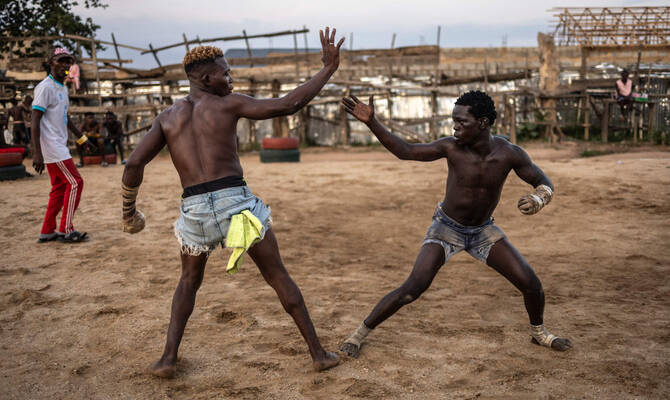
As Coronavirus — nicknamed for his ferocious punches — spoke to AFP, two amateur fighters worked the ring behind him, in a pre-tournament exhibition match in Dei Dei, a working-class Abuja exurb.
Chickens pecked under the rickety wooden stands while cigarette smoke wafted above the crowd.
In Dambe, in lieu of a glove, the fighters each have one fist tightly bound in rope — their striking arm. The other hand reaches out, feeling the space between the opponents and looking for something to grab or parry before the fighting arm whips forward as if from a loaded spring.
Amid the blows, one fighter lost his balance and fell — a “kill.” The round was over.
Dambe might have once seemed destined to be confined to the margins in places like Dei Dei as Abuja’s elite paved over anything standing in the way of modern skyscrapers and highways.
But slowly, the government has taken more interest in preserving and promoting the sport, as have private groups like the WAFC.
With the advent of YouTube and Instagram, Dambe now attracts fans across the world, with one promoter telling BBC in 2017 that 60 percent of his viewers were outside Nigeria.
The sport has also grown at home.
In 2018, a Dambe match in the southern city of Lagos drew spectators curious about their northern countrymen’s pastime — and excited to see it in a proper stadium.
Earlier this month, athletes from across the continent descended on the megacity for the African Knockout Championship, a Western-style mixed martial arts tournament.
But Kalu envisions the opposite: foreigners making their way to witness a distinctively Nigerian way of fighting.
Professionalization also brings the opportunity to bring in safety protocols and stable salaries to the otherwise unregulated sport.
“If I get married, I won’t allow my children to do it,” said Usman Abubakar, 20, his fist dyed a dark henna color and arm replete with charmed scars, recalling an injury to the chest that saw him sit out for two years.
Saturday’s fighters were competing to represent Nigeria in what is envisioned as a multi-stage, international series.
Boxers took to a sand-filled ring under stadium lights, with matches interspersed with musical acts and commercial breaks.
“Coronavirus” and his opponent danced around each other, sweat glistening, looking for an opening. He landed a blow, sending a tensed crowd into cheers as spectators overcame their urge to wince in shared pain.
“It’s somehow scary, but I do enjoy it,” said Joy Beatrice, a 30-year-old forestry officer in the stands.
Last year, supported by the WAFC, British national Luke Leyland traveled from Liverpool to compete in a Dambe match — reportedly the first white fighter to ever do so.
He was “destroyed,” according to one local media report, though he wrote positively of the experience.
Nigerian fighters remain cool on the idea of sharing the spoils of victory.
Asked what would happen if non-Nigerians started competing, “Coronavirus,” Abubakar and a third fighter, Anas Hamisu, were all excited at the prospect of more people embracing their sport.
But they also all shared the same prediction: the Nigerians would win.

Nigerian Dambe boxing goes global — amulets and charms included
https://arab.news/nrs8p
Nigerian Dambe boxing goes global — amulets and charms included
- The Dambe World Series kicked off in Abuja, Nigeria’s capital, on Saturday in the latest evolution of a sport that traces its roots back centuries among west Africa’s Hausa speakers
John Cena, WWE superstar widely admired in Saudi Arabia, retires from in-ring competition
- Cena was one of a few WWE superstars such as Hulk Hogan who were admired in Saudi Arabia and the region
- His career spanned more than two decades on top of the sports entertainment landscape
RIYADH: John Cena officially retired from in-ring competition on Dec. 13 after competing his final match at WWE Saturday Night’s Main Event in Washington, DC.
Cena, a 17-time world champion, tapped out to a sleeper hold after a brutal 24-minute match with rising Austrian superstar Gunther, a result which stunned and disappointed some fans but served to elevate Gunther’s status as a dominant force in the sport. Cena would not have left the world of sports entertainment without the long-standing tradition of paying it forward to elevate talent on the way out of the business.
The legendary superstar first announced his plan to retire from being an active member of the WWE roster in July of 2024 during the Money in the Bank Premium Live Event. Cena said that 2025 would be his last as an active in-ring performer and he embarked on a year-long farewell tour.
Cena was one of a select few of WWE Superstars such as Hulk Hogan, The Undertaker and Stone Cold Steve Austin who were at the forefront of fans’ admiration in Saudi Arabia and considered as unofficial ambassadors to American sports, entertainment and pop culture.
This admiration only amplified after March 2018 through the partnership deal between the General Entertainment Authority and the WWE for an exclusive 10-year contract to hold multiple events in the Kingdom.
This partnership was a catalyst for Cena to hold a special place in the hearts of fans in the Kingdom. He has competed in three significant matches in Saudi Arabia. His first match in the Kingdom was during the Greatest Royal Rumble in April of 2018 where he defeated Triple H in the opening match of the event, which was also the first major WWE show in Saudi Arabia under the partnership.
His second match was in 2023 during November’s Crown Jewel where Cena lost to Solo Sikoa after a brutal match in which he endured nine Samoan Spikes from the rising Samoan star. In his final appearance in Saudi Arabia, John Cena defeated his long-time rival CM Punk to retain the Undisputed WWE Championship in the main event of the Night of Champions held last June in Riyadh.
Since the partnership began, major events such as Crown Jewel, Elimination Chamber, and King & Queen of the Ring have been held in the Kingdom. The partnership also includes the Royal Rumble in January 2026 and WrestleMania 43 in 2027 — the first times these events have been held outside of North America.
Cena began an illustrious career that spanned 26 years and started in November 1999 before signing a developmental contract with the WWE in 2001. His first televised WWE match was against WWE Hall of Fame inductee and Olympic gold medalist and former world champion, Kurt Angle, in the June 27, 2002 edition of WWE’s blue-branded show SmackDown.
Cena’s introduction to the WWE fanbase started when he answered Angle’s open challenge and introduced himself as possessing “ruthless aggression” before slapping Angle and starting the match.
At WrestleMania 20 in 2004, Cena defeated Big Show in the opening match to win his first championship in WWE, the US Championship at Madison Square Garden. This marked Cena’s first WrestleMania appearance and the beginning of his significant championship collection, and was a pivotal moment in his career.
A year later in 2005, Cena defeated John Bradshaw Layfield at WrestleMania 21 for his first WWE championship, marking his official transition to top star.
Cena is a ten-time Slammy Award winner, and has headlined WrestleMania a record six times. Cena holds a record of 17-WWE World Champion wins (14 WWE Championship, three World Heavyweight Championship) under his belt, only surpassing Ric Flair's 16 reigns, a record Flair held for years.
Cena is a two-time Royal Rumble winner (2008, 2013) and a one-time Money in the Bank winner (2012). He is recognized as both a Triple Crown and Grand Slam champion, holding the US Championship five times, Intercontinental Championship once, WWE Tag Team Championship twice, with The Miz and David Otunga, and World Tag Team Championship twice with Dave Batista and The Heartbreak Kid Shawn Michaels.
Cena became the face of the WWE brand over the past two decades. He also enjoyed the accolade of being the longest-reigning face of the WWE brand before he transitioned to a part-time schedule around 2017 to focus on his acting career. He has built a significant career in film and philanthropy.
He holds the record for the most wishes granted by any celebrity for the Make-A-Wish Foundation, with more than 650 wishes fulfilled. In 2005, he released the rap album “You Can’t See Me,” which debuted at No. 15 on the US Billboard 200 chart.
Cena has successfully transitioned to acting, with notable roles in films such as
“Trainwreck,” “Blockers,” “Bumblebee,” “F9,” and “The Suicide Squad” as the character Peacemaker, which was also spun off as a superhero series for HBO Max.