

Pakistan army chief hails cadets from Arab and allied nations at Naval Academy graduation

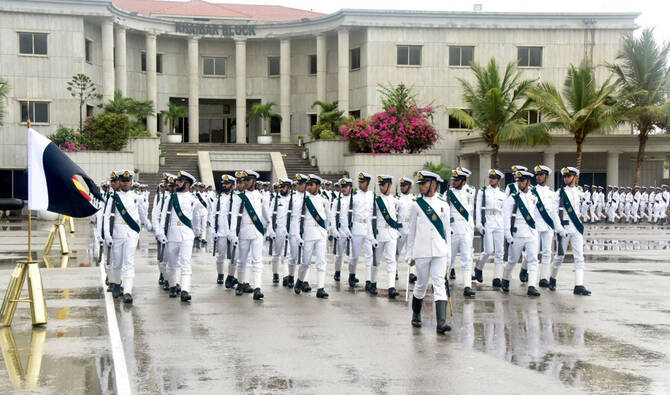
This handout photo, taken and released by Pakistan’s Inter-Services Public Relations (ISPR), shows graduating midshipmen during a passing out parade at the Naval Academy in Karachi on June 28, 2025. (Handout/ISPR)
Short Url
Updated 28 June 2025
Follow

Pakistan army chief hails cadets from Arab and allied nations at Naval Academy graduation

  • Among the 127 graduating midshipmen were 19 cadets from Bahrain, four from Iraq and two from Palestine
  • The army chief says Pakistan’s response to India standoff showed armed forces ready to defend the country

ISLAMABAD: Pakistan’s army chief, Field Marshal Asim Munir, on Saturday hailed the presence of cadets from Arab and allied countries at a Naval Academy graduation ceremony, saying it reflected the high standard of training the country offers to its military partners.

The commissioning parade, held in Karachi, marked the completion of the 123rd Midshipmen and 31st Short Service Commission courses.

Among the 127 graduating midshipmen were 19 cadets from Bahrain, four from Iraq and two from the State of Palestine, with additional participants from the Republic of Djibouti and the Republic of Türkiye.

“The Pakistan Naval Academy has consistently provided excellent professional training to cadets from allied nations,” the army chief said, according to a statement issued by the military’s media wing, Inter-Services Public Relations (ISPR).


This handout photo, taken and released by Pakistan’s Inter-Services Public Relations (ISPR), Pakistan Army Chief Field Marshal Asim Munir addressing a passing out parade at the Naval Academy in Karachi on June 28, 2025. (Handout/ISPR)

“The presence of cadets from Bahrain, Iraq, the State of Palestine, the Republic of Djibouti and the Republic of Türkiye in today’s commissioning parade is a reflection of the Academy’s high training standards,” he added.

Pakistan regularly trains cadets and officers from partner nations and sends its own officers abroad to institutions in countries such as the United States and the United Kingdom for advanced military education and joint training.

The ceremony was attended by senior officials from Pakistan and other countries, government representatives and families of the graduating cadets.
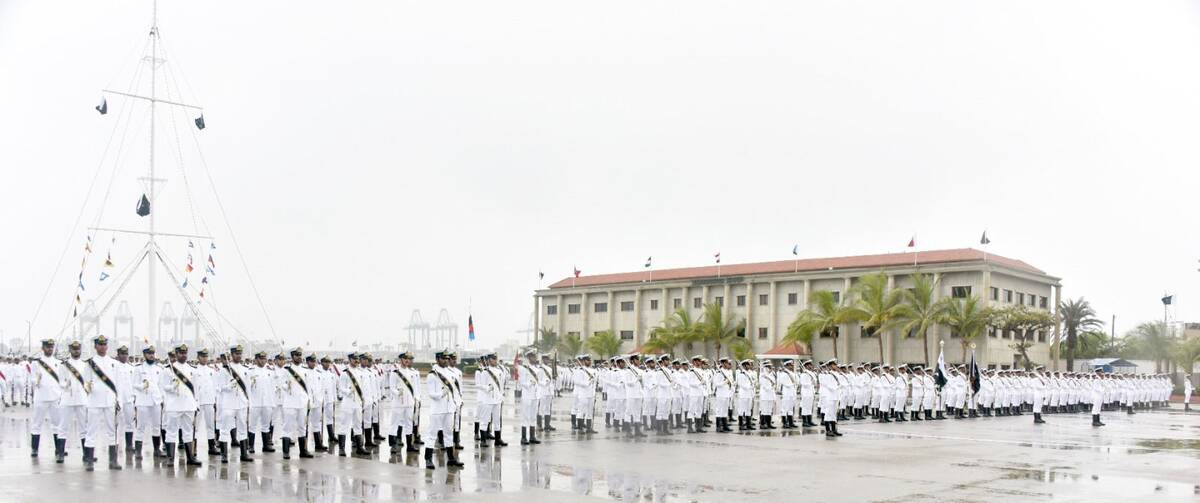


This handout photo, taken and released by Pakistan’s Inter-Services Public Relations (ISPR), shows graduating midshipmen during a passing out parade at the Naval Academy in Karachi on June 28, 2025. (Handout/ISPR)

In his remarks, the army chief also praised the Navy’s professionalism and its efforts as a regional maritime force committed to securing international sea lines of communication.

He also referenced the recent standoff with India, saying the country’s armed forces had “responded swiftly and decisively against a numerically superior enemy,” and were fully prepared to defend Pakistan’s sovereignty.


Pakistan offers Kyrgyzstan Arabian Sea access as two states sign 15 cooperation accords

Updated 5 sec ago
Follow

Pakistan offers Kyrgyzstan Arabian Sea access as two states sign 15 cooperation accords

  • Pakistan and Kyrgyzstan sign MOUs spanning trade, energy, agriculture, ports, education, security cooperation
  • Kyrgyz president is on first visit to Pakistan in 20 years as both sides push connectivity and CASA-1000 power links

ISLAMABAD: Pakistan on Thursday offered Kyrgyzstan the shortest and most economical route to the Arabian Sea as the two countries signed 15 agreements and memoranda of understanding aimed at boosting cooperation across trade, energy, agriculture, education, customs data-sharing and port logistics.

The accords were signed during a visit to Islamabad by President Sadyr Zhaparov, the first by a Kyrgyz head of state to Pakistan in two decades, and part of Islamabad’s renewed push to link South Asia with landlocked Central Asian economies through ports, power corridors and transport routes.

For Pakistan, Kyrgyzstan offers access to hydropower through CASA-1000, a $1.2 billion regional electricity transmission project designed to carry surplus summer electricity from Kyrgyzstan and Tajikistan through Afghanistan into Pakistan. For Bishkek, Pakistan provides overland access to warm-water ports on the Arabian Sea, creating a shorter commercial route to global markets.

“President Asif Ali Zardari has reiterated Pakistan’s readiness to offer Kyrgyzstan the shortest and most economical route to the Arabian Sea,” Radio Pakistan reported after Zhaparov met the Pakistani president. 

The two leaders also discussed expanding direct flights to deepen business, tourism and people-to-people ties.

Zardari welcomed Kyrgyzstan’s completion of its segment of the CASA-1000 project and “reaffirmed Pakistan’s commitment to completing its part of the project, which is now at an advanced stage,” the state broadcaster said. 

Zhaparov thanked Islamabad for supporting Bishkek’s candidacy for a non-permanent UN Security Council seat and invited Zardari to visit Kyrgyzstan at a time of his convenience. Both sides expressed satisfaction with progress under the Quadrilateral Traffic in Transit Agreement, designed to facilitate road movement between Pakistan, Kyrgyzstan, Kazakhstan and China.

Earlier, both governments exchanged 15 sectoral cooperation documents covering commerce, mining, geosciences, power, agriculture, youth programs, the exchange of convicted persons, customs electronic data systems and a sister-city linkage between Islamabad and Bishkek.

According to APP, the MOUs were signed by ministers representing foreign affairs, commerce, economy, energy, power, railways, interior, culture, health and tourism. Agreements also covered cooperation between Pakistan’s Foreign Service Academy and the Diplomatic Academy of Kyrgyzstan, as well as collaboration between universities, youth ministries and cultural institutions.

“Our present mutual trade, comprising of about $15–16 million will be enhanced to $200 million in the next two years,” Prime Minister Shehbaz Sharif said after the agreements were signed, calling them “a framework for structured, result-oriented engagement and closer institutional linkages.”

Sharif said Pakistan was ready to serve as a maritime outlet for the landlocked Central Asian republic, offering access to Karachi, Port Qasim and Gwadar to help Kyrgyz goods reach regional and global markets.