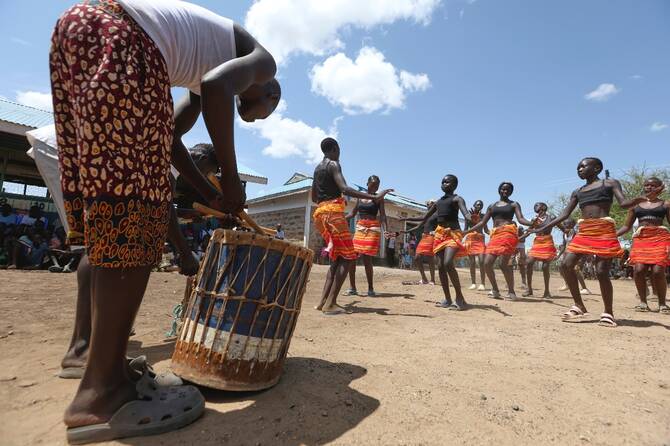
KALOBEYEI: Beads of sweat drip from the faces of young girls and boys as they dance to the rhythm of traditional drums and open calabashes, while their peers watch them in awe.
These are refugee children, some who were born in one of Africa’s largest camps — Kakuma, located in northern Kenya, where more than 300,000 refugees’ livelihoods have been affected by funding cuts that have halved monthly food rations.
The children use the Acholi traditional dance as a distraction from hunger and have perfected a survival skill to skip lunches as they stretch their monthly food rations that are currently at 30 percent of the UN nutritional recommendation per person.
The Acholi people, mostly from Uganda and South Sudan, are among refugees who live in Kakuma camp, which was established in 1992 as a safe haven for people fleeing conflict from dozens of east African countries.
For a moment, the melodious sound of one of the refugee mothers stops the playground buzz of activity as dozens of children sit down to enjoy the traditional dance performance.
The colorful swings doting the community center at Kakuma’s Kalobeyei Refugee Settlement were donated by a Swiss organization, Terre des hommes, which still manages the playground aptly named “Furaha” — Swahili for Happiness.
But the happiness of these children isn’t guaranteed now as funding cuts have affected operations here. Fewer resources and staff are available to engage the children and ensure their safety.
One of the dancers, Gladis Amwony, has lived in Kakuma for 8 years now. In recent years, she has started taking part in the Acholi traditional dances to keep her Ugandan roots alive.
The now 20-year-old doesn’t imagine ever going back to Uganda and has no recollection of life in her home village.
“I’m happiest when I dance, I feel connected to my ancestors,” the soft-spoken Amwony says after her dance session.
While Amwony and her friends are looking for a cultural connection, just about 5 kilometers (3 miles) from their village in neighboring Kalobeyei Village 3, some boys are in touch with modernity.
The five boys have been practicing a one-of-a-kind dance where they mimic robots, complete with face masks that hide their human faces.
They make their sharp synchronized moves that they have been perfecting for months.
The boys will be part of performances that will be showcased during this year’s World Refugee Day, as an example of the talent and resilience that exists among the refugee community.
This younger generation of dancers make precision moves in a small hall with play and learning items stored in a cabinet that is branded with an American flag, an indication that it was donated by the USgovernment.
Such donations are now scarce, with the United States having cut down on funding in March.
These cuts have affected operations here, with the future stardom hopes for these children dimming by the day.
The center, which previously featured daily programs such as taekwondo and ballet, may not be operational in a few months if the funding landscape remains as is.
“We are now reducing some of the activities because we are few. The staff are few and even per day we only have one staff remaining in the center and it is really hard for him/her to conduct 500 children,” said John Papa, a community officer for Terre des hommes in Kalobeyei Village 3.
These programs do more than entertain the children — they keep them away from issues such as child labor, abuse and crime which as a major concern for humanitarian organizations in Kakuma.
And as the children dance and play beneath the sweltering sun, the only hope is that these child friendly spaces remain operational for years.

Fusion between culture and modernity as children dance in Kenyan refugee camp
https://arab.news/nph3j
Fusion between culture and modernity as children dance in Kenyan refugee camp
- The Acholi people, mostly from Uganda and South Sudan, are among refugees who live in Kakuma camp, which was established in 1992 as a safe haven for people fleeing conflict from dozens of east African countries
Trump urges Iranian Kurds to attack Iran as war widens
- Azerbaijan preparing unspecified retaliatory measures on Thursday
- The seven-day war has now seen Iran target Israel, the Gulf states, Cyprus, Turkiye and Azerbaijan, and spread to the Indian Ocean off Sri Lanka
DUBAI/WASHINGTON: US President Donald Trump encouraged Iranian Kurdish forces in Iraq to launch attacks against Iran as the Middle East conflict widened, with Azerbaijan warning it would retaliate for being targeted by Iranian missiles.
Israel on Friday said it had started a “broad-scale” wave of attacks against infrastructure targets in Tehran, as Gulf cities came under renewed bombardment by Iran.
The seven-day war has now seen Iran target Israel, the Gulf states, Cyprus, Turkiye and Azerbaijan, and spread to the Indian Ocean off Sri Lanka where a US submarine sank an Iranian naval ship.
On the possibility of the Iranian Kurdish forces entering Iran, Trump told Reuters on Thursday: “I think it’s wonderful that they want to do that, I’d be all for it.”
Two Iranian drone attacks targeted an Iranian opposition camp in Iraqi Kurdistan on Thursday, security sources said.
Iranian Kurdish militias have consulted with the United States in recent days about whether, and how, to attack Iran’s security forces in the western part of the country, according to three sources with knowledge of the matter.
The Iranian Kurdish coalition of groups based on the Iran-Iraq border in the semi-autonomous region of Iraqi Kurdistan has been training to mount such an attack in hopes of weakening the country’s military, as the United States and Israel pound Iranian targets with bombs and missiles. Trump, speaking with Reuters in a telephone interview, also said the United States must have a role in deciding who will be the next leader of Iran after airstrikes killed Supreme Leader Ayatollah Ali Khamenei last week.
“We’re going to have to choose that person along with Iran. We’re going to have to choose that person,” he said.
US Defense Secretary Pete Hegseth said on Thursday that the US was not expanding its military objectives in Iran, despite what Trump said about choosing the country’s next leader.
“There’s no expansion in our objectives. We know exactly what we’re trying to achieve,” he said. The attack on Iran is a major political gamble for the Republican president, with opinion polls showing little support and Americans concerned about the rise in gasoline prices caused by disruption to energy supplies. Trump dismissed that concern. Shares on Wall Street fell on Thursday, weighed by surging oil prices, as the economic impact of the campaign intensified, with countries around the world cut off from a fifth of global supplies of oil and liquefied natural gas and air transport still facing chaos and global logistics increasingly snarled.
Azerbaijan prepares to retaliate
Azerbaijan was preparing unspecified retaliatory measures on Thursday after it said four Iranian drones crossed its border and injured four people in the Nakhchivan exclave.
“We will not tolerate this unprovoked act of terror and aggression against Azerbaijan,” President Ilham Aliyev told a meeting of his Security Council.
Iran, which has a significant Azeri minority, denied it targeted its neighbor.
Lebanon’s Iran-backed Hezbollah militia warned Israeli residents to evacuate towns within 5 km (3 miles) of the border between the countries in a message posted on its Telegram channel in Hebrew early on Friday.
“Your military’s aggression against Lebanese sovereignty and safe citizens, the destruction of civilian infrastructure and the expulsion campaign it is carrying out will not go unchallenged,” Hezbollah said.
Us munitions full
Hegseth and Admiral Brad Cooper, who leads US forces in the Middle East, said during a briefing about operations that the US has enough munitions to continue its bombardment indefinitely.
“Iran is hoping that we cannot sustain this, which is a really bad miscalculation,” Hegseth told reporters at Central Command headquarters in Florida. “Our munitions are full up and our will is ironclad.”
The Pentagon earlier this week said the military campaign, known as Operation Epic Fury, is focused on destroying Iran’s offensive missiles, missile production and navy, while not allowing Tehran to have a nuclear weapon.
Cooper said the US had now hit at least 30 Iranian ships, including a large drone carrier that he said was the size of a World War Two aircraft carrier.
He added that B-2 bombers had in the past few hours dropped dozens of 2,000 penetrator bombs targeting deeply buried ballistic missile launchers, and that bombings were also targeting Iran’s missile production facilities.
Iran’s ballistic missile attacks had decreased by 90 percent since the first day of the war, while drone attacks had decreased by 83 percent in that time frame, he said. In Iran, at least 1,230 people have been killed, according to the Iranian Red Crescent Society, including 175 schoolgirls and staff killed at a primary school in Minab in the country’s south on the first day of the war. Another 77 have been killed in Lebanon, its Health Ministry says. Thousands fled southern Beirut on Thursday after Israel warned residents to leave.


