

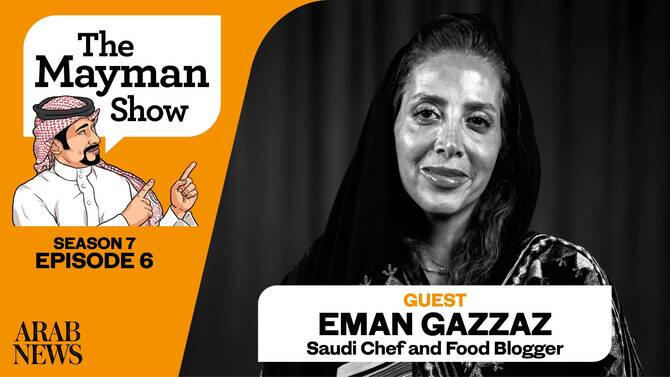

RIYADH: According to Saudi chef and food blogger Eman Gazzaz, diplomacy can be achieved through food and other cultural practices.
The daughter of a diplomat, Gazzaz is more than a home cook — she is an artist and a mother of three who is turning simple dishes into soulful stories. She also wants to form cultural bridges through her work, as she explained when she appeared as a guest on the Mayman Show.
Growing up as the daughter of a Saudi ambassador, she dreamed of following the same path. In many ways, she did — but her “embassy” was her kitchen and she chose food, rather than politics, as her language.
After a childhood spent in various continents, Gazzaz now has a YouTube kitchen that feels like home and has taken it upon herself to show the world what real Saudi food and real Saudi women are all about.
During her interview, she recalled her time living in different parts of the world and her parents’ creative expression.
“My parents are very diverse. And they’re not just diplomats; they are creative in many ways. My dad is a gardener; he collects old antique cars, he collects old pocket watches,” she said.
She has fond memories of living in Pakistan during her father’s tenure in the late 1980s: “It’s a beautiful country; the people are so beautiful. Living in six countries and just being exposed to the world and the different cultures they have, it’s just like … it creates something in you as an individual. It makes you more connected somehow.”
Her exposure to different cultures and the connections she made helped her become the person who is now presenting the joy of Saudi cooking to the world. She carries her experiences with her — the countries, the cultures and the people — and some of what she has seen means she is especially appreciative of the stability and security she enjoys in Saudi Arabia.
“That’s what made me as Eman, what changed me as somebody who lived abroad,” she said. “I appreciate coming to Saudi Arabia and the safety and the security that we experienced. When I was studying in the American school in Karachi, one of my classmates got kidnapped. And he was kidnapped for six months.”
Gazzaz explained that previously she traveled around with a bodyguard and in a bullet-proof car to ensure her safety and security.
“Every time I come to Saudi Arabia I’m just like, ‘We don’t have to lock the door, we don’t have a bodyguard, nobody is carrying a gun.’ That made me feel like… coming back home made me feel so safe,” she said.
Eman also recalls a childhood memory of making a popular Saudi dish with her father.
“Every time we go outdoors, he always cooks the same dish and it’s actually one of my favorite dishes, which is saleeg (a white rice dish, cooked with broth and milk),” she said.
“I used to help him do the chicken, strain the stock and take the food out. And I grew up tasting these flavors and just eating the saleeg outdoors and being part of that experience, just me being so close to saleeg. My daughter loves saleeg as well.”
Cooking was always a family affair. Gazzaz’s mother was known for her delicious salads, while everyone had a role to play in preparing meals.
“From both sides of my parents, they were very good cooks. My dad is very good at barbecuing,” she said. “He loves to go to the beach every weekend. When we were living abroad, he always rented a place, and he used to make the barbecue and marinate (the food) and barbecue it.”
Her own YouTube fame, Gazzaz credits to both her husband and her friend, Alia. Back in 2010, Alia visited for a month and revealed she had her own channel, Cooking with Alia.
“When she came, she’s like, ‘Eman, I have a YouTube channel.’ Back in 2010, YouTube was like five, six years old, It was still very new,” recalled Gazzaz.
Alia wanted her to present Saudi dishes on YouTube — something that made Gazzaz pause. At that time, it was not common for Saudi women to show their faces on social media, so she replied that she would have to ask her husband.
His response, said Gazzaz, was: “Do what you want.”
“He is a Miami boy, so he’s very chilled,” she explained.
She took it as an opportunity to show off her national dress, as well as the food.
“(I thought) I’ll wear my abaya, I’ll put on my tarha (scarf), introduce my clothes and my outfits and things like that, and that’s what we did,” she said. From there, grew the first Saudi channel that introduced the world to the Kingdom’s culture through food.
Gazzaz has also written a book, “A Saudi Mandela,” which is a meditation and coloring book for adults.


