

US, Pakistan agree to work together to promote peace in Middle East

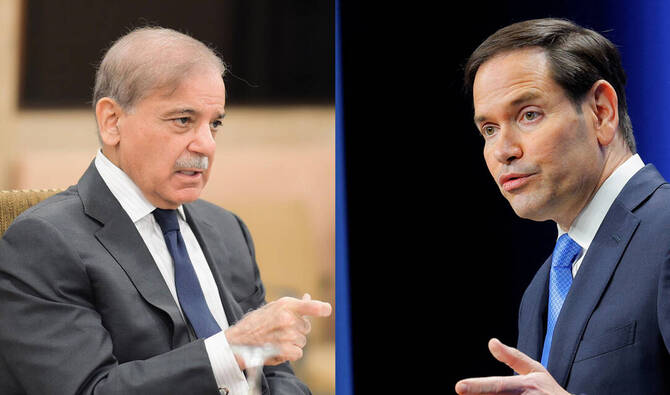
This combination of photos, created on June 27, 2025, shows Pakistan Prime Minister Shehbaz Sharif speaking during the Federal Cabinet meeting at the Parliament House in Islamabad, Pakistan on June 27, 2025, and US Secretary of State Marco Rubio addressing a press conference at the NATO summit in The Hague, Netherlands on June 25, 2025. (Photo courtesy: PMO/REUTERS/File)
Short Url
Updated 27 June 2025
Follow

US, Pakistan agree to work together to promote peace in Middle East

  • The development comes after 12-day war between Iran, Israel raised alarms in the region
  • State Secretary Marco Rubio tells Pakistan PM Iran can never acquire a nuclear weapon

ISLAMABAD: The United States (US) and Pakistan have agreed to work together for peace in the Middle East, the US State Department said on Thursday, following a telephone call between US State Secretary Marco Rubio and Pakistan Prime Minister Shehbaz Sharif.

The development comes after a 12-day war between Iran and Israel, which began with June 13 Israeli airstrikes on Iranian nuclear facilities and military leadership, raising alarms in a region that was already on edge since the start of Israel’s war on Gaza in October 2023.

The Israeli strikes came at a time when Iranian officials were engaged in nuclear negotiations with the US and the conflict worsened after the US struck three Iranian nuclear sites on June 22. President Donald Trump claimed the strikes set back Iran’s nuclear program by years.

Pakistan has remained engaged in talks with regional partners like Saudi Arabia, Iran, China and Qatar to de-escalate tensions in the Middle East after Iran conducted retaliatory strikes on a US base in Qatar, raising fears the conflict could draw in other regional states.

“Secretary Rubio emphasized Iran can never develop or acquire a nuclear weapon,” State Department spokesperson Tammy Bruce said in a statement after Rubio-Sharif call. “The two leaders acknowledged the importance of working together to promote a durable peace between Israel and Iran and maintaining regional stability.”

Israel, the only Middle Eastern country widely believed to have nuclear weapons, said its war against Iran aimed to prevent Tehran from developing its own nuclear weapons. Iran is a party to the Nuclear Non-Proliferation Treaty while Israel is not.

Pakistan condemned Israeli and US strikes on Iran, and expressed concern over Iranian strikes on the US base in Qatar, calling for all parties to adhere to international law and the United Nations (UN) charter principles.

“While exchanging views on the current situation in the Middle East, the prime minister stated that Pakistan would continue to play a constructive role for bringing peace to the Middle East,” Sharif’s office said in a statement after his telephonic talk with Rubio.

In recent weeks, Pakistan has also repeatedly thanked Trump for his mediation during Islamabad’s four-day military standoff with India last month. Both countries had pounded each other with missiles, fighter jets, artillery fire and drone strikes that killed over 70 on both sides before the US announced a ceasefire on May 10.

While the May 10 ceasefire continues to hold, New Delhi has refused to budge from its earlier stance of suspending a decades-old water-sharing treaty with Pakistan. Islamabad has previously said any attempts to stop or divert its water will be regarded as an “act of war” and is also exploring a challenge to the Indian move.

During his conversation with Rubio, Sharif appreciated the “key role” Washington played in the Pakistan-India ceasefire, according to his office.

“The Prime Minister and Secretary Rubio agreed to continue working closely to strengthen Pakistan-US relations, particularly through enhanced trade,” it said.

Pakistan launches digital cash aid for low-income families during Ramadan, PM says

Updated 6 sec ago
Follow

Pakistan launches digital cash aid for low-income families during Ramadan, PM says

  • Ramadan relief moves from state-run Utility Stores to targeted digital wallet transfers
  • Government to transfer financial assistance through wallets to support sehri, iftar expenses

ISLAMABAD: Pakistan will provide financial assistance to low-income households through digital wallets during the fasting month of Ramadan, Prime Minister Shehbaz Sharif said on Thursday, announcing a government relief initiative aimed at helping families afford daily meals.

The support program comes as many Pakistanis continue to face elevated food and utility costs despite easing inflation, with Ramadan traditionally increasing household spending on staple foods, fruits and energy consumption.

For decades, government-run Utility Stores Corporation outlets were central to Ramadan relief in Pakistan, selling subsidized flour, sugar, ghee and pulses through special “Ramzan packages” that drew long queues in low-income neighborhoods. In recent years, however, authorities have steadily scaled back the system amid mounting losses, corruption complaints and logistical inefficiencies, shifting instead toward targeted cash transfers delivered through digital wallets and banking channels. 

The change reflects a broader policy move away from state-managed commodity distribution toward direct financial assistance intended to give households flexibility while reducing leakages in subsidy programs.

“The Government of Pakistan has launched a Ramadan package under which financial assistance will be transferred to deserving individuals through digital wallets so that households can maintain sehri and iftar meals,” Sharif said in a message issued by his office.

The prime minister said Ramadan encourages compassion and collective responsibility toward vulnerable segments of society, adding that welfare support was part of the state’s duty during the holy month.

Officials say the digital cash transfers approach improves transparency and reduces corruption risks while enabling faster payments nationwide, particularly in urban low-income communities.

But the shift to fully digital assistance also brings challenges. 

Access to smartphones and reliable mobile Internet remains uneven, particularly in rural areas and among older recipients, while many low-income households use SIM cards registered to someone else, complicating verification.