Pakistani industrialists eye Gulf nations for business as tax laws toughen at home

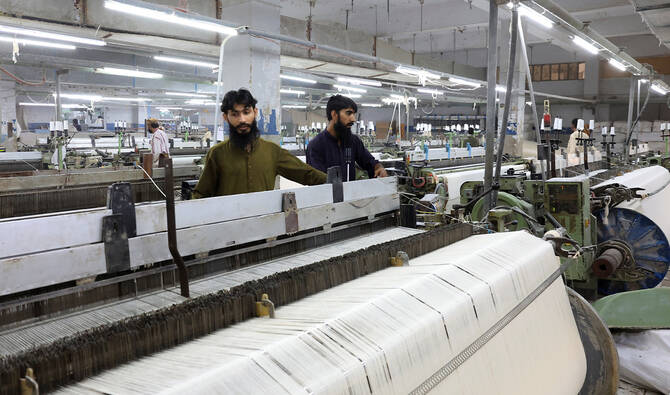
Workers inspect loom machines, weaving fabric at a textiles manufacturer in Karachi, Pakistan, April 3, 2025. (REUTERS/File)
Short Url
Updated 27 June 2025
Follow

Pakistani industrialists eye Gulf nations for business as tax laws toughen at home

  • The development comes amid protests by the Karachi Chamber of Commerce and Industry, the nation’s biggest trade body, over policing powers to tax collectors
  • KCCI President Jawed Bilwani says over 24,000 Pakistani businesses have already registered with the Dubai Chamber of Commerce in the last two and half years

KARACHI: More and more Pakistanis are planning to shift their businesses to the Gulf countries as Prime Minister Shehbaz Sharif’s government seeks to give policing powers to tax collectors, a traders’ representative said on Thursday, describing the move as being “worse than law of the jungle.”

The government this month introduced a new legal provision in the form of Section 37AA of the Sales Tax Act, 1990 that allows officers of the Federal Board of Revenue (FBR) to make arrests in case of a “tax fraud or any other offense warranting prosecution.”

The move has sparked protests by the Karachi Chamber of Commerce and Industry (KCCI), the country’s largest body of traders and industrialists, in Karachi which the KCCI members say could be expanded to the whole country, if the government did not withdraw the provision decision.

In an interview with Arab News, KCCI President Muhammad Jawed Bilwani said investors were already deserting Pakistan for Gulf countries, Vietnam, South Korea, US, African and Central Asian regions and even Afghanistan, and more people plan on joining them after the latest move.

“Most of the people have shifted to the UAE (United Arab Emirates) and Gulf countries where they say the tax rate and electric tariffs have been fixed for 10 years,” the KCCI president said.

“In those countries the tax rate applied is fixed for a decade, unlike Pakistan where we see a change every year. The utility rates are fixed, the departments are fixed, there is one-window operation. Everything is made available for you within 24 hours. The government’s response is very good.”

Arab News reached out to Pakistan’s finance adviser Khurram Schehzad and FBR spokesperson Najeeb Ahmad Memon, who did not respond to requests for comment on the subject.

In his budget speech on June 10, Finance Minister Muhammad Aurangzeb said granting policing powers to the FBR was part of the government’s efforts to reform Pakistan’s weak revenue system that has created an estimated tax gap of Rs5.5 trillion ($19.4 billion).

“This situation was unacceptable,” the minister said at the time.

Pakistan has the region’s lowest tax-to-GDP ratio that the government seeks to increase to 14 percent in the next three years in line with the International Monetary Fund’s loan program that supports the new budget.

The IMF’s tough conditions have made the government to take steps like the withdrawal of energy subsidies and toughening laws to meet Rs14 trillion ($50 billion) tax target for the next fiscal year starting July 1. Giving policing powers to FBR officers was another such measure.

“That day [June 10] some members asked us what help the [Karachi] chamber could extend if we wanted to make a committee to shift our businesses abroad,” Bilwani told Arab News, warning of going on a strike if the government did not address their concerns.

The agitation may jeopardize the macroeconomic stability Pakistan has achieved in the last one year. Sharif’s government is already coping with the persisting political instability that is keeping foreign investors away from Pakistan and the country has not attracted more than $3 billion foreign direct investment in about last two decades, according to official data.

“[We] will pay taxes with honor,” reads one of the KCCI banners the traders have placed throughout Pakistan’s commercial capital of Karachi.

Bilwani said the government was granting “very dangerous powers” to the FBR that would then be able to seize bank accounts of traders, withdraw money from them and arrest them.

According to the KCCI data, more than 24,000 Pakistani businesses have registered with the Dubai Chamber of Commerce in the last two and a half years. As many as 8,036 Pakistani firms registered in 2023, 8,179 in 2024 and over 8,100 by the initial months of 2025.

“Thanks to Dubai Chamber membership data, we can see a clear trend of Pakistani businesses establishing themselves in the UAE,” said KCCI spokesman Aamir Hasan.

Presently, he said, more than 47,000 Pakistani-owned firms are operating in the UAE, including 8,000 having established there within last one year.

“The kind of direction this budget has taken it can neither help the exports industry nor the import substitute industry to run,” said Bilwani, who was unsure if the government had made any changes in the new budget which the lower house of Pakistan’s parliament passed on Thursday.

“The exports of this country have been continuously falling for the last two months.”

Pakistan’s exports declined by 6 percent in May to $2.67 billion and by 17.66 percent to $2.17 billion in April, according to official figures. The exports rose by 3 percent to $2.65 billion in March.

“Who will survive in this environment? Those who have money can go anywhere and do business,” Bilwani said, adding that mill owners would soon start agitating in Pakistan’s textiles and sports goods hubs like Faisalabad, Sialkot and Lahore.

This departure by industries will significantly increase unemployment and poverty as well as deteriorate the law-and-order situation in the country, according to the traders’ representative.

In a separate KCCI statement, Bilwani said “the protest will escalate. If our demands are ignored, we may be left with no option, but to call for citywide or even nationwide strikes.”

“We don’t see things are in order,” Bilwani told Arab News. “The government should correct its decisions and set them in the right direction so the industry could run.”


Pakistani politicians urge dialogue with Imran Khan’s party as PM offers talks

Updated 07 January 2026
Follow

Pakistani politicians urge dialogue with Imran Khan’s party as PM offers talks

  • National Dialogue Committee group organizes summit attended by prominent lawyers, politicians and journalists in Islamabad
  • Participants urge government to lift alleged ban on political activities and media restrictions, form committee for negotiations 

ISLAMABAD: Participants of a meeting featuring prominent politicians, lawyers and civil society members on Wednesday urged the government to initiate talks with former prime minister Imran Khan’s Pakistan Tehreek-e-Insaf (PTI) party, lift alleged bans on political activities after Prime Minister Shehbaz Sharif recently invited the PTI for talks. 

The summit was organized by the National Dialogue Committee (NDC), a political group formed last month by former PTI members Chaudhry Fawad Husain, ex-Sindh governor Imran Ismail and Mehmood Moulvi. The NDC has called for efforts to ease political tensions in the country and facilitate dialogue between the government and Khan’s party. 

The development takes place amid rising tensions between the PTI and Pakistan’s military and government. Khan, who remains in jail on a slew of charges he says are politically motivated, blames the military and the government for colluding to keep him away from power by rigging the 2024 general election and implicating him in false cases. Both deny his allegations. 

Since Khan was ousted in a parliamentary vote in April 2022, the PTI has complained of a widespread state crackdown, while Khan and his senior party colleagues have been embroiled in dozens of legal cases. Prime Minister Shehbaz Sharif last month invited the PTI for talks during a meeting of the federal cabinet, saying harmony among political forces was essential for the country’s progress.

“The prime objective of the dialogue is that we want to bring the political temperatures down,” Ismail told Arab News after the conference concluded. 

“At the moment, the heat is so much that people— especially in politics— they do not want to sit across the table and discuss the pertaining issues of Pakistan which is blocking the way for investment.”

Former prime minister Shahid Khaqan Abbasi, who heads the Awaam Pakistan political party, attended the summit along with Jamaat-e-Islami senior leader Liaquat Baloch, Muttahida Quami Movement-Pakistan’s Waseem Akhtar and Haroon Ur Rashid, president of the Supreme Court Bar Association. Journalists Asma Shirazi and Fahd Husain also attended the meeting. 

Members of the Pakistan Peoples Party, the ruling Pakistan Muslim League-Nawaz (PML-N) and the PTI did not attend the gathering. 

The NDC urged Prime Minister Shehbaz Sharif, President Asif Ali Zardari and PML-N chief Nawaz Sharif to initiate talks with the opposition. It said after the government forms its team, the NDC will announce the names of the opposition negotiating team after holding consultations with its jailed members. 

“Let us create some environment. Let us bring some temperatures down and then we will do it,” Ismail said regarding a potential meeting with the jailed Khan. 

Muhammad Ali Saif, a former adviser to the Khyber Pakhtunkhwa chief minister, told participants of the meeting that Pakistan was currently in a “dysfunctional state” due to extreme political polarization.

“The tension between the PTI and the institutions, particularly the army, at the moment is the most fundamental, the most prominent and the most crucial issue,” Saif noted. 

‘CHANGED FACES’

The summit proposed six specific confidence-building measures. These included lifting an alleged ban on political activities and the appointment of the leaders of opposition in Pakistan’s Senate and National Assembly. 

The joint communique called for the immediate release of women political prisoners, such as Khan’s wife Bushra Bibi and PTI leader Yasmin Rashid, and the withdrawal of cases against supporters of political parties.

The communiqué also called for an end to media censorship and proposed that the government and opposition should “neither use the Pakistan Armed Forces for their politics nor engage in negative propaganda against them.”

Amir Khan, an overseas Pakistani businessperson, complained that frequent political changes in the country had undermined investors’ confidence.

“I came here with investment ideas, I came to know that faces have changed after a year,” Amir Khan said, referring to the frequent change in government personnel. 

Khan’s party, on the other hand, has been calling for a “meaningful” political dialogue with the government. 

However, it has accused the government of denying PTI members meetings with Khan in the Rawalpindi prison where he remains incarcerated. 

“For dialogue to be meaningful, it is essential that these authorized representatives are allowed regular and unhindered access to Imran Khan so that any engagement accurately reflects his views and PTI’s collective position,” PTI leader Azhar Leghari told Arab News last week.