

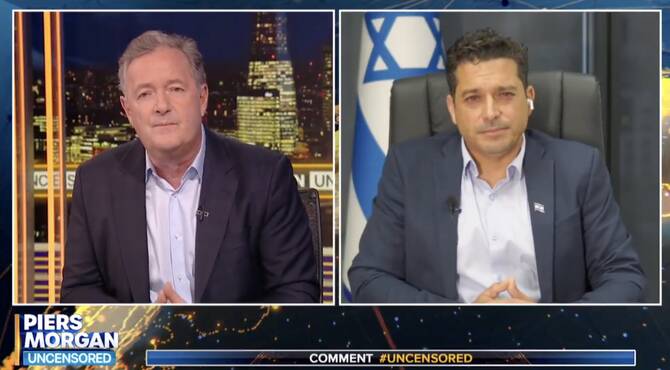

LONDON: Israeli Minister for Diaspora Affairs and Combating Antisemitism Amichai Chikli has denied accusing British broadcaster Piers Morgan of antisemitism following a heated exchange during a recent episode of “Piers Morgan Uncensored,” despite a post on his official X account that said Morgan’s rhetoric marked “a sharp and troubling descent into overt antisemitism.”
The confrontation aired on Tuesday during an episode focused on Israel’s escalating conflicts with Iran and Hamas and featured appearances from both Chikli and former Israeli Prime Minister Ehud Barak.
Tensions erupted as Morgan repeatedly pressed Chikli to explain his public accusations.
“You did, you implied it,” Morgan said, adding that Chikli’s accusations led to “thousands of people calling me antisemitic and (a) Jew-hater” on social media. He demanded evidence, ultimately calling the minister “pathetic” and “an embarrassment” when none was offered.
"Absolute categorical weapons-grade nonsense!"
Piers Morgan blasts Minister of Diaspora Affairs in Israel Amichai Chikli for saying he platforms holocaust deniers.
https://t.co/AO5YsXcBkq@piersmorgan | @AmichaiChikli pic.twitter.com/IiXmRk7wbC
— Piers Morgan Uncensored (@PiersUncensored) June 23, 2025
The row stemmed from a June 4 post by Chikli, who shared a clip of a prior interview between Morgan and British barrister Jonathan Hausdorff, a member of the pro-Israel group UK Lawyers for Israel.
In the post, viewed over 1.3 million times by the time of Tuesday’s broadcast, Chikli claimed Morgan had hosted “every Israel hater he can find” and treated Hausdorff with “vile condescension and bullying arrogance — revealing his true face, one he had long tried to conceal.”
The post also referenced an unverified claim by American commentator Tucker Carlson that Morgan had said he “hates Israel with every fiber of his being” — a statement Morgan has firmly denied.
During Tuesday’s interview, Morgan challenged Chikli to cite a single antisemitic remark or action.
“Is it because I dare to criticize Israeli actions in Gaza?” Morgan told Chikli.
I’ve been following @piersmorgan’s interviews since the beginning of the war. From the outset, it was clear that, like most Western media, his basic inclination was pro-Palestinian — but he appeared to maintain a relatively fair and balanced line.
Since then, however, I’ve… https://t.co/OvBtQsoYoE
— עמיחי שיקלי - Amichai Chikli (@AmichaiChikli) June 4, 2025
According to Israeli outlet Haaretz, Chikli later denied ever calling Morgan antisemitic, despite his earlier post.
The episode reflects Morgan’s shifting stance on the war in Gaza. Once a vocal supporter of Israel’s right to self-defense in the immediate aftermath of the Oct. 7 attacks, Morgan has since adopted a more critical view as the civilian toll in Gaza has mounted and international outrage has grown.
The show has become a flashpoint for debate since the conflict began, hosting polarizing guests from both sides, including controversial American Rabbi Shmuley Boteach, a staunch defender of Israel, and influencer Dan Bilzerian, who has faced accusations of Holocaust denial.
Chikli, meanwhile, has faced criticism for blurring the lines between genuine antisemitism and political criticism of Israel. He recently sparked controversy by inviting members of far-right European parties — some with antisemitic histories — to a conference on antisemitism in Jerusalem, raising questions about his credibility.


