

Kenya protests were ‘terrorism disguised as dissent,’ minister says

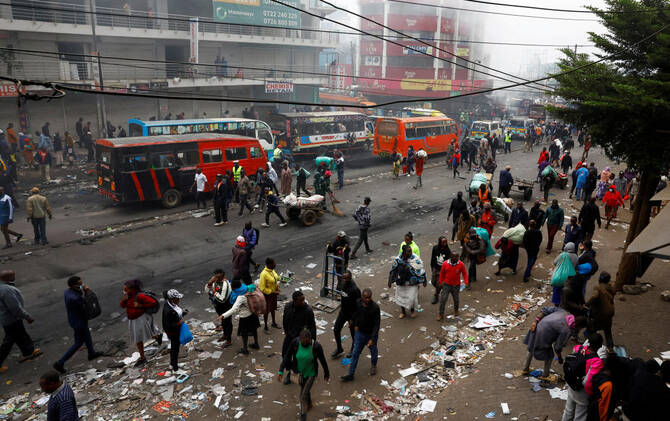
People walk past debris of broken retail electronics following demonstrations to mark the first anniversary of the deadly 2024 anti-government protests that drew widespread condemnation over the use of force by security agencies, in Nairobi, Jun. 26, 2025. (Reuters)
Short Url
Updated 26 June 2025
Follow

Kenya protests were ‘terrorism disguised as dissent,’ minister says

  • Thousands of businesses destroyed as death toll from anti-government rallies rises to 16

NAIROBI: At least 16 people died in protests across Kenya on Wednesday, Amnesty International said Thursday, as businesses and residents were left to clean up the devastation in the capital and beyond.

The marches had been called to mark one year since anti-tax demonstrations that peaked when a huge crowd stormed parliament and security forces killed dozens.

The anniversary marches began peacefully on Wednesday but descended into chaos as young men held running battles with police, lit fires, and ripped up pavements to use as projectiles.

“What unfolded yesterday was not a protest. It was terrorism disguised as dissent,” Interior Minister Kipchumba Murkomen said in a televised speech.

“We condemn the criminal anarchists who, in the name of peaceful demonstrations, unleashed a wave of violence, looting, sexual assault, and destruction upon our people,” he added.

He said police would follow up with owners whose CCTV cameras captured the looters to ensure swift arrests.

In Nairobi’s business district, the epicenter of the unrest, journalists found entire shopping centers and thousands of businesses destroyed, many still smoldering.

At least two banks had been broken into, while businesses ranging from supermarkets to small electronics and clothing stores were reduced to ashes or ransacked by looters.

“When we came, we found the whole premise burnt down,” said Raphael Omondi, 36, owner of a print shop, adding that he had lost machines worth $150,000.

“There were guys stealing, and after stealing, they set the whole premises on fire ... If this is what protest is, it is not worth it.”

“They looted everything ... I do not know where to start,” said Maureen Chepkemoi, 32, owner of a perfume store.

“To protest is not bad, but why are you coming to protest inside my shop? It is wicked,” she added.

Several business owners reported that looting began in the afternoon after the government ordered TV and radio stations to stop broadcasting live images of the protests.

Amnesty International’s Kenya director Irungu Houghton said the death toll had risen to 16.

Rights group Vocal Africa, which was documenting the deaths and helping affected families at a Nairobi morgue, said at least four bodies had been brought there so far.

“All of them had signs of gunshots, so we suspect they all died of gunshot wounds,” said its head, Hussein Khalid.

“We condemn this excessive use of force,” he said. 

“We believe that the police could have handled themselves with restraint.”

“You come out to protest police killings, and they kill even more.”

A coalition of rights groups had earlier said at least 400 people were wounded, with 83 in serious condition in the hospital. 

It recorded protests in 23 counties around Kenya.

Emergency responders reported multiple gunshot wounds, and there were unconfirmed local media reports that police had opened fire on protesters, particularly in towns outside the capital.

There is deep resentment against President William Ruto, who came to power in 2022 promising rapid economic progress.

Many are disillusioned by continued economic stagnation, corruption, and high taxes, as well as police brutality after a teacher was killed in custody earlier this month.


Italian fruit detective racing to save forgotten varieties

Updated 58 min 3 sec ago
Follow

Italian fruit detective racing to save forgotten varieties

  • The Italian agronomist-turned-detective seeks descriptions of bygone local fruits in centuries-old diaries or farming documents, and sets out to find them

CITTA DI CASTELLO: Isabella Dalla Ragione hunts in abandoned gardens and orchards for forgotten fruits, preserving Italy’s agricultural heritage and saving varieties which could help farmers withstand the vagaries of a changing climate.
The 68-year-old’s collection of apples, pears, cherries, plums, peaches and almonds, grown using methods of old, are more resilient to the climate shifts and extremes seen increasingly frequently in the southern Mediterranean.
The Italian agronomist-turned-detective seeks descriptions of bygone local fruits in centuries-old diaries or farming documents, and sets out to find them.
Others she identifies by matching them to fruits in Renaissance paintings, where they often appear in depictions of the Madonna and Child.
Of the 150 or so varieties collected from Tuscany, Umbria, Emilia-Romagna and Marche and grown by her non-profit Archaeologia Arborea foundation, the small, round Florentine pear is among Dalla Ragione’s favorites.
“I’d found it described in documents from the 1500s, but I’d never seen it and believed it lost,” she told AFP.
“Then 15 years ago, in the mountains between Umbria and Marche, I found a tree almost in the middle of the woods,” thanks to an elderly local woman who told her about it by chance.
While old varieties are flavoursome, most disappeared from markets and tables after the Second World War as Italy’s agricultural system modernized.

- ‘Urgent’ -

Italy is a large fruit producer. Its pear production ranks first in Europe and third globally, but just five modern varieties — none of which are Italian — account for over 80 percent of its output.
“There used to be hundreds, even thousands, of varieties because each region, each valley, each place had its own,” Dalla Ragione said as she showed off wicker baskets full of fruit, stored in a little church near the orchard.
Modern markets instead demand large crops of fruits that can be harvested quickly, easily stored and last a long time.
But as global warming makes for an increasingly challenging climate, experts say a broader range of plant genetic diversity is key.
“Heirloom varieties... are able to adapt to climate change, to more severe water shortages, to extremes of cold and heat,” said Mario Marino, from the climate change division of the UN’s Food and Agriculture Organization.
“However, a much more severe disease arrives, one that improved varieties are normally more resistant to... and the local varieties perish, or perhaps don’t produce fruit,” he told AFP.
The answer lies in creating new varieties by crossing modern and old-fashioned ones, he said.
Marino, who advises Dalla Ragione’s foundation, said her work was “urgent” because “preserving one’s heritage means preserving the land, preserving biodiversity... and (allowing) us to use that DNA for new genetic resources.”

- Oral testimonies -

Researchers can access the collection, while Dalla Ragione also recreates historical gardens which can host recovered varieties as part of an EU-funded project.
“We don’t do all this research and conservation work out of nostalgia, out of romanticism,” she said as she harvested pink apples from her trees in the hilly hamlet of San Lorenzo di Lerchi in Umbria.
“We do it because when we lose variety, we lose food security, we lose diversity and the system’s ability to respond to various changes, and we also lose a lot in cultural terms.”
Dalla Ragione has sought answers to fruit mysteries in monastery orchards, the gardens of nobility and common allotments. She has pored over local texts from the 16th and 17th centuries.
She once traced a pear to a village in southern Umbria after reading about it in the diary of a musical band director.
But one of her richest sources on how best to cultivate such varieties has been oral testimonies — and as the last generation of farmers that grew the crops die, much local knowledge is lost.
That has made it difficult to know how to divide her time between researching and looking for a new variety, though she has learnt the hard way that the urgency “is always to save it.”
“In the past if I’ve delayed, thinking ‘I’ll do it next year’, I’ve found the plant has since gone.”