

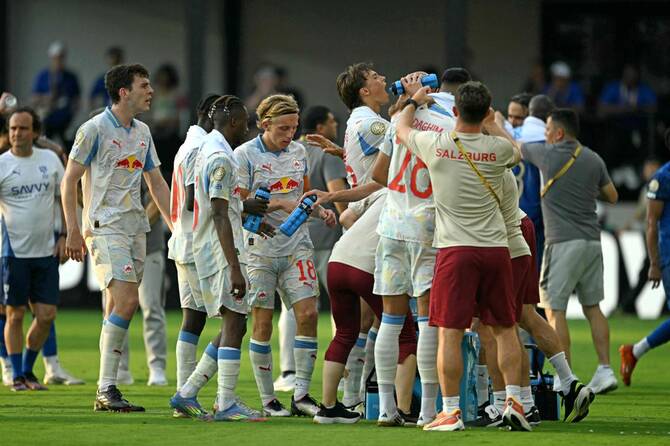

TEXAS: Substitutes who watch from the locker room, abandoned practice sessions and sweat-soaked jerseys. A heat wave hitting a wide swath of the country is taking a toll on players at the FIFA Club World Cup.
The gruelling conditions could also be a preview of what’s to come next summer when the United States, Canada and Mexico host soccer’s premier event, the 2026 World Cup.
“It’s impossible, it’s terribly hot. My toes were sore, even my toenails were hurting, I couldn’t stop or start. In the end, it’s incredible, but since it’s the same for everyone, there’s no excuse,” Atlético’s Marcos Llorente said following a match against Paris Saint-Germain.
A “heat dome” of high pressure has settled in over the central and eastern United States, sending temperatures soaring into the 90s in Fahrenheit and above in many areas.
That’s rough on both Club World Cup players and fans, who can potentially experience dehydration and cramps, or more serious conditions like heat exhaustion and heat stroke.
“In Europe it’s more of a dry heat and this is more of a humid heat. I think it’s going to hit them twice as hard,” fan Tyler Fernando said before Bayern Munich’s match against Benfica on Tuesday in Charlotte, North Carolina, where the temperature was 97 degrees Fahrenheit (36 Celsius) at game time.
Those at the Auckland City match against Boca Juniors in Nashville on Tuesday braved temperatures in the upper 90s. Male spectators went shirtless and fans sought sections where there was shade.
Heat is of particular concern during big tournaments like the Club World Cup because the players don’t have much time off to recover between games. And in the group stages, matches are usually staggered each day, meaning some teams play in the midday sun.
Chelsea cut short a practice session in Philadelphia, where temperatures reached the 90s.
“I always try to avoid excuse, I always try to be honest. It’s not about excuses, it’s about reality. It’s an excuse when it’s not hot, and we say it’s hot. That’s an excuse. But if it’s hot, it’s hot. But we are here, and we’re trying to do our best,” Chelsea coach Enzo Maresca said.
During a match between Borussia Dortmund and the Mamelodi Sundowns, Dortmund posted on social media: “Our subs watched the first half from inside the locker room to avoid the blazing sun at TQL Stadium — never seen that before, but in this heat, it absolutely makes sense.”
“We always think about how we can help the team, how we can minimize a negative influence. And it was just very, very hot. We had cooling sticks in order to cool the players down. We had them waiting in the dressing room with the air conditioning,” Dortmund coach Niko Kovac said through an interpreter. “This was very important for all of us. It’s not only about tactics, but it’s also about minimizing the load, minimizing the stress. The stress is already high enough.”
FIFA guidelines mandate breaks when the Wet Bulb Globe Temperature — a composite of factors including temperature and humidity — reaches 89.6 degrees. The breaks usually occur around the 30th and 75th minutes.
Cooling breaks were initially used at the 2008 Olympic final between Lionel Messi’s Argentina and Nigeria at Beijing’s National Stadium, where the on-field temperature reached 107 degrees.
But at the time, such breaks were rare. They became more commonplace following the 2014 World Cup in Brazil, where a Brazilian labor court ordered hydration breaks when the Wet Bulb Globe Temperature reached 89.6 degrees.
Miami-Dade Fire Rescue went to social media to urge Club World Cup fans to exercise caution in the heat before Inter Miami’s match against Palmeiras on Monday night, and Chelsea posted “heat mitigation” guidelines on their official website before the Blues’ match against Esperance on Tuesday.
It’s not just high temperatures that can impact summer tournaments: Five Club World Cup matches have been delayed by thunderstorms.
The climate is going to be an increasing issue for FIFA as global temperatures rise. Sixteen cities will host World Cup games next year. Five of the stadiums that will be used have roofs to provide some sun protection.
At Mexico’s venues, Mexico City and Guadalajara could be impacted by the summer’s hurricane season, and in Monterrey, summer temperatures average in the 90s.
After the 2026 World Cup, the 2030 edition will be held in Morocco, Spain, and Portugal. And the problem isn’t just on the men’s side: The 2027 Women’s World Cup is set to be played in Brazil.
Peter Crisp from Fossil Free Football said: “Scheduling matches in no-shade stadiums in the middle of the day and promoting oil-dependent sponsors shows FIFA is dangerously out of touch with the threat extreme heat poses to its major summer tournaments.”


