


BEIRUT: The Israeli army on Wednesday claimed that Lebanese Haytham Abdullah Bakri, who was killed in an Israeli airstrike on Tuesday in the town of Kfar Dajjal in the Nabatiyeh governorate in southern Lebanon, was “the head of a currency exchange who operated with Hezbollah to transfer funds for Hezbollah terrorist activities.”
In a social media post, Israeli army spokesman Avichay Adraee said: “The ‘Al-Sadiq’ Currency Exchange, managed by Bakri, serves as a funds storage and transfer mechanism for Hezbollah, for funds originating from the Iranian Quds Force.”
Adraee also posted photos of five other exchange centers in Lebanon that he accused of being companies that also finance Hezbollah, in what appeared to be a threat that they could be targeted similarly to Bakri.
The documented establishments include Al-Insaf Exchange under the management of Ali Hassan Shamas, and a currency house operated by Hassan Mohammed Hussein Ayyash.
The intelligence imagery also shows Yara Exchange, run by Mohammed Badr Barbir, alongside another operation managed by Ramez Mektef. Additionally, surveillance targeted Maliha Exchange, which operates under Hussein Shaheen’s management.
The post displayed photographs of these shops pinpointed on a map stretching from Beirut to Chtoura in the Bekaa and Mount Lebanon, including Beirut’s southern suburbs.
Adraee said that “these funds are used for military purposes including purchasing weapons, manufacturing means, and providing salaries to operatives, and are diverted for terrorist purposes and to finance the continuation of Hezbollah's terrorist activities.”
The Israeli forces announced the killing of Behnam Shahriari in Iran last weekend, identifying him as the head of Quds Force Unit 190 responsible for channeling hundreds of millions of dollars every year to Iranian proxy organizations. Israeli officials claim Shahriari oversaw sophisticated money transfer operations that funneled Quds Force resources to Hezbollah through a network of currency exchange firms spanning Turkey, Iraq, the UAE, and Lebanon. The killings of Shahriari and Bakri allegedly disrupted critical Iranian financing channels to the Lebanese militant group.
Dr. Louis Hobeika, an economic analyst, said to Arab News that Lebanon’s Central Bank monitors all international transfers, automatically freezing transactions above $10,000 to verify their purpose, origin, and destination.
“Money exchange operators in Lebanon operate under regulatory oversight without special exemptions based on transaction volume,” Hobeika said. “Yet Lebanon harbors financial channels that evade state monitoring and control. Legal and illegal operations sometimes blur together — a pattern visible beyond banking, including customs enforcement where contraband interdiction remains incomplete pending better scanning technology.”
Hobeika described Lebanon’s Syrian frontier as equally challenging, noting that financial flows previously moved through coordinated arrangements under Bashar Al-Assad’s government but now rely on individual smuggling operations.
Israel has repeatedly targeted Hezbollah’s Al-Qard Al-Hassan financial network, which it accuses of bankrolling the organization’s activities. During last year’s Israel-Hezbollah confrontations before November, Israeli airstrikes hit several branches of the institution, which operates a parallel banking system outside Lebanon’s regulated financial sector.
The Lebanese Ministry of Interior and Municipalities officially licensed the Al-Qard Al-Hassan Association in 1987, describing its objective as “assisting individuals by providing short-term loans to help address certain social challenges.”
Following the ceasefire agreement reached at the end of November, the Israeli army placed Beirut International Airport under surveillance, blocking an Iranian plane from landing to “prevent the transfer of funds and weapons to Hezbollah.”
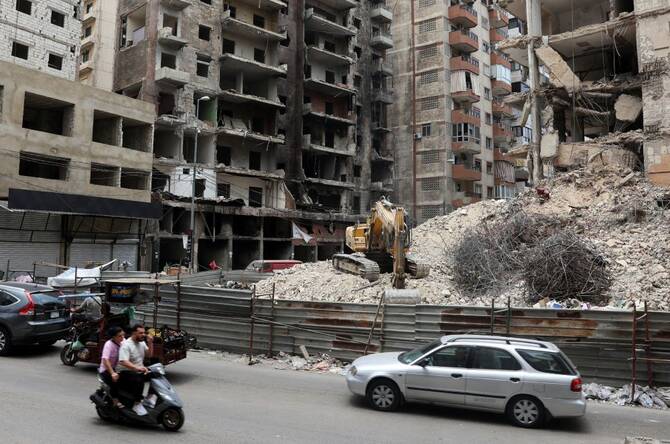
This measure coincided with a period in which Hezbollah faced a severe economic crisis, struggling to secure the funds needed to pay its members’ salaries and to provide shelter for thousands of families displaced by Israel’s systematic destruction of villages along the southern border, as well as hundreds of residential buildings in Beirut’s southern suburbs and the Bekaa Valley.
In February, Hezbollah called on the government to “revoke its decision to prevent (the) Iranian plane from landing at Beirut Airport and to take serious measures to stop the Israeli enemy from imposing its orders and violating national sovereignty.”
Iran is estimated to provide Hezbollah with up to $700 million a year, according to a US State Department report issued in 2022.
In a 2016 speech, the former secretary-general of Hezbollah Hassan Nasrallah, said: “Our budget, salaries, expenses, food, water, weapons, and missiles are provided by the Islamic Republic of Iran.”
He also confirmed in a 2021 speech that Al-Qard Al-Hassan Association has provided $3.7 billion in loans to 1.8 million people in Lebanon since its founding in the 1980s, with approximately 300,000 individuals obtaining loans during that period.
In May, the US State Department announced a reward of up to $10 million for information leading to the disruption of Hezbollah’s financial networks operating in Argentina, Brazil and Paraguay.


