

Pakistan says Trump still deserves Nobel for halting India clash, Iran-Israel fighting

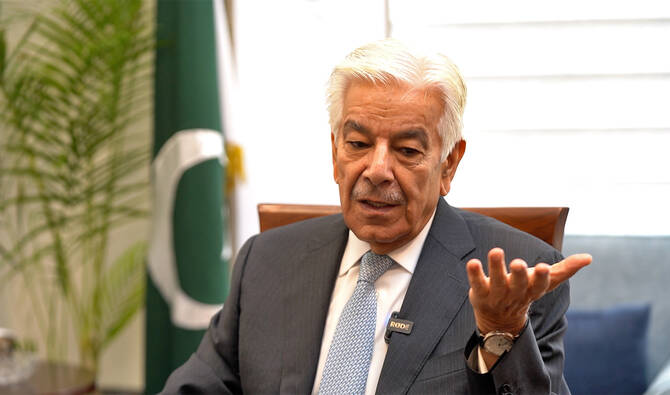
Pakistan’s Defense Minister Khawaja Asif speaks with Arab News Pakistan in Islamabad, Pakistan, on June 17, 2025. (AN photo)
Short Url
Updated 25 June 2025
Follow

Pakistan says Trump still deserves Nobel for halting India clash, Iran-Israel fighting

  • Islamabad says US president helped end conflicts with India and between Iran and Israel
  • Defense minister urges Trump to now work on implementing two-state solution for Palestine

ISLAMABAD: Pakistan’s Defense Minister Khawaja Asif on Tuesday defended Islamabad’s decision to recommend United States President Donald Trump for the 2026 Nobel Peace Prize, citing his role in brokering two ceasefires in under two months.

The government last week announced it would formally nominate Trump for what it called his “decisive diplomatic intervention” during last month’s military standoff with India, a brief but intense escalation in which the nuclear-armed rivals exchanged missile, drone and artillery strikes before the US brokered a truce on May 10.

The standoff, which killed nearly 70 people on both sides, renewed fears of a wider conflict between Pakistan and India, who have fought three full-scale wars, mostly over the disputed Himalayan region of Kashmir. Indian officials have denied that Trump played any role in securing the May 10 ceasefire, but Pakistan insists his behind-the-scenes push was key to defusing the crisis.

The nomination, however, has sparked public criticism after Trump last week launched strikes on Iranian nuclear facilities in retaliation for attacks on Israeli targets. The region narrowly avoided further escalation when Washington subsequently said it had brokered a ceasefire between Iran and Israel on Monday, ending nearly two weeks of missile and drone attacks that killed over 200 Iranians and about 30 Israelis.

“I believe that within just a month and a half, President Trump has managed two ceasefires,” Asif told Independent Urdu in an interview. “So, our endorsement for his Nobel Prize, it’s not just about one but two ceasefires that has further strengthened our case for it.”

Asif also credited Trump for preventing a wider regional war in the Middle East and urged him to build on the momentum by reviving efforts for a two-state solution in Palestine.

“And I would take it a step further that President Trump should now work toward a two-state solution and the establishment of a Palestinian state,” he said.

While reports of violations continued to emerge after the Iran-Israel ceasefire was announced, the truce has largely held under heavy US pressure. Trump, who campaigned on pledges to act as a “peacemaker” and quickly resolve conflicts in Ukraine and Gaza — both still ongoing five months into his presidency — has called the Iran-Israel truce a personal diplomatic triumph.

Trump has also claimed credit for mediating a deal between the Democratic Republic of Congo and Rwanda to defuse tensions over rebel groups operating near their border. He has also previously offered to mediate the decades-old Kashmir dispute between India and Pakistan and has sought to portray himself as a mediator in the long-running Serbia-Kosovo conflict.



Pakistan remittances seen surpassing $40 billion in FY26 as Saudi Arabia leads November inflows

Updated 4 sec ago
Follow

Pakistan remittances seen surpassing $40 billion in FY26 as Saudi Arabia leads November inflows

  • The country’s November remittances rose 9.4 percent year-on-year to $3.2 billion, official data show
  • Economic experts say rupee stability and higher use of formal channels are driving the upward trend

ISLAMABAD: Pakistan’s workers’ remittances are expected to exceed the $40 billion mark in the current fiscal year, economic experts said Tuesday, after the country recorded an inflow of $3.2 billion in November, with Saudi Arabia once again emerging as the biggest contributor.

Remittances are a key pillar of Pakistan’s external finances, providing hard currency that supports household consumption, helps narrow the current-account gap and bolsters foreign-exchange reserves. The steady pipeline from Gulf economies, led by Saudi Arabia and the United Arab Emirates, has remained crucial for Pakistan’s balance of payments.

A government statement said monthly remittances in November stood at $3.2 billion, reflecting a 9.4 percent year-on-year increase.

“The growth in remittances means the full-year figure is expected to cross the $40 billion target in fiscal year 2026,” Sana Tawfik, head of research at Arif Habib Limited, told Arab News over the phone.

“There are a couple of factors behind the rise in remittances,” she said. “One of them is the stability of the rupee. In addition, the country is receiving more inflows through formal channels.”

Tawfik said the trend was positive for the current account and expected inflows to remain strong in the second half of the fiscal year, noting that both Muslim festivals of Eid fall in that period, when overseas Pakistanis traditionally send additional money home for family expenses and celebrations.

The official statement said cumulative remittances reached $16.1 billion during July–November, up 9.3 percent from $14.8 billion in the same period last year.

It added that November inflows were mainly sourced from Saudi Arabia ($753 million), the United Arab Emirates ($675 million), the United Kingdom ($481.1 million) and the United States ($277.1 million).

“UAE remittances have regained momentum in recent months, with their share at 21 percent in November 2025 from a low of 18 percent in FY24,” said Muhammad Waqas Ghani, head of research at JS Global Capital Limited. “Dubai in particular has seen a steady pick-up, reflecting improved inflows from Pakistani expatriates owing to some relaxation in emigration policies.”