France condemns deadly ‘Israeli fire’ near Gaza aid point
France condemns deadly ‘Israeli fire’ near Gaza aid point/node/2605688/middle-east
France condemns deadly ‘Israeli fire’ near Gaza aid point
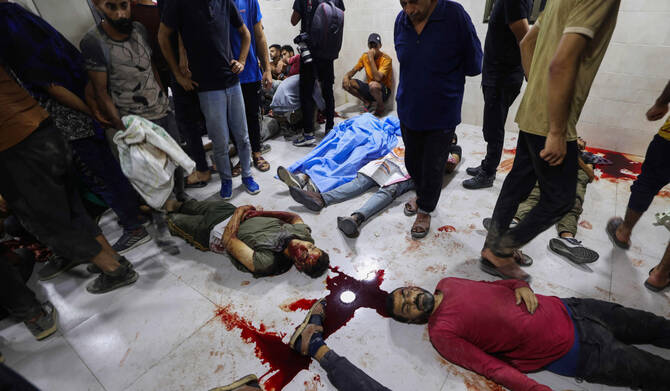
Palestinians look at bodies of men killed in Israeli fire at a food aid distribution point set up by the privately-run Gaza Humanitarian Foundation (GHF) on the Salaheddin road, at Al-Awda hospital in the Nuseirat refugee camp in the central Gaza Strip on June 24, 2025. (AFP)
France condemns deadly ‘Israeli fire’ near Gaza aid point
The territory of more than two million people is suffering from famine-like conditions after Israel blocked all supplies from early March to the end of May and continues to impose restrictions, according to human rights groups
The United Nations and major aid groups have refused to cooperate with the foundation over concerns it was designed to cater to Israeli military objectives
Updated 24 June 2025
AFP
PARIS: France on Tuesday condemned what it called deadly “Israeli fire” against civilians in Gaza, after rescuers accused Israeli forces of killing 21 people as they waited for aid.
“France condemns the Israeli fire that last night hit civilians gathered around an aid distribution center in Gaza, causing several dozen dead and wounded,” the foreign ministry said, appearing to refer to an incident early on Tuesday in central Gaza that the Israeli military says was “under review.”
In a second such incident, a civil defense spokesman also reported Israeli fire killing a further 25 people seeking rations in south Gaza later in the day.
According to figures issued on Tuesday by the health ministry in the Gaza Strip, a territory run by the Hamas Islamist group, at least 516 people have been killed and nearly 3,800 wounded by Israeli fire while seeking rations since late May.
The territory of more than two million people is suffering from famine-like conditions after Israel blocked all supplies from early March to the end of May and continues to impose restrictions, according to human rights groups.
The aid is being distributed by US- and Israeli-backed privately run aid group Gaza Humanitarian Foundation (GHF), which was brought into the Palestinian territory at the end of May to replace UN agencies.
The United Nations and major aid groups have refused to cooperate with the foundation over concerns it was designed to cater to Israeli military objectives.
“France reiterates its full support for United Nations agencies and their humanitarian partners, who have proven their integrity and ability to deliver aid in full respect of humanitarian principles,” the ministry said.
“Humanitarian aid must not be exploited for political or military purposes,” it added.
“France calls on the Israeli government to allow immediate, massive, and unhindered access to humanitarian aid in Gaza.”
Over the weekend, tents in Khan Younis were soaked, leaving families struggling to stay dry
At least 12 people have died from hypothermia or building collapses since December 13
Updated 4 sec ago
AP
KHAN YOUNIS, Gaza: Rain lashed the Gaza Strip over the weekend, flooding makeshift encampments with ankle-deep puddles as Palestinians displaced by the two-year war attempted to stay dry in tents frayed by months of use. Muddy water soaked blankets and mattresses in tents in a camp in Khan Younis and fragile shelters were propped up with old pieces of wood. Children wearing flip-flops and light clothing ill-suited for winter waded through the freezing puddles, which turned dirt roads into rivers. Some people used shovels to try to push the water out of their tents. Nowhere to escape the rain “We drowned last night,” said Majdoleen Tarabein, a woman displaced from Rafah in southern Gaza. “Puddles formed, and there was a bad smell. The tent flew away. We don’t know what to do or where to go.” She showed blankets and the remaining contents of the tent, completely soaked and covered in mud, as she and family members tried to wring them dry by hand. “When we woke up in the morning, we found that the water had entered the tent,” said Eman Abu Riziq, also displaced in Khan Younis, as she pointed to a puddle just outside. “These are the mattresses — they are all completely soaked. My daughters’ belongings were soaked. The water is entering from here and there,” she said, gesturing toward the ceiling and the corners of the tent. Her family is still reeling from her husband’s recent death, and the constant struggle to stay dry in the winter rains. At least 12 people, including a 2-week-old infant, have died since Dec. 13 from hypothermia or weather-related collapses of war-damaged homes, according to Gaza’s Health Ministry, part of the Hamas-run government. Emergency workers warned people not to stay in damaged buildings because they could collapse at any moment. But so much of the territory reduced to rubble, there are few places to escape the rain. In July, the United Nations Satellite Center estimated that almost 80 percent of the buildings in Gaza have been destroyed or damaged. Since a ceasefire between Israel and Hamas went into effect on Oct. 11, 414 people have been killed and 1,142 wounded in Gaza, according to the Health Ministry. The overall Palestinian death toll from the war has risen to at least 71,266. The ministry, which does not distinguish between militants and civilians in its count, is staffed by medical professionals and maintains detailed records viewed as generally reliable by the international community. More shelter desperately needed in Gaza as aid falls short Aid deliveries into Gaza are falling far short of the amount called for under the US-brokered ceasefire, according to an Associated Press analysis of the Israeli military’s figures. The Israeli military body in charge of humanitarian aid said in the past week that 4,200 trucks full of humanitarian aid entered Gaza, plus eight garbage trucks to assist with sanitation, as well as tents and winter clothing as part of the winterization efforts. But it refused to elaborate on the number of tents. Humanitarian aid groups have said the need far outstrips the number of tents that have entered. Since the ceasefire began, approximately 72,000 tents and 403,000 tarps have entered, according to the Shelter Cluster, an international coalition of aid providers led by the Norwegian Refugee Council. “Harsh winter weather is compounding more than two years of suffering. People in Gaza are surviving in flimsy, waterlogged tents and among ruins. There is nothing inevitable about this. Aid supplies are not being allowed in at the scale required,” Philippe Lazzarini, the commissioner-general of the top UN group overseeing aid in Gaza, wrote on X. Netanyahu travels to Washington for talks about second stage of ceasefire Israeli Prime Minister Benjamin Netanyahu traveled to Washington to meet with US President Donald Trump in Florida about the second stage of the ceasefire. Netanyahu is expected to meet with Trump at Mar-a-Lago on Monday. Though the ceasefire agreement has mostly held over the past 2 1/2 months, its progress has slowed. Israel has said it refuses to move on to the next stage of the ceasefire while the remains of the final hostage killed in the attack on Oct. 7, 2023, that sparked the war are still in Gaza. Challenges in the next phase of the ceasefire include the deployment of an international stabilization force, a technocratic governing body for Gaza, the disarmament of Hamas and further Israeli troop withdrawals from the territory. Both Israel and Hamas have accused each other of truce violations.