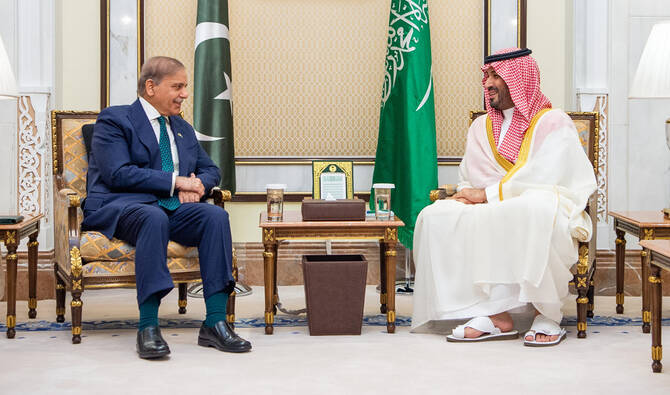

ISLAMABAD: Pakistani Prime Minister Shehbaz Sharif on Tuesday spoke by phone with Saudi Crown Prince Mohammed bin Salman to discuss the situation in the Middle East amid escalating tensions between Iran and Israel.
The call followed Israeli and United States strikes on Iran and Tehran’s retaliatory missile attack on a US base in Qatar on Tuesday. Qatar condemned the Iranian strikes as a “flagrant violation” of its sovereignty, raising fears the crisis could draw in other regional powers if not defused.
During the call, Sharif said Pakistan supported immediate de-escalation of the Iran-Israel conflict and its peaceful resolution through dialogue and diplomacy.
“While referring to last night’s attacks, he called for adherence to international law and the UN Charter principles by all sides,” Sharif’s office said after the telephone discussion with the Saudi Crown Prince. “In this context, the Prime Minister reaffirmed Pakistan’s unwavering support for the Kingdom’s sovereignty and territorial integrity.”
Sharif also praised the Saudi crown prince’s efforts to restore calm, describing them as reflective of the kingdom’s leadership role in the Muslim world and its position as a peacemaker, according to his office.
The crown prince, for his part, appreciated Pakistan’s show of solidarity and acknowledged Islamabad’s constructive role in supporting a peaceful resolution to the conflict.
“His Royal Highness said that the Kingdom of Saudi Arabia was fully committed to efforts aimed at fostering lasting peace and stability in the Middle East,” Sharif’s office said.
On Monday, US President Donald Trump said Israel and Iran had agreed to a “complete and total ceasefire” to be phased in over 24 hours. However, Israel warned of possible missile launches from Iran early Tuesday, and the launches began after 4am local time in Tehran.
Iranian Foreign Minister Abbas Araghchi said Iran would halt its attacks if Israel ended its airstrikes.
It was unclear how the latest developments would affect the planned ceasefire.
Separately on Tuesday, Sharif held a third phone call in as many days with Iranian President Masoud Pezeshkian and again urged dialogue and diplomacy to restore peace in the region.
The crisis has left Islamabad navigating a delicate balance between ties with Iran, other Gulf partners and the United States, which remains one of Pakistan’s largest trading partners and a major source of military and economic assistance.
“The prime minister said that Pakistan was closely following the rapidly evolving situation in the Middle East,” Sharif’s office said after the call with Pezeshkian. “He reiterated Pakistan’s support for Iran at all diplomatic forums, including at the UN Security Council and the OIC [Organization of Islamic Cooperation], while calling for adherence to international law and the UN Charter principles.”