

Club World Cup prize money does not mean more pressure: Chelsea boss Maresca

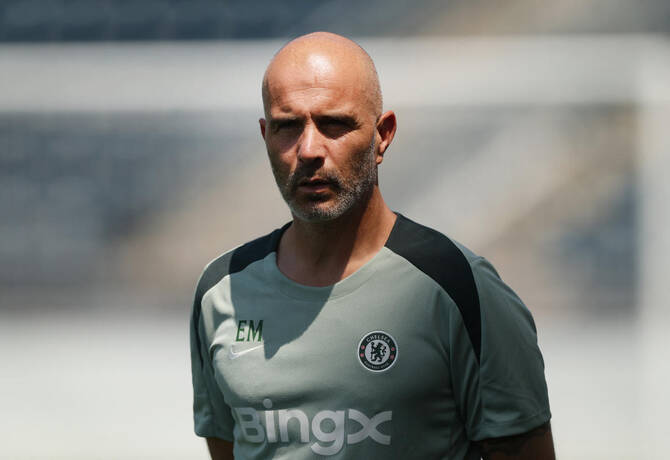
Chelsea manager Enzo Maresca during training at Chelsea Training — Subaru Park, Chester, Pennsylvania, Jun. 23, 2025. (Reuters)
Short Url
Updated 24 June 2025
Follow

Club World Cup prize money does not mean more pressure: Chelsea boss Maresca

  • If Chelsea, as one of the 12 European representatives, go on to win the trophy on July 13, they can take home around $125m as a cash reward.
  • “The owners just want the best for us and for the players game by game and they are not talking about the final prize or the final reward in terms of money,” Maresca told reporters

PHILADELPHIA: Chelsea coach Enzo Maresca has insisted that the club’s owners are not putting extra pressure on him to win the Club World Cup as a result of the enormous financial incentives on offer at FIFA’s new tournament.

World football’s governing body has dangled the carrot of a total $1 billion in prize money to the 32 competing teams in the United States.

If Chelsea, as one of the 12 European representatives, go on to win the trophy on July 13, they can take home around $125 million (£92.4m) as a cash reward.

That could give the Stamford Bridge side a considerable advantage over many of their English and European rivals going forward into next season.

However, Maresca claims money has not come up in discussions with the club’s hierarchy around the ongoing competition.

“The owners just want the best for us and for the players game by game and they are not talking about the final prize or the final reward in terms of money,” the Italian told reporters in Philadelphia ahead of Tuesday’s match against Esperance of Tunis.

“They never put pressure on me or the players in terms of we need to win this tournament because of the money.”

Chelsea must avoid defeat against the Tunisian four-time African champions in order to qualify for the last 16 from Group D.

That is after they were beaten 3-1 by Brazilian giants Flamengo in their last game, when Maresca appeared to prioritize tactical experiments over the need for results.

Playing Cole Palmer on the right of a front three was not a success, as the England international struggled to make a big impact on the game.

“Off the ball Cole was defending a little more wide, but the position on the ball was exactly the same position as during the season,” Maresca explained.

“If it is a good moment or not to try new things, I don’t know. But we also are here to think about the future, and to try different systems.

“Last year we played three or four different systems during the season. The idea is to continue to evolve and improve, and to try different things.”

Philadelphia is sweating under a fierce heatwave at the moment, and while the 9:00 p.m. local time kick-off on Wednesday should mean that is not a huge factor for the game itself, it has made preparations tricky.

“It is almost impossible to train because of the weather. Now we are just trying to save energy for the game,” said Maresca, who is likely to rotate his squad and make numerous changes to the starting line-up.

Striker Nicolas Jackson is suspended after being sent off against Flamengo having come on as a substitute only a few minutes earlier.

Chelsea won their opening match at the tournament, defeating Los Angeles FC 2-0 in Atlanta, before the reverse at the hands of Flamengo.

Esperance bounced back from a defeat to the Brazilians as they beat LAFC 1-0 in Nashville in their last outing — that is the only victory so far in six matches at this Club World Cup for a North African team.

If Chelsea go through they will head to Charlotte for a last-16 tie on Saturday against the winners of Group C, which could be Bayern Munich.

“If we go through we can talk about Bayern,” said Maresca. “In this moment it has to be about tomorrow. Football is full of surprises.”

Maher Kanzari, the coach of the Tunisian champions, said his team were ready for a ‘historical’ battle against the Blues.

“We are prepared and we have to fulfil the expectations of our technical team, of our fans, of the Tunisian public. It will be a historical game,” he said.

“We will be well prepared, especially mentally. Everyone is waiting for this game and we are really proud of what we have achieved so far.

“Hopefully we will do what it takes.”


Football’s return to Syrian pitches brings fanfare — and friction

Updated 31 December 2025
Follow

Football’s return to Syrian pitches brings fanfare — and friction

RIYADH: Just 10 days after the first anniversary of Syria’s Liberation Day, and one week after the historic performance of the country’s football team at the 2025 Arab Cup — where they reached the quarterfinals — domestic football returned as the Syrian Premier League kicked off its new season.

While league football has continued intermittently since a one-year suspension in 2011, this season represents a notable shift.

For the first time since 2017, the competition features 16 teams playing a full round-robin format — a return to structural normality after years of disrupted campaigns, withdrawals and operational challenges caused by conflict and deteriorating infrastructure.

Foreign players have also returned in significant numbers. A total of 25 overseas players are registered across the 16 clubs in what is now known as the “Prime TV” Syrian Premier League, following the broadcaster’s acquisition of domestic broadcasting rights for the season.

Yet despite the sense of renewal, the league’s reset has been far from smooth. Average attendances remain well below pre-war levels, while the season itself was delayed multiple times before eventually beginning in mid-December — a schedule that is now expected to extend deep into the summer months.

Concerns over facilities and fan safety have already sparked internal tension. The anticipated Matchday Two fixture between Tishreen and Hottin — also known as the Latakia Derby — was postponed by the Syrian Football Association until further notice. No official explanation was provided, but stadium readiness and crowd safety has been at the core of football discussion in Syria.

Supporters have also voiced their frustration over the newly announced ticket prices. Entry fees increased from 5,000 Syrian pounds ($0.45) to 15,000 SYP, a threefold rise announced by the SFA and widely cited as a factor behind subdued crowds.

Infrastructure remains a pressing issue. Historic venues such as Khalid Ibn Al-Walid Stadium in the city of Homs are still not cleared to host games due to pitch conditions and safety requirements, reinforcing the sense of uneven progress — advances made, but frequently offset by new obstacles.

Operational shortcomings were evident as early as the first game of the season. In the opening fixture between Al-Shorta and Hottin, a formal warning was issued to the former by the Disciplinary and Ethics Committee due to a breach in organizational arrangements for the match, including the failure to provide ball boys, which led to a five-minute delay to kick-off.

Political sensitivities have not been easy to navigate either. Al-Karamah were fined 1,500,000 SYP after fans directed verbal abuse at Al-Wahda player Milad Hamad, due to previous political posts made on his Facebook account.

Five days later, Al-Wahda announced Hamad’s suspension from all sporting activities pending review by the relevant committee at the SFA. “This decision comes in solidarity with all our beloved Syrian fans and as a reaffirmation of our commitment to the unity of our people and our land, and to the fact that the blood of our martyrs in the Syrian Revolution has not been shed in vain,” the club said in a statement posted via their official Facebook page.

Rebuilding a sustainable football system in Syria has proven complex. The league’s return has brought moments of excitement alongside renewed tension — a reminder that restoring domestic football is not simply about restarting competition, but about addressing the structures that support it. The Syrian Football Association was contacted for comment, but did not respond.