

Pakistan national carrier resumes flight operations to Gulf countries

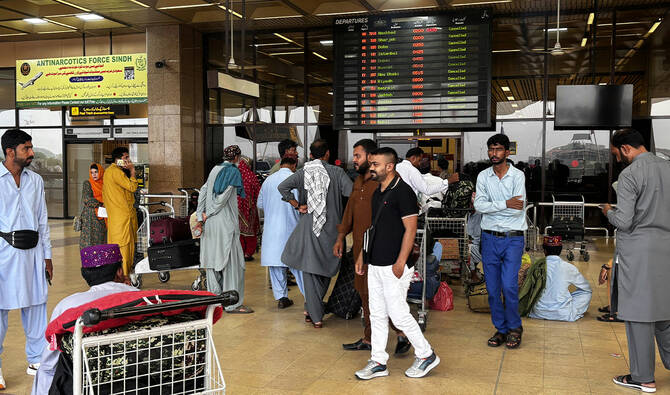
Passengers wait at Jinnah International airport after all domestic and international flights were cancelled in Karachi on May 7, 2025. (AFP/File)
Short Url
Updated 24 June 2025
Follow

Pakistan national carrier resumes flight operations to Gulf countries

  • PIA suspended flights to Qatar, Bahrain, Kuwait and UAE on Monday night after Iran attacked US air base in Doha
  • Iran’s missile attack was in response to American strikes that targeted Iranian nuclear facilities over the weekend

KARACHI: Pakistan’s national carrier announced on Tuesday it has resumed its flight operations for Gulf countries, which it had suspended following Iran’s missile attack on a United States (US) air base in Qatar a day earlier, as a fragile ceasefire between Tehran and Tel Aviv takes hold. 

The Pakistan International Airlines (PIA) suspended its flights to Saudi Arabia, Qatar, Bahrain, Kuwait and the United Arab Emirates (UAE) on Monday night after Iran confirmed it had attacked American forces stationed at Qatar’s Al-Udeid air base. 

PIA said it had limited its flight operations as a precautionary measure due to the ongoing situation in the Gulf region, where tensions have been high since June 13 after Israel attacked Iran’s nuclear facilities and military leadership, triggering a military conflict between both sides. 

“PIA Flight Operations for Gulf/KSA have resumed,” a PIA spokesperson said in a statement. 

Sharing details of the flights, the spokesperson said PIA’s PK-245 flight departed from Islamabad for Dammam at 12:30 p.m. after a delay of 15 hours while the airline’s PK-743 Karachi to Madinah flight, which was diverted due to the closure of the airspace on Monday, departed at 1:30 p.m. after a delay of 14.5 hours. 

The spokesperson shared that PK-713 flight from Lahore to Madinah also departed at 1:30 p.m. after a delay of seven hours while PK-209 Sialkot to Sharjah flight departed at 1:30 p.m. after a delay of 15 hours.

“In addition, flight PK-221 from Multan to Dubai, flight PK-251 from Sialkot to Doha, flight PK-761 from Karachi to Jeddah, and flight PK-261 from Islamabad to Abu Dhabi also departed at 1:30 pm,” the spokesperson said. 

Due to the delayed departure of these flights, those returning home will also be delayed, he clarified. 

“We apologize for the inconvenience caused to passengers, however, the decision to restrict operations last night was taken in accordance with air safety principles,” the spokesperson said.

Iran’s response came a day after the US launched a surprise attack Sunday morning on three of Iran’s nuclear sites, joining Israel in the biggest Western military action against the Islamic Republic since its 1979 revolution.

US President Donald Trump dismissed Iran’s missile attack as a “weak response,” calling for peace in the Middle East. Hours later on Tuesday, the US president announced both Israel and Iran had agreed to a ceasefire. 

The military conflict between Iran and Israel began on June 13 when the former attacked the latter’s nuclear facilities, alleging Tehran is close to building an atomic weapon. Iran has dismissed Israel’s allegations and says its nuclear program is for peaceful purposes only.


Pakistan orders four-day workweek, shuts schools to save fuel amid Middle East oil crisis

Updated 09 March 2026
Follow

Pakistan orders four-day workweek, shuts schools to save fuel amid Middle East oil crisis

  • The development comes as ongoing US-Israeli strikes on Iran disrupt oil supplies in Strait of Hormuz, push prices past $119 a barrel
  • Islamabad bans government purchases, cuts fuel allocation for vehicles as well as workforce in public and private offices by 50 percent

ISLAMABAD: Prime Minister Shehbaz Sharif on Monday announced austerity measures, including a four-day work week, cuts in government expenditures and closure of schools, to offset the impact of rising global oil prices due to an ongoing conflict in the Middle East.

Global fuel supply lines have been disrupted in the Strait of Hormuz, which supplies nearly a fourth of world oil consumption, after Tehran blocked it following United States-Israeli strikes on Iran and counterattacks against US interests in the Gulf region.

Oil prices surged more than 25 percent globally on Monday to $119.50 a barrel, the highest levels since mid-2022, as some major producers cut supplies and fears of prolonged shipping disruptions gripped the market due to the expanding US-Israeli war with Iran.

In his televised address on Sunday night, Sharif said global oil prices were expected to rise again in the coming days but vowed not to let the people bear their brunt, announcing austerity measures to lessen the impact of fuel price hikes.

“Fifty percent staff in public and private entities will work from home,” he announced, adding this would not be applicable to essential services. “Offices will remain open for four days a week. One-day additional off is being given to conserve oil, but it would not be applicable to banks.”

Sharif didn’t specify working days of the week and the government was likely to issue a notification in this regard.

He said a decrease of 50 percent was being made in fuel allocation for government vehicles immediately for the next two months, but they would not include ambulances and public buses.

“Cabinet members, advisers and special assistants will not draw salaries for the next two months, 25 percent salaries of parliamentarians are being deducted, two-day salaries of Grade 20 and above officers, or those who are paid Rs300,000 ($1,067) a month, are being deducted for public relief,” he said.

Similarly, there will be 20 percent reduction in public department expenses and a complete ban on the purchase of cars, furniture, air conditioners and other goods, according to the prime minister.

Foreign trips of ministers and other government officials will also be banned along with government dinners and iftar buffets, while teleconferences and online meetings will be given priority.

“All schools will be off for two weeks, starting from the end of this week, and all higher education institutions should immediately begin online classes,” he said.

Sharif’s comments were aired hours after Pakistani authorities said the country had “comfortable levels” of petroleum stocks and the supply chains were functioning smoothly, despite intensifying Middle East conflict.

Petroleum Minister Ali Pervaiz Malik said three oil shipments were due to reach Pakistan this week, state media reported.

Meanwhile, Pakistan Navy (PN) launched ‘Operation Muhafiz-ul-Bahr’ to safeguard national energy shipments, the Pakistani military said on Monday, amid disruptions to critical sea lanes due to the conflict.

The navy is conducting escort operations in close coordination with the Pakistan National Shipping Corporation (PNSC), according to the Inter-Services Public Relations (ISPR), the military’s media wing. It is fully cognizant of the prevailing maritime situation and is actively monitoring and controlling the movement of merchant vessels to ensure their safe and secure transit.

“With approximately 90 percent of Pakistan’s trade conducted via sea, the operation aims to ensure that vital sea routes remain safe, secure, and uninterrupted,” the ISPR said on Monday. “Currently, PN ships are escorting 2 x Merchant Vessels, one of which is scheduled to arrive Karachi today.”