

Netherlands to send $202 million military aid to Ukraine, expands drone cooperation

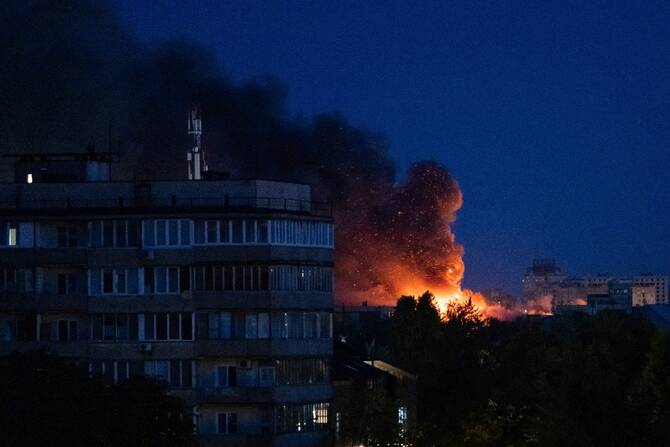
A fire is seen after a Russian strike on Kyiv, Ukraine. (AP)
Short Url
Updated 25 June 2025
Follow

Netherlands to send $202 million military aid to Ukraine, expands drone cooperation

THE HAGUE: The Netherlands will provide Ukraine with 100 drone-detection radars and 20 medical evacuation vehicles as part of a new €175 million ($202 million) aid package, Dutch Defense Minister Ruben Brekelmans said on Tuesday.

Delivery of the radars, which will help identify incoming drones and relay data to air defense systems, is expected to be completed by year-end.

In a statement on Friday, the Dutch Defense Ministry specified that 80 million euros of the package will go toward drone support through the international drone coalition.

The move on Tuesday follows a 500 million euro deal to produce 600,000 drones with the Ukrainian defense industry, Brekelmans said ahead of a NATO Summit in The Hague.

The Netherlands has pledged about 10 billion euros in military support for Ukraine since the beginning of the full-scale Russian invasion in early 2022.


A total lunar eclipse will turn the moon blood red on Tuesday across several continents

A total lunar eclipse, known as the blood moon, is visible between skyscrapers Friday, March 14, 2025, in downtown Chicago. (AP)
Updated 4 sec ago
Follow

A total lunar eclipse will turn the moon blood red on Tuesday across several continents

  • The eclipses tend to follow each other, taking advantage of the sweet spot in the celestial bodies’ orbits

NEW YORK: A blood-red moon will soon grace the skies for a total lunar eclipse — and there won’t be another until late 2028.
The spectacle will be visible Tuesday morning from North America, Central America and the western part of South America. Australia and eastern Asia can catch it Tuesday night. Partial stages of the eclipse with small bites taken out of the moon can be seen from Central Asia and much of South America. Africa and Europe will be shut out.
Solar and lunar eclipses happen due to a precise alignment of the sun, moon and Earth. There are between four and seven a year, according to NASA.
The eclipses tend to follow each other, taking advantage of the sweet spot in the celestial bodies’ orbits. Tuesday’s total eclipse of the moon comes two weeks after a ‘ring of fire’ solar eclipse that dazzled people and penguins in Antarctica.
During a total lunar eclipse, the Earth is between the sun and full moon, casting a shadow that covers the moon. The so-called blood moon looks red because of stray bits of sunlight filtering through Earth’s atmosphere.
The show unfolds over several hours, with totality lasting about an hour.
Compared to a solar eclipse, “the lunar eclipse is a little more of a relaxed pace,” said Catherine Miller at Middlebury College’s Mittelman Observatory.
For those in the path, there’s no need for any special equipment to observe — just a clear, cloudless view of the sky.
Use a forecasting app or any online celestial calendar to look up the exact timing for your area. Venture outside a few times to see Earth’s shadow darken the moon, eventually revealing the reddish-orange orb.
“You don’t have to be out there the whole time to see the shadows moving,” said astronomer Bennett Maruca with the University of Delaware.
There’s a partial lunar eclipse on the docket for August, visible across the Americas, Europe, Africa and west Asia.