

Pakistan says holds ample petroleum reserves amid fears of Iran’s closure of Strait of Hormuz

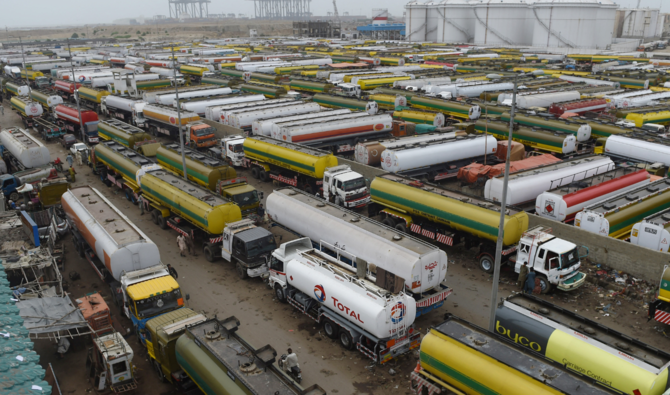
In this file photo, taken on July 26, 2017, oil tankers are seen parked in Karachi, Pakistan. (AFP/ file)
Short Url
Updated 23 June 2025
Follow

Pakistan says holds ample petroleum reserves amid fears of Iran’s closure of Strait of Hormuz

  • Iran’s parliament has approved cutting off the narrow shipping lane through which about 20 percent of global oil and gas passes
  • State Minister Bilal Azhar Kayani says no cause of concern for Pakistanis, government prepared to address any uncertainties

ISLAMABAD: Pakistan has ample petroleum reserves and an uninterrupted supply chain, a junior minister said on Monday, amid fears that Iran may cut off a vital oil and gas shipping lane in retaliation for US strikes on its nuclear facilities.

Iran’s parliament has approved cutting off the Strait of Hormuz, a narrow shipping lane in the Arabian Gulf through which about 20 percent of global oil and gas passes. It’s now up to Iran’s national security council to decide whether to move forward with the idea, which could lead to a spike in the cost of goods and services worldwide.

The price of oil jumped 4 percent shortly after trading began on Sunday night, but it quickly pared back as the focus shifted from what the US military did to how Iran would react. Oil futures were flip-flopping in Monday morning trading between gains and losses. They still remain higher than they were before the fighting began a little more than a week ago.

Pakistan’s State Minister for Finance and Railway Bilal Azhar Kayani denied rumors about a shortage of petroleum products in the South Asian country, stressing that his government was closely monitoring developments following tensions between Iran, Israel and the US to ensure stability.

“The Oil and Gas Regulatory Authority (OGRA) has directed all oil marketing companies to strictly maintain mandatory reserve levels in light of current global conditions, mitigating potential risks,” Kayani was quoted as saying by Pakistan’s Press Information Department.

“There is no cause for concern as petroleum product inventories are sufficient and supply operations continue smoothly across the nation.”

The statement came hours after President Donald Trump called for the US and other oil-producing economies to pump more oil as the White House sharpened its warnings to Iran against closing the Strait of Hormuz.

Global markets were trying to ascertain what lays ahead after the US struck on Sunday key Iranian nuclear facilities with a barrage of 30,000-pound bunker busting bombs and Tomahawk missiles.

Pakistan lacks adequate resources to run its oil- and gas-powered plants and mainly sources its oil from Arab Gulf nations.

Kayani reassured citizens that the Prime Minister’s office, Ministry of Petroleum and the Ministry of Finance were continuously monitoring the situation.

“We are fully prepared to address any uncertainties,” he said, adding the government was committed to ensuring the country’s energy security.


Pakistan Airports Authority reports ‘historic’ twin-engine aircraft landing in Lahore

Updated 13 December 2025
Follow

Pakistan Airports Authority reports ‘historic’ twin-engine aircraft landing in Lahore

  • Twin-engine aircraft are usually larger, heavier and require better airport infrastructure, navigation systems to land
  • Pakistan Airports Authority says landing reflects its commitment to enhance aviation sector, strengthen infrastructure

ISLAMABAD: The Pakistan Airports Authority (PAA) announced on Saturday that the New General Aviation Aerodrome achieved a significant milestone when it handled the landing of a twin-engine aircraft. 

A twin-engine aircraft has two engines that provide it redundancy and increased performance compared to single-engine counterparts. These aircraft range from small twin-engine propeller planes to large commercial jetliners. The presence of multiple engines enhances safety by allowing the aircraft to continue flying in the event of an engine failure.

However, twin-engine aircraft are usually larger, heavier and more complex than single-engine planes. They require advanced airport infrastructure such as better runways, navigation systems and air traffic coordination. 

“The New General Aviation Aerodrome, Lahore achieved another significant operational milestone today with the successful landing of a twin-engine aircraft, following the recent arrival of a single-engine aircraft,” the PAA said in a statement. 

It said the flight was also boarded by Air Vice Marshal Zeeshan Saeed, the director general of the PAA. The move reflected “strong institutional confidence” in the aerodrome’s safety standards, operational capability, and overall readiness, it added. 

“The landing was conducted with exceptional precision and professionalism, demonstrating the aerodrome’s robust operational framework, technical preparedness, and effective airside coordination in accordance with contemporary aviation requirements,” the PAA said. 

It said the landing represented a “major advancement” in Pakistan’s general aviation sector and underscores the PAA’s commitment to enhancing regional aviation capacity, strengthening infrastructure and promoting excellence in aviation development.