NATO strikes spending deal, but Spain exemption claim risks Trump ire

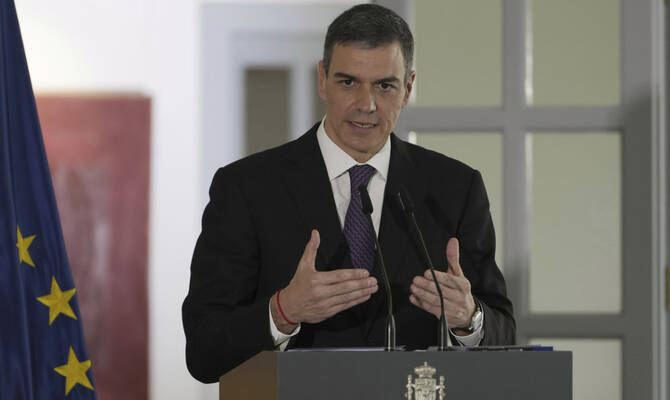
Sanchez is facing a difficult balancing act of aligning with NATO allies. (AP/File)
Short Url
Updated 22 June 2025
Follow

NATO strikes spending deal, but Spain exemption claim risks Trump ire

  • The country is only set to hit the alliance’s current target of two percent this year after a 10-billion-euro ($11.5 billion) injection

BRUSSELS, Belgium: NATO on Sunday signed off on a pledge to ramp up defense spending before its upcoming summit, but Madrid insisted it would not need to hit the five percent of GDP demanded by US President Donald Trump.
The claim by Spanish Prime Minister Pedro Sanchez sets up a potential clash with Trump, who has pressured allies to commit to that headline figure when they meet for the two-day gathering starting on Tuesday in The Hague.
Spain had been the last holdout on a compromise deal that sees allies promise to reach 3.5 percent on core military needs over the next decade, and spend 1.5 percent on a looser category of “defense-related” expenditures such as infrastructure and cybersecurity.
Multiple diplomats at NATO said the agreement — set to be unveiled at the summit — had gone through with the approval of all 32 nations and that there was no exemption for Madrid.
But within minutes Sanchez came out saying he had struck an accord with NATO that would see his country keep respecting its commitments “without having to raise our defense spending to five percent of gross domestic product.”
“We understand the difficulty of the geopolitical context, fully respect the legitimate desire of other countries to increase their defense investment, if they so wish, but we are not going to do it,” he said.
NATO diplomats now fear that Spain’s position could undermine its carefully choreographed show of unity with Trump in The Hague, which already risks being overshadowed by the US decision to strike Iran.
“Not ok,” one diplomat said, on condition of anonymity.
Madrid’s claims came after Sanchez on Thursday threw a last-minute grenade into preparations for the gathering in the Netherlands by taking a strong stand against the agreement.
In a blistering letter to NATO chief Mark Rutte, Sanchez said that committing to a headline figure of five percent of GDP “would not only be unreasonable, but also counterproductive.”
That prompted a warning from Trump that “Spain has to pay what everybody else has to pay.”
“NATO is going to have to deal with Spain,” he told reporters on Friday, calling the country “notorious” for spending less on defense than other alliance members.
The outburst from Madrid’s center-left leader also sparked fury from other NATO members desperate to keep Trump — who has threatened not to protect allies spending too little — on their side.
The pledge is seen as key both to satisfying Trump and helping NATO build up the forces it needs to deter Russia.
After several days of wrangling involving Sanchez and Rutte, officials said Spain on Sunday signed off on the pledge.
Diplomats said that language around the spending pledge in the summit’s final declaration had been slightly softened from “we commit,” to “allies commit.”
They insisted the fundamentals of the deal remained intact and that it applied to Spain.
But government sources in Madrid said the linguistic tweak meant only those countries that opted-in were covered by the promise and that Rutte was set to send a letter to Sanchez saying that Spain will have “flexibility.”
Sanchez is facing a difficult balancing act of aligning with NATO allies and cajoling his junior coalition partner, the far-left alliance Sumar, which is hostile to increasing military spending.
Spain has been one of the lowest-spending NATO countries on defense in relative terms.
The country is only set to hit the alliance’s current target of two percent this year after a 10-billion-euro ($11.5 billion) injection.


Trump sues the BBC for defamation over editing of January 6 speech, seeks up to $10 billion in damages

Updated 25 min 52 sec ago
Follow

Trump sues the BBC for defamation over editing of January 6 speech, seeks up to $10 billion in damages

  • A BBC spokesperson told Reuters earlier on Monday that it had “no further contact from President Trump’s lawyers at this point
  • The BBC is funded through a mandatory license fee on all TV viewers, which UK lawyers say could make any payout to Trump politically fraught

WASHING: President Donald Trump sued the BBC on Monday for defamation over edited clips of a speech that made it appear he directed supporters to storm the US Capitol, opening an international front in his fight against media coverage he deems untrue or unfair. Trump accused Britain’s publicly owned broadcaster of defaming him by splicing together parts of a January 6, 2021 speech, including one section where he told supporters to march on the Capitol and another where he said “fight like hell.” It omitted a section in which he called for peaceful protest.
Trump’s lawsuit alleges the BBC defamed him and violated a Florida law that bars deceptive and unfair trade practices. He is seeking $5 billion in damages for each of the lawsuit’s two counts. The BBC has apologized to Trump, admitted an error of judgment and acknowledged that the edit gave the mistaken impression that he had made a direct call for violent action. But it has said there is no legal basis to sue.
Trump, in his lawsuit filed Monday in Miami federal court, said the BBC despite its apology “has made no showing of actual remorse for its wrongdoing nor meaningful institutional changes to prevent future journalistic abuses.”
The BBC is funded through a mandatory license fee on all TV viewers, which UK lawyers say could make any payout to Trump politically fraught.
A spokesman for Trump’s legal team said in a statement the BBC “has a long pattern of deceiving its audience in coverage of President Trump, all in service of its own leftist political agenda.”
A BBC spokesperson told Reuters earlier on Monday that it had “no further contact from President Trump’s lawyers at this point. Our position remains the same.” The broadcaster did not immediately respond to a request for comment after the lawsuit was filed.

CRISIS LED TO RESIGNATIONS
Facing one of the biggest crises in its 103-year history, the BBC has said it has no plans to rebroadcast the documentary on any of its platforms.
The dispute over the clip, featured on the BBC’s “Panorama” documentary show shortly before the 2024 presidential election, sparked a public relations crisis for the broadcaster, leading to the resignations of its two most senior officials.
Trump’s lawyers say the BBC caused him overwhelming reputational and financial harm.
The documentary drew scrutiny after the leak of a BBC memo by an external standards adviser that raised concerns about how it was edited, part of a wider investigation of political bias at the publicly funded broadcaster.
The documentary was not broadcast in the United States.
Trump may have sued in the US because defamation claims in Britain must be brought within a year of publication, a window that has closed for the “Panorama” episode.
To overcome the US Constitution’s legal protections for free speech and the press, Trump will need to prove not only that the edit was false and defamatory but also that the BBC knowingly misled viewers or acted recklessly.
The broadcaster could argue that the documentary was substantially true and its editing decisions did not create a false impression, legal experts said. It could also claim the program did not damage Trump’s reputation.
Other media have settled with Trump, including CBS and ABC when Trump sued them following his comeback win in the November 2024 election.
Trump has filed lawsuits against the New York Times, the Wall Street Journal and a newspaper in Iowa, all three of which have denied wrongdoing. The attack on the US Capitol in January 2021 was aimed at blocking Congress from certifying Joe Biden’s presidential win over Trump in the 2020 US election.