Pakistan’s new electric vehicle policy targets 30% green cars by 2030

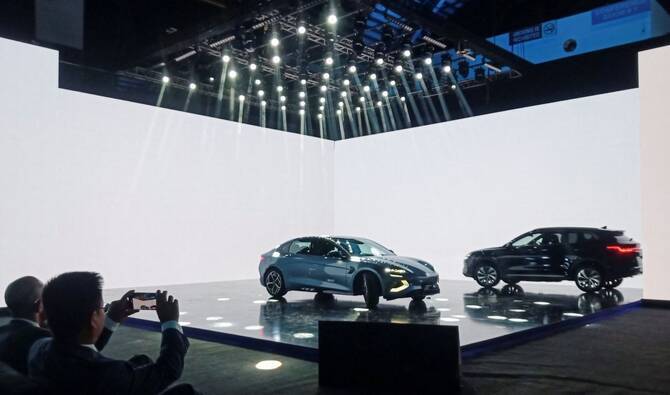
An attendee takes photos of the Chinese electric vehicle BYD models on display during an event to announce the plans to open a car production plant in Pakistan, in Lahore on August 17, 2024. (REUTERS/File)
Short Url
Updated 22 June 2025
Follow

Pakistan’s new electric vehicle policy targets 30% green cars by 2030

  • The policy aims to cut Pakistan’s reliance on imported fuel, shielding the economy from global oil price fluctuations
  • Electric vehicles are also expected to offer long-term savings for consumers through reduced fuel and maintenance costs

ISLAMABAD: Pakistan has unveiled an ambitious New Electric Vehicle Policy (NEVP) 2025–2030 that targets 30% of all new vehicle sales to be electric by 2030, Pakistani state media reported on Sunday.

The policy, which covers cars, buses, motorcycles and rickshaws, aims to accelerate the country’s shift toward sustainable transport, reduce fossil fuel dependence, and curb climate-warming emissions, the state-run APP news agency reported.

Pakistan imports most of its energy needs and the country’s urban areas exhibit some of the world’s highest levels of air pollution, primarily due to sub-2.5 μm particulate emissions. This issue significantly impairs both the country’s economy and the quality of life of its residents.

“Transitioning to electric vehicles (EVs) is critical for a healthier, greener and economically stable future,” Muhammad Saleem Shaikh, a spokesperson for the Climate Change Ministry, told APP, contending that transport sector was a major contributor to air pollution and greenhouse gas emissions in Pakistan.

With the NEVP now in effect, Pakistan, which has seen erratic changes in its weather patterns which experts blame on climate change, joins a growing list of nations pushing for zero-emission mobility to combat climate change and urban pollution.

Mohammad Asif Sahibzada, director-general of the Climate Change Ministry, highlighted that EVs produce zero tailpipe emissions, which will significantly reduce urban smog and help Pakistan meet its international commitments.

“This shift will also lower respiratory and cardiovascular diseases, particularly benefiting children and the elderly,” he added.

The policy aims to cut Pakistan’s reliance on imported fossil fuels, shielding the economy from global oil price fluctuations. EVs are also expected to offer long-term savings for consumers through reduced fuel and maintenance costs.

The government plans to incentivize EV adoption through tax breaks, subsidies, and infrastructure development, including nationwide charging stations.

“Electric vehicles are not just about transport; they are central to Pakistan’s climate action strategy,” Muhammad Azeem Khoso, the ministry’s director for urban affairs, was quoted as saying by the APP.

“This policy marks a decisive step toward a cleaner, more resilient future.”


Pakistan says CPEC has helped bridge cultural and language barriers with China

Updated 10 sec ago
Follow

Pakistan says CPEC has helped bridge cultural and language barriers with China

  • Ataullah Tarar suggests Pakistan-China digital platform to counter ‘disinformation’ around CPEC
  • People-to-people ties have remained limited between the two states despite strong official relations

ISLAMABAD: Federal Minister for Information and Broadcasting Ataullah Tarar said on Wednesday the China-Pakistan Economic Corridor (CPEC) has brought about a “cultural change,” helping break barriers of language and bringing the two countries closer together.

Pakistan and China have longstanding strategic relations, though much of their interactions have traditionally occurred at the government-to-government level through diplomatic, strategic and economic engagements. People-to-people ties between them have mostly remained limited, though the Pakistani minister said there was a gradual shift in the trend in the wake of the multibillion-dollar economic, infrastructure development and regional connectivity initiative.

Launched in 2015, CPEC includes investments in energy, transport, and industrial zones, and has since become a cornerstone of bilateral ties and Pakistan’s long-term development strategy.

“CPEC in Pakistan has broken a lot of barriers. It has broken the barrier of language, and it has broken the barriers of division. It has brought harmony,” Tarar said while addressing a ceremony organized by the Pakistan-China Institute, a local think tank.

“This corridor brought about a cultural change where we had investments coming in, where we had infrastructure being built, where we had industry being built, where we had airports and seaports being developed.”

He said it was “heartening” to see cultural change in Pakistan, such as a Chinese citizen speaking fluent Urdu or a Pakistani citizen speaking Mandarin.

Tarar said the cultural shift had become part of Pakistan’s ethos as the two countries move forward, describing Chinese President Xi Jinping’s 2015 visit as a turning point in reviving the economy.

He also maintained CPEC was targeted by a disinformation campaign, suggesting a digital media platform between Pakistan and China to counter the problem.

“I would suggest that maybe the Pakistan-China Institute can come up with a digital media platform to call out fake news and to label fake news circulating around CPEC,” he said, adding the government would fully support the endeavor.

“I think that will go a long way in not only strengthening the media cooperation but also in getting rid of misinformation and stating the correct facts in a very timely manner,” he added.

Tarar said the initiative will help promote a positive narrative around CPEC 2.0, referring to the next phase of the initiative that aims to focus on industrial development in Pakistan.